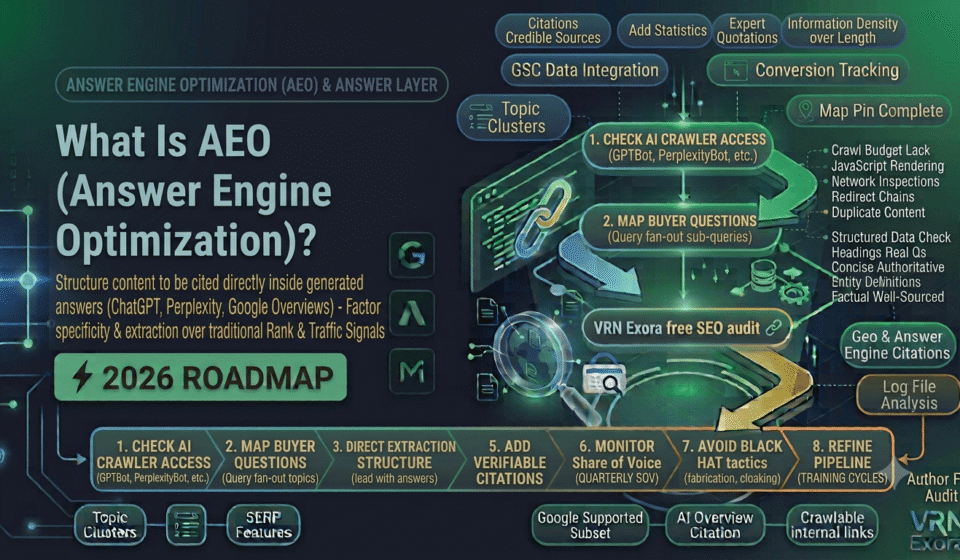

Answer Engine Optimization, or AEO, is the practice of structuring content so AI-powered platforms like ChatGPT, Perplexity, Google AI Overviews, and Gemini can extract, trust, and cite it directly inside a generated answer, rather than only linking to it in a list of results. This guide is for marketers, content teams, and business owners who want a clear, practical understanding of what AEO actually means, how it grew out of older concepts like featured snippets, and what specifically makes a page more likely to become the answer an AI system chooses to deliver. You will learn how AEO relates to GEO, why the shift toward answer engines matters in measurable terms, and the concrete techniques that make content genuinely answer-ready.
AEO Definition: The Short Answer
AEO means optimizing content to be the source an AI system quotes, summarizes, or cites when answering a specific question. Instead of competing for a ranked position among ten blue links, AEO competes for the answer itself, the exact sentence an AI delivers and the source it credits for that sentence. A definition, a comparison, a statistic, a product claim, or a specific recommendation can all become the cited answer, and importantly, the whole page does not need to earn that citation, just the specific passage that directly resolves the question being asked.
Where AEO Sits Inside the Broader GEO Landscape
AEO is best understood as the answer layer inside the broader discipline of Generative Engine Optimization, not a fully separate practice. GEO covers the wider problem of being present anywhere across AI-generated discovery, including brand mentions, comparison content, and general AI visibility. AEO is the more specific discipline focused on winning the moment an AI system is trying to produce a concise, direct response to a single question. In practice, most teams use the terms somewhat interchangeably, since the underlying techniques for improving AEO and GEO overlap heavily, but AEO specifically emphasizes the answer-format layer within that broader surface.
How AEO Grew Out of Featured Snippets and Voice Search
AEO did not appear from nowhere. It builds directly on techniques SEOs have used for years to win Google’s featured snippets and voice assistant responses, both of which already rewarded content that gave a clear, extractable answer near the top of a page. What has changed is the scale and stakes: instead of one featured snippet box competing against ten organic listings below it, an AI-generated answer often replaces the entire results page experience, synthesizing one response from several sources at once rather than presenting a single quoted snippet alongside a full list of links.
AEO vs Traditional SEO: The Core Shift
Traditional SEO asks how to rank on a search engine’s results page. AEO asks how to become the source an AI system cites when answering a question in your category. This distinction reflects a real shift in how people evaluate options: a growing share of buyers now form preferences and understanding through an AI assistant’s synthesized answer, arriving at a website, if they arrive at all, already further along in their decision process than a typical organic visitor.
The underlying signals AEO rewards differ from classic SEO signals too. Where SEO has historically leaned heavily on backlink volume as a trust signal, AEO leans more on content quality, specificity, and demonstrated expertise, since large language models evaluate whether content actually answers a question with authority rather than counting how many other sites happen to link to it. Where SEO targets specific keywords and phrases, AEO targets conceptual ownership of a topic, since language models work by understanding concepts and relationships rather than by matching exact keyword strings.
Why AEO Matters: The Numbers Behind the Shift
The shift toward answer engines is measurable and accelerating. AI search visits grew sharply year over year through early 2026, while growth in traditional Google search visits over the same window stayed comparatively flat, narrowing the ratio between the two considerably. There is also a real value argument behind prioritizing AEO: AI search visitors have been found to convert at several times the rate of an average traditional organic visitor, largely because they arrive having already read a synthesized comparison or explanation rather than a bare list of links they still need to evaluate themselves.
Google itself has responded to this shift directly, introducing dedicated generative AI performance reporting inside Search Console in 2026, a clear signal that AI-driven answer surfaces are now treated as a distinct, trackable part of search performance rather than a side experiment.
What Makes Content Answer-Ready
Research analyzing citation patterns across major AI platforms has consistently found the same handful of variables predict whether a page gets cited or skipped: clear structure, content freshness, and credible sourcing. Answer engines specifically favor pages that lead with a direct, unambiguous answer, back that answer up with real evidence, demonstrate genuine topical depth beyond the surface-level response, and show clear, credible authorship rather than anonymous or generic content.
Structured data plays a supporting role here too, but only when used correctly. Schema markup works best when it accurately reflects content that is genuinely visible on the page and reinforces real authorship, entities, and page intent, rather than being used to mark up hidden or implied content that does not actually appear for a human reader. Freshness matters more for high-intent, decision-stage content specifically, since answer engines tend to weight recency more heavily for topics where being current genuinely affects the accuracy of the answer.
Using Query Fan-Out to Build AEO Content
A practical, high-leverage AEO tactic starts with understanding query fan-out, the process by which an AI system breaks a single user question into several smaller sub-queries and researches each one separately before synthesizing a final answer. Rather than guessing at target phrases from a generic keyword list, mapping out the realistic sub-queries an AI system would generate from a core question and building FAQ content directly around each one creates what practitioners describe as a compound citation advantage, since it gives the AI system a clean, directly matching answer for multiple pieces of its research process rather than just the original broad question.
How to Measure AEO Success
AEO performance is measured against the specific answers a business actually cares about, not a generic ranking position. The core metrics worth tracking are citation frequency, how often a page or brand gets cited for relevant questions, brand mentions inside AI-generated answers, visibility relative to competing sources on the same questions, AI-search impressions where platforms report them, and any referral traffic or conversions that can be traced back to an AI-search origin. Because zero-click behavior is now mainstream, meaning a large share of users get their answer without ever visiting the source site, traffic alone significantly understates AEO’s actual business impact, and tracking citation and brand mention data directly gives a more complete picture.
Common AEO Mistakes
The most frequent mistake is treating AEO as a separate content strategy layered awkwardly on top of existing SEO content, rather than restructuring the content itself so a specific answer is genuinely extractable near the top of the page. A second common mistake is implementing schema that does not match what is actually visible on the page, which functions as a mismatch between markup and content rather than a genuine reinforcement of it. A third mistake is optimizing only for the broad, original question a user might ask while ignoring the narrower sub-queries an AI system’s query fan-out process actually generates, missing the compound citation opportunity that answering those sub-queries directly can create.
Frequently Asked Questions
What is the difference between AEO and GEO?
AEO is the answer-layer discipline focused specifically on winning the moment an AI system produces a direct response to a question. GEO is the broader practice of being present across AI-generated discovery generally, including brand mentions and comparison content beyond direct answers. The techniques overlap heavily in practice.
Does AEO replace traditional SEO?
No. SEO still provides real technical and authority foundations, like site speed and domain trust, that AEO builds on rather than replaces. Most practitioners treat AEO as a necessary extension of SEO rather than a substitute for it.
How is AEO related to featured snippets and voice search optimization?
AEO builds directly on the same techniques that historically won featured snippets and voice assistant responses, clear, extractable, direct answers positioned prominently in the content. What has changed is scale: an AI-generated answer now often replaces the entire results page experience rather than sitting alongside a full list of organic links.
Does schema markup guarantee an AI citation?
No. Schema helps when it accurately reflects genuinely visible page content and reinforces real authorship and entities, but it does not guarantee a citation on its own. Poorly matched schema, marking up hidden or implied content, can actually undermine trust rather than build it.
What is query fan-out and why does it matter for AEO?
Query fan-out is the process by which an AI system breaks one user question into several smaller sub-queries it researches separately before generating a final answer. Building FAQ content around those specific sub-queries, rather than only the broad original question, creates more opportunities for a page to get cited.
How do I measure whether my AEO efforts are working?
Track citation frequency, brand mentions inside AI-generated answers, and visibility relative to competing sources for the specific questions your buyers actually ask, rather than relying on traditional rank tracking or raw traffic alone, since zero-click AI answers often satisfy a user without any click ever occurring.
Get a Free Expert Review of Your AI Answer Visibility
Understanding AEO is the first step, seeing whether your content is actually answer-ready is the next one. If you want a faster starting point, get a free SEO audit from VRN Exora and see how your content currently performs for both traditional rankings and AI-generated answers.