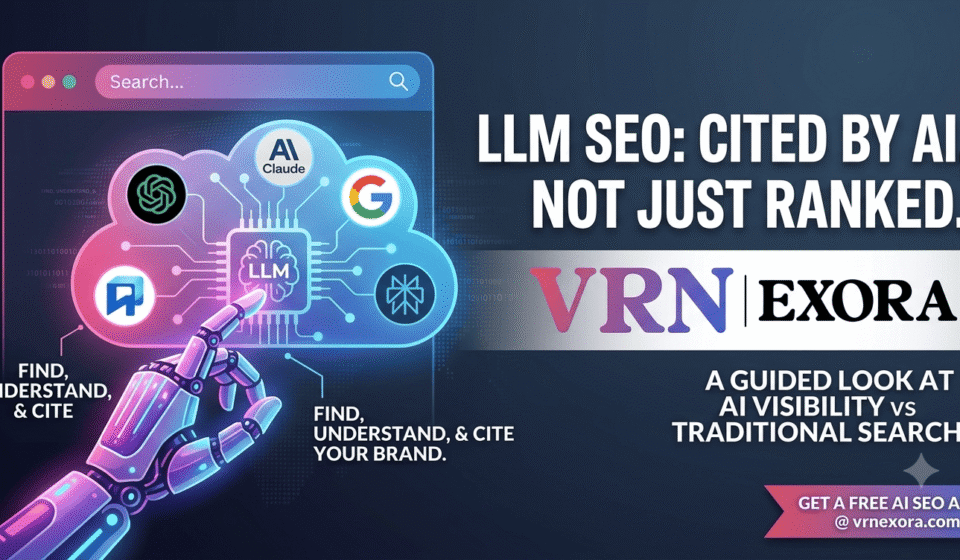

LLM SEO is the practice of optimizing your content and brand presence so large language models like ChatGPT, Claude, Gemini, Perplexity, and Copilot can find, understand, and cite you directly inside a generated answer. This guide is for marketers, SEO managers, and business owners who want to understand specifically how large language models process information differently than a traditional search engine, and what that difference actually requires from a content and technical strategy. You will learn the two distinct pathways LLMs use to learn about a brand, how the underlying technology processes content, and the concrete ways LLM SEO diverges from the ranking-based SEO most teams already practice.
LLM SEO Definition: The Short Answer
LLM SEO stands for large language model search engine optimization, sometimes also called LLMO. It refers to optimizing content and brand presence specifically so large language models can find, understand, and reference that content in their responses. The term is one of several names, alongside GEO and AEO, describing essentially the same underlying discipline of earning citation inside an AI-generated answer, though LLM SEO has become the everyday label many marketers and agencies are converging on because it names the actual technology doing the work rather than a more abstract concept.
Two Ways LLMs Learn About Your Brand: Training Data and Retrieval
Understanding LLM SEO starts with understanding that large language models learn about a brand through two genuinely distinct pathways. The first is training data, the vast body of text a model learned from during its original training process, which shapes its baseline understanding of a brand’s reputation, but which only updates on the model provider’s own schedule, sometimes months apart. The second pathway is retrieval, where a system like Perplexity or an AI Overview actively fetches live web pages at the moment a question is asked, a technique known as retrieval-augmented generation, or RAG. Most AI systems rely on a mix of both, and which pathway dominates depends heavily on the specific platform and the type of query being asked.
This distinction has genuinely practical consequences. A fix to a page can influence a retrieval-based citation within days or weeks once the page is recrawled, while the same fix will not change what a purely training-based response says about your brand until that model’s next training cycle, which can be a considerably longer wait.
How LLMs Actually Process Your Content
Large language models do not read a page the way a traditional search engine indexes it, matching keywords against a query. Instead, they break a page down into embeddings, vectorized mathematical representations that capture the underlying meaning of the content rather than its exact wording. On top of that, models typically apply named entity recognition to identify specific brands, people, tools, and places mentioned on the page, and they map semantic relationships between concepts, understanding, for example, that a CRM tool relates to SaaS and startups as a category, rather than simply counting how often those exact phrases appear together.
This is a fundamentally different kind of pattern matching than classic keyword-based SEO relied on. A page does not need to repeat an exact target phrase to be understood as relevant to it, since the model is reasoning about the concept the page represents, not scanning for a literal string match. What genuinely earns citation in this system is clear, well-organized expertise that a model can confidently extract and attribute, since large language models consistently favor citing clean, well-supported ideas over vague or poorly structured claims.
LLM SEO vs Traditional SEO: The Core Differences
Traditional SEO succeeds when a page earns a ranking position and a subsequent click. LLM SEO can succeed even when nobody clicks at all, since a brand can be cited by name inside a generated answer, with the user reading that citation and forming an impression of the brand without ever leaving the chat interface. This changes what success actually looks like and how it needs to be measured, since standard click-based analytics simply cannot see a large share of the value LLM SEO is designed to create.
The competitive landscape is also considerably narrower. A traditional search results page shows ten organic listings competing for attention. An AI-generated answer typically draws from around five citation slots at most, and research tracking multiple AI platforms simultaneously has found meaningful disagreement between them, with different engines often agreeing on only a small fraction of which sources to cite for the same underlying question. This means winning visibility on one platform does not guarantee winning it on another, unlike traditional SEO where a strong Google ranking often correlates reasonably well with performance on other traditional search engines.
The Visibility vs Influence Gap
A genuinely important and often overlooked distinction in LLM SEO is the difference between visibility and influence. A site can maintain strong traditional rankings and healthy crawl metrics in Search Console while still being entirely absent from AI-generated responses discussing the same topic. Visibility in the traditional sense does not automatically translate into influence over what an AI system actually says or recommends, which is precisely the gap LLM SEO exists to close. Organizations that assume strong existing SEO performance automatically extends to AI visibility are frequently surprised to find their brand missing entirely from the exact conversations their strong rankings would suggest they should dominate.
Why LLM SEO Matters Now
The shift toward AI-mediated search is measurable and continuing to accelerate. Industry forecasting firms have projected a significant decline in traditional search volume as AI-powered answers absorb a growing share of query resolution, and some tracking of Google’s own AI Overview feature has found it now appears across a substantial and rising share of queries, meaningfully reducing organic click-through on the queries where it shows. For any brand relying primarily on organic click traffic as its visibility metric, this shift represents a genuine blind spot, since a query can be fully resolved by an AI-generated answer with the brand cited by name, delivering real brand impression and trust without ever registering as a session in traditional analytics.
Technical Requirements LLM Crawlers Need
A frequently overlooked technical detail is that most AI crawlers fetch a page’s raw HTML but do not execute JavaScript the way a modern browser does. This means content rendered entirely client-side through JavaScript can be effectively invisible to an AI crawler, even though it displays perfectly fine to a human visitor using a real browser. Server-side rendering or static HTML is the more reliable way to guarantee that content is actually readable by the retrieval systems LLM SEO depends on, and this technical requirement sits underneath every other tactic in this discipline, since none of it matters if the crawler cannot read the page in the first place.
Core LLM SEO Tactics
Most LLM SEO work rests on a strong traditional SEO foundation. Crawlability, indexable HTML, clear heading structure, accurate schema, and genuine topical authority still matter as much as they ever did, since LLM SEO adds a new optimization layer rather than replacing the technical and content fundamentals underneath it. Beyond that foundation, the specific tactics that move the needle for citation include implementing schema markup that accurately reflects visible content, establishing clear E-E-A-T signals through named authors with real credentials, writing with entity clarity so brands, tools, and concepts are unambiguous rather than vaguely referenced, keeping high-intent content genuinely current, and publishing original research or data that a model cannot find duplicated anywhere else.
How to Measure LLM SEO
Measuring LLM SEO requires tracking metrics that traditional analytics were never built to capture. Citation frequency, how often your brand or content is referenced across a defined set of realistic prompts, brand mentions inside generated answers, and share of voice relative to named competitors, tracked separately for each individual AI platform rather than as one blended average, together give a far more accurate picture than organic traffic alone. Because engines frequently disagree on which sources to cite for the same question, per-platform tracking matters more here than it typically does in traditional SEO, where a single rank tracker covering Google usually tells most of the story.
Frequently Asked Questions
Is LLM SEO the same thing as GEO or AEO?
Functionally, yes. LLM SEO, GEO, and AEO all describe the same underlying discipline of earning citations inside AI-generated answers. LLM SEO has become the more common everyday term because it names the actual technology involved, while GEO and AEO emerged as more academic or marketing-driven labels for the same work.
Do I need to abandon traditional SEO to focus on LLM SEO?
No. LLM SEO builds directly on traditional SEO fundamentals like crawlability, clear content structure, and topical authority. It adds a new layer of technique on top of that foundation rather than replacing it, and most sites need both working together.
Why does my site rank well on Google but not appear in ChatGPT answers?
This reflects the visibility versus influence gap. Strong traditional rankings do not automatically translate into AI citation, since large language models evaluate content differently, through embeddings and semantic relationships rather than keyword matching, and different platforms often disagree significantly on which sources to cite for the same question.
Why does JavaScript matter for LLM SEO specifically?
Most AI crawlers fetch a page’s raw HTML but do not execute JavaScript the way a browser does, which means content rendered entirely client-side can be effectively invisible to them even though it displays normally for a human visitor. Server-side rendering or static HTML avoids this problem.
How many sources does an AI system typically cite in one answer?
Most AI-generated answers draw from around five citation slots, a considerably narrower field than the ten organic listings on a traditional search results page, which makes the competition for each individual citation slot meaningfully tighter.
Can I measure LLM SEO success the same way I track Google rankings?
Not directly. LLM SEO is better measured through citation frequency, brand mentions inside generated answers, and share of voice against named competitors, tracked separately per AI platform, since engines frequently disagree on which sources they cite for the same question.
Get a Free Expert Review of Your AI Search Visibility
Understanding how LLMs process your content is the first step, seeing whether they can actually read and trust it is the next one. If you want a faster starting point, get a free SEO audit from VRN Exora and see exactly where your visibility and your AI influence currently stand.