
Google AI Mode is Google’s conversational, AI-first search experience, built on Gemini, that answers a query directly rather than presenting a simple list of links, and Google itself has confirmed there is no separate, secret system for optimizing it. This guide is for marketers, SEO managers, and site owners who want a practical, sequenced approach to earning visibility inside AI Mode, based directly on Google’s own official guidance rather than speculative tactics. You will learn what AI Mode actually is, why traditional SEO remains the real foundation, and the specific structural, technical, and content steps that improve your odds of being cited.
What Google AI Mode Actually Is
AI Mode is Google’s deeper, conversational layer of AI-generated search, built on the Gemini model, that generates direct answers by pulling content from multiple sources rather than pointing users to a list of pages to investigate themselves. Rather than returning ten blue links, AI Mode synthesizes a response immediately, often letting users ask a follow-up question directly from that answer and slide into an ongoing conversation without losing context. Google has been gradually merging AI Mode with AI Overviews into a single, unified AI Search experience, with Gemini becoming the default model powering both globally.
What Google’s Own Official Guidance Says
On May 15, 2026, Google published its first official guide to optimizing for AI Search, covering both AI Overviews and AI Mode directly. Its central message is direct: optimizing for AI Search is not a separate strategy, it remains rooted in the same core Search ranking and quality systems used by traditional Google Search, with one factor, original and non-commodity information, made more important than it was under a purely keyword-first approach. Google’s guidance also explicitly states what businesses do not need: a special AI-specific schema format, since standard schema.org markup remains sufficient, and no separate secret optimization system exists to learn from scratch.
Step 1: Fix Your Traditional Rankings First
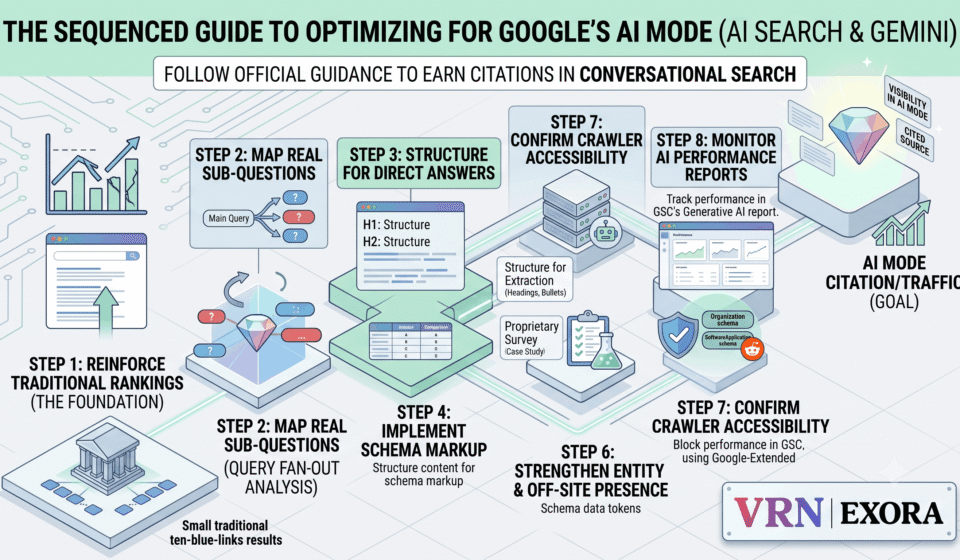
AI Mode and AI Overviews both use retrieval-augmented generation and query fan-out to pull supporting pages directly from Google’s existing search index before constructing a response, and a substantial share of AI Mode citations come from pages that already rank in the traditional top ten organic results. This means AI Mode visibility problems are frequently downstream of an unresolved traditional SEO problem rather than a distinct, separate issue. Before pursuing any AI Mode-specific tactic, confirm the page in question already ranks reasonably well in traditional search, since chasing AI-specific optimization on a page with a genuine ranking problem addresses the symptom rather than the actual cause.
Step 2: Understand Query Fan-Out and Map Real Sub-Questions
AI Mode, powered by Gemini, breaks a single search into many parallel sub-searches rather than evaluating the original query as one flat request. A broad question a user types gets internally decomposed into several narrower, related questions, each researched somewhat independently before being synthesized into one final answer. Practically, this means content built to answer only the broad, original version of a topic misses real opportunities. Map out the realistic narrower sub-questions a genuine buyer or researcher would have around your core topic, and build dedicated, clearly structured content directly answering each one, since matching even one of Gemini’s parallel sub-searches meaningfully increases citation likelihood for that specific answer.
Step 3: Structure Content for Direct, Extractable Answers
AI systems need to extract information quickly, which means content structure carries real weight in AI Mode specifically. Use a clear, descriptive heading hierarchy across H1, H2, and H3 levels, answer the core question directly at the start of each section before layering in supporting detail, and keep paragraphs short, generally two to four sentences, so individual points remain easy to isolate and cite cleanly. Use bullet points for lists, tables for comparisons, and numbered steps for any genuinely sequential process, since each of these formats gives an AI system a clean, self-contained unit it can lift without needing the surrounding prose for context.
Step 4: Implement the Right Schema Markup
Standard schema.org markup remains sufficient, but specific types carry particular weight for AI Mode citation. Article schema, including author, publication date, and article body structure, helps Gemini verify content freshness and credibility. FAQPage schema directly answers the kind of sub-queries query fan-out generates, and a well-matched FAQ entry can meaningfully increase citation likelihood for that specific question. HowTo schema breaks a process into discrete steps AI models parse and cite more readily, with each individual step functioning as its own potential extraction point. For comparative or commercial queries, Product schema with aggregate ratings and offer data helps Gemini surface a specific product directly in a generated comparison. BreadcrumbList schema helps Gemini understand a page’s place within a site’s broader content hierarchy, reinforcing topical authority signals. The underlying strategy is not simply adding more schema, it is making sure the schema accurately reflects genuinely strong, well-structured content underneath it.
Step 5: Build Original Data and Genuine Expertise Into Content
Google’s guidance is explicit that generic, commodity information will not move the needle in AI Mode visibility. Original research, proprietary surveys, first-hand case studies, and genuine industry benchmarks position a brand as a primary knowledge source rather than one more page repeating information already available everywhere else. This matters more in categories where E-E-A-T requirements are especially strict, such as healthcare and financial topics, where Google’s evaluation of genuine expertise and trustworthiness is applied with the least tolerance for generic or unverified claims.
Step 6: Strengthen Entity Signals and Off-Site Presence
Google’s entity graph, its underlying understanding of who a business actually is, forms a meaningful part of how confidently AI Mode cites that business in a generated answer. Implementing Organization and, where relevant, SoftwareApplication structured data reinforces this entity understanding directly. Beyond your own site, building a genuine, active presence in relevant community spaces matters too, since sections like Google’s “Expert Advice and Community Perspectives” draw preferentially from high-engagement discussion threads on platforms like Reddit, which means participating authentically in relevant category discussions can support AI Mode visibility in a way purely on-site optimization cannot replicate on its own.
Step 7: Confirm Technical Accessibility for AI Crawlers
AI Mode shares the same underlying crawl infrastructure as standard Google Search, which means there is no clean way to selectively opt into traditional rankings while opting out of AI Mode specifically, blocking one effectively blocks both. A more targeted option exists for training data specifically: blocking Google-Extended opts a site out of contributing to Google’s AI model training without affecting AI Mode visibility itself, since AI Mode draws from the live search index rather than solely from training data. Beyond crawler access, confirm pages are cleanly indexed, snippet-eligible, and reasonably fast across every device, since these baseline technical requirements remain prerequisites for AI Mode citation exactly as they are for traditional ranking eligibility.
Step 8: Monitor Performance in the Right Reports
Rather than guessing at AI Mode performance, open the Generative AI performance report inside Google Search Console, which shows real, first-party data on which of your pages are actually being cited in AI-generated results. Pull your top twenty target queries from your existing highest-traffic keyword data in Search Console, supplemented with real questions your sales or support teams hear directly from prospects, and track how those specific queries perform in AI Mode over time rather than relying solely on a blended, aggregate traffic view that can obscure what is actually happening at the query level.
Frequently Asked Questions
Do I need special AI schema to appear in Google AI Mode?
No. Google’s own official guidance states standard schema.org markup is sufficient, with specific types like Article, FAQPage, HowTo, and Product schema carrying particular weight, but no separate, AI-exclusive schema format is required.
Can I block AI Mode from citing my site without also losing traditional rankings?
No, not cleanly. AI Mode shares the same crawl infrastructure as standard Google Search, so blocking that access affects both simultaneously. Blocking Google-Extended specifically opts a site out of AI training data contribution without affecting AI Mode visibility, since AI Mode draws from the live search index.
Does ranking well traditionally guarantee AI Mode citation?
No, but it is a strong prerequisite. A substantial share of AI Mode citations come from pages already in the traditional top ten organic results, so unresolved traditional ranking issues should be fixed before pursuing AI Mode-specific tactics.
What is query fan-out and why does it matter for AI Mode optimization?
Query fan-out is the process by which Gemini breaks one search into several parallel sub-searches before generating a unified answer. Content built to directly answer the specific, narrower sub-questions within a broader topic has more chances to match one of those parallel searches and get cited.
How can I check whether my content is actually being cited in AI Mode?
Open the Generative AI performance report inside Google Search Console, which provides real, first-party data on which pages are being cited in AI-generated results, rather than relying on estimates from third-party tools.
Is optimizing for AI Mode a completely different discipline from traditional SEO?
No. Google has stated directly that AI Search optimization remains rooted in the same core ranking and quality systems as traditional Search, with original, non-commodity content and strong technical accessibility mattering more than they did under a purely keyword-first approach.
Get a Free Expert Review of Your AI Mode Visibility
Knowing exactly where your content stands for AI Mode citation takes a real diagnostic look, not guesswork. If you want a faster starting point, get a free SEO audit from VRN Exora and see how your site performs across both traditional rankings and Google’s AI Search experience.