
An LLM SEO audit checks whether AI tools like ChatGPT, Gemini, and Perplexity can find, understand, and mention your website when someone asks a related question. Unlike a normal SEO check that only looks at Google rankings, this audit looks at how well your content performs inside AI-generated answers, where many buyers now start and end their search.
What Is an LLM SEO Audit, Really?
For years, an SEO audit meant one thing: checking whether your website could rank on Google’s results page. Things have changed. Today, a growing number of people ask ChatGPT, Gemini, Perplexity, or Claude a question instead of typing it into Google. If your website never gets mentioned inside those AI answers, you lose out on a customer who never even sees a search results page, let alone your website.
An LLM SEO audit, sometimes called an AI visibility audit or a GEO audit, checks exactly that gap:
- Whether AI tools can technically access your content
- Whether they understand who you are as a brand
- Whether they trust your pages enough to quote or mention them in an answer
A regular SEO audit checks things like page speed, keywords, and backlinks. An LLM SEO audit checks something different: whether your content is written and structured so an AI model can easily lift a fact, a quote, or a recommendation straight from your page. A website can rank on page one of Google and still be completely invisible inside ChatGPT or Perplexity, simply because the content is not written in a way these tools can extract and trust.
Why This Audit Cannot Wait
The shift toward AI-powered search is not a future prediction anymore. It is already happening. Many businesses that check their own visibility for the first time are surprised to discover they rank well on Google, yet AI tools rarely mention them at all when asked the exact same question a customer might ask.
This gap exists because AI models build their answers differently than a search engine does. Instead of showing ten blue links and letting a person choose, an AI model reads through a handful of trusted sources, pulls out the clearest facts, and writes one combined answer, often naming only two or three sources along the way. If your content is vague, poorly structured, or hard to verify, the AI model quietly moves on to a competitor’s page instead. Running a proper LLM SEO audit early gives you a real, honest baseline to measure future changes against.
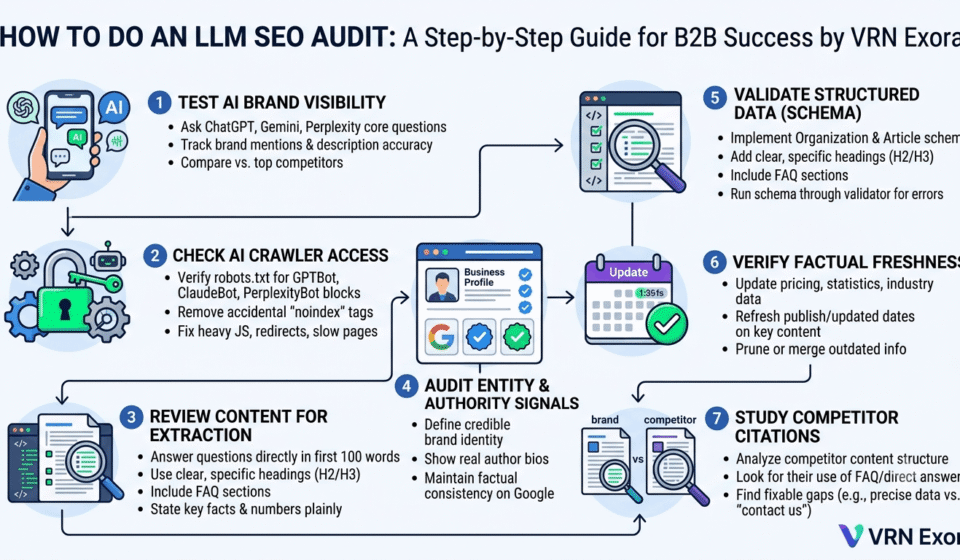
Step 1: Test How AI Tools Currently See Your Brand
Before touching any technical settings, start with the simplest test of all: ask the AI tools directly. Open ChatGPT, Gemini, Perplexity, and a couple of other popular tools, then type in the exact kinds of questions a real customer might ask about your industry, your product, or your service.
Since AI answers can shift slightly even for the same question, pick a fixed list of five to ten core questions and test them consistently, rather than testing random new questions each time. For every question, track:
- Whether your brand appeared in the answer at all
- Whether the description of your brand was accurate and up to date
- Which competitor brands appeared instead, and how often
- Which specific page or source the AI tool seemed to be pulling from, if it mentioned one
This simple exercise alone often reveals surprising gaps that a purely technical audit would miss entirely.
Step 2: Check Whether AI Crawlers Can Even Reach Your Site
An AI tool cannot mention content it has never been able to read. This step checks the basic, technical gateway that decides whether AI crawlers can access your website at all. Start by opening your robots.txt file, usually found at yourwebsite.com/robots.txt, and check whether it accidentally blocks AI-related bots such as GPTBot, ClaudeBot, or PerplexityBot. Many sites block these bots by accident during a redesign, without ever realizing the damage it causes.
Beyond robots.txt, a few other quiet blockers can stop AI tools from reading pages properly:
|
Blocker |
Why It Hurts AI Visibility |
|
Accidental “noindex” tags |
Tells all bots to skip the page entirely |
|
Heavy JavaScript-only content |
Some AI crawlers struggle to read text loaded this way |
|
Broken redirects or slow pages |
Crawler may time out before finishing the page |
|
Missing llms.txt file |
Not essential, but a low-cost, harmless extra signal |
A newer file worth checking is llms.txt, a simple text file some sites use to point AI tools toward their most important pages. Current research suggests it does not directly boost citations on its own, but it costs very little to add, so many sites include it alongside the more important fixes above.
Step 3: Review Your Content Structure for Easy Extraction
Even if an AI tool can technically reach your page, it still needs to easily pull out a clear fact or answer from your writing. AI models tend to favor content that answers a question directly near the top of a page, rather than content that buries the answer under several paragraphs of background. If a visitor has to scroll through two full paragraphs before reaching the actual answer, an AI tool is likely to skip that page for a competitor’s clearer one.
Go through your most important pages and check each one against this list:
- Does the first hundred words or so directly answer the main question the page is about?
- Do your headings read like clear, specific statements rather than vague, creative titles?
- Does the page include a FAQ section, since question-and-answer pairs are especially easy for AI tools to lift?
- Are key facts, numbers, and specifications stated plainly, instead of hidden inside long, flowery sentences?
Pages built around clear pillar topics, with smaller supporting pages linking back to them, also tend to perform better, since this structure signals real depth on a subject rather than one isolated post trying to cover everything at once.
Step 4: Check Your Entity and Authority Signals
AI models do not just read your words. They also try to understand who you are as a brand, a person, or a business, something SEO experts call your entity. A weak or unclear entity signal makes it much harder for an AI tool to trust and mention you confidently. A few checks matter here:
- Does your website clearly explain who you are, what you do, and what makes you credible?
- Do article authors have a real, visible bio, rather than appearing as an anonymous “admin” account?
- Is your brand mentioned consistently across other trusted websites, reviews, and industry publications, not just on your own site?
AI models often cross-check facts across multiple sources before trusting a claim. If your website states one fact about your business, but your Google Business profile, a review site, or a press mention states something slightly different, this inconsistency can quietly lower how much an AI model trusts your information overall. Keeping business details, achievements, and key facts consistent across every platform is one of the simplest, highest-value fixes in this entire audit.
Step 5: Add or Fix Structured Data
Structured data is a behind-the-scenes labeling system, often called schema markup, that tells search engines and AI tools exactly what a page represents. Without it, machines are left to guess at meaning based on surrounding text alone, increasing the chance of a mistake or a missed citation.
Common schema types worth checking on a business website include:
- Organization schema — confirms your business identity and core details
- Article schema — helps AI tools correctly identify and date blog content
- FAQ schema — turns your question-and-answer sections into clean, extractable units
Once schema is added, always run it through a validator tool to check for errors, since broken schema markup can sometimes cause more confusion than having none at all.
Step 6: Check for Factual Freshness and Accuracy
AI tools tend to avoid citing content that looks outdated or possibly wrong, since a wrong answer damages the AI tool’s own credibility with its users. This makes freshness a real ranking factor inside AI search, not just a nice extra.
Go through your key pages and check publish dates and last-updated timestamps, especially on pages that mention prices, statistics, or industry data. A guide that was accurate a couple of years ago may now contain outdated numbers or outdated tool recommendations, quietly hurting your credibility without any obvious warning sign. Updating old content with current facts and a fresh timestamp is a small task that often produces a noticeable improvement in AI visibility.
Step 7: Study Your Competitors Inside AI Answers
While testing your own brand in Step 1, you likely already noticed which competitors kept appearing instead of you. This step goes one level deeper, studying exactly why those competitors are winning the citation.
Open the specific pages that AI tools are pulling their answers from, and compare them directly against your own equivalent page. Look closely at:
- How they structure their opening paragraph
- Whether they use a FAQ section
- How detailed their facts and figures are
- Whether they clearly show real expertise on the topic
This comparison often reveals a very specific, fixable gap, such as a competitor listing exact pricing while your page only says “contact us for a quote.”
Turning Your Audit Into a Real Action Plan
An audit without a follow-up plan is just a long list of observations. Once you have gathered your findings from every step above, sort them into a simple priority order:
- Fix technical blockers first, since these prevent AI tools from reading your content at all
- Tackle structural issues next, such as pages that bury their answers or lack a FAQ section
- Address entity and consistency problems across your website and outside profiles
- Finish with structured data and content freshness updates
This order matters because fixing content quality first, while a technical block is still in place, wastes effort on pages that AI tools cannot even reach yet. Set a simple habit to re-run your core test questions from Step 1 every month or two. Since AI answers can shift as models update, tracking your results over time shows you whether your fixes are actually working, rather than relying on a single audit result that may already be outdated by the time you read it.
Wrapping Up
An LLM SEO audit is quickly becoming just as important as a traditional SEO audit, since a growing share of buyers now ask an AI tool their question before they ever open a search engine. The good news is that this audit does not require expensive software to get started. A simple, honest test of how AI tools currently describe your brand, combined with a careful check of your technical access, content structure, and factual accuracy, will reveal most of the gaps holding your visibility back.
Treat this audit as an ongoing habit rather than a one-time project. AI models keep changing, competitors keep publishing new content, and facts on your own website can quietly go stale without warning. Businesses that build this kind of regular check into their normal SEO routine will be far better positioned to stay visible, trusted, and cited as more of the world’s searching happens through conversations with AI instead of a traditional search bar.
Frequently Asked Questions
- How is an LLM SEO audit different from a regular SEO audit?
A regular SEO audit checks Google rankings, keywords, and backlinks. An LLM SEO audit checks whether AI tools like ChatGPT and Perplexity can access, understand, and confidently cite your content inside their generated answers.
- How often should I run an LLM SEO audit?
A full audit once every few months is a good starting point, with a quick recheck of your core test questions monthly. AI models update often, so results can shift, making regular tracking more useful than a single one-time check.
- Do I need paid tools to do an LLM SEO audit?
No, you can start for free by manually asking AI tools your key questions and checking your robots.txt and schema markup yourself. Paid tools simply make tracking citations across many prompts and competitors faster at a larger scale.
- What is the single biggest factor affecting AI citations?
Clear, direct, and factually accurate content that answers a question near the top of the page tends to matter most. Technical accessibility, meaning AI crawlers can actually reach your content, is the essential foundation everything else depends on.
- Can a small business realistically compete for AI citations?
Yes, since AI citation depends more on clarity, accuracy, and topical depth than on advertising budget. A small business with well-structured, consistent, and genuinely expert content can often out-perform a larger competitor with vague or outdated pages.