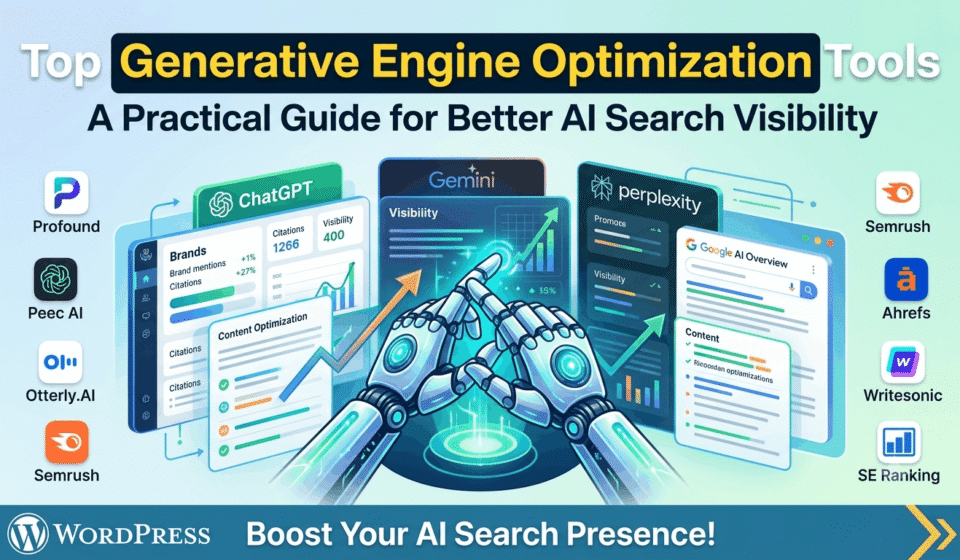
Top Generative Engine Optimization Tools: A Practical Guide for Better AI Search Visibility

Search is changing. People increasingly ask ChatGPT, Gemini, Perplexity, and Google’s AI experiences for direct recommendations instead of opening several search results. That shift has created a new optimization discipline: Generative Engine Optimization (GEO).
The best generative engine optimization tools help marketers understand whether their brand is being mentioned or cited in AI-generated answers, identify visibility gaps, monitor competitors, and improve content. But not every GEO platform solves the same problem. Some focus on tracking, while others combine monitoring with content optimization and reporting.
What Is Generative Engine Optimization?
Generative Engine Optimization is the practice of improving a brand’s visibility in AI-generated search experiences. Instead of focusing only on traditional keyword rankings, GEO looks at signals such as brand mentions, citations, recommendations, source selection, and visibility across AI platforms.
This does not replace SEO. In fact, strong technical SEO, useful content, authoritative sources, and clear website structures remain important. Google itself recommends creating unique, valuable content for people and ensuring that search engines can access and understand your pages.
Top 7 Generative Engine Optimization Tools
The right tool depends on what you are trying to measure. Current GEO platforms generally fall into four groups: visibility trackers, SEO-suite add-ons, content optimization tools, and auditing or grading platforms.
1. Profound
Best for: Enterprise AI visibility monitoring
Profound focuses heavily on tracking how brands appear across generative search experiences. It can be useful for larger organizations that need detailed citation intelligence, competitive analysis, and historical visibility data.
Its strength is depth rather than simplicity, making it more appropriate for established marketing or SEO teams than beginners.
2. Peec AI
Best for: Competitive AI visibility analysis
Peec AI is designed around monitoring brand visibility and competitor performance across multiple AI search environments. It can help teams identify which questions trigger brand mentions and where competitors receive citations instead.
This makes it useful when the objective is not simply “Are we visible?” but “Why are competitors appearing more often than us?”
3. Otterly.AI
Best for: Smaller businesses and marketers starting with GEO
Otterly.AI focuses on AI search visibility tracking and prompt monitoring. Its relatively accessible positioning makes it worth considering for smaller teams that want to experiment with GEO without immediately investing in an enterprise platform.
4. Semrush AI Visibility
Best for: Existing SEO teams
For businesses already using Semrush, its AI visibility capabilities can provide a convenient way to bring traditional SEO and emerging AI-search measurement into one workflow.
This can be particularly practical for teams that do not want a completely separate GEO technology stack.
5. Ahrefs Brand Radar
Best for: Businesses already using Ahrefs
Ahrefs has expanded beyond conventional SEO research with AI visibility capabilities through Brand Radar. It is particularly relevant for teams already using Ahrefs for keywords, backlinks, and competitor research.
The advantage is having AI visibility data alongside established SEO intelligence rather than managing everything separately.
6. Writesonic
Best for: Content teams
Writesonic combines content creation with SEO and GEO-oriented features. This can appeal to teams that want to move from identifying an AI-search opportunity to creating or improving content within the same broader workflow.
However, content generation alone does not guarantee AI visibility. Human review, original information, strong sources, and genuine usefulness still matter.
7. SE Ranking
Best for: Mid-sized SEO teams
SE Ranking offers an increasingly integrated approach to traditional SEO and AI-search visibility. It can be a practical option for agencies and businesses that want conventional SEO capabilities alongside emerging GEO features.
How to Choose the Right GEO Tool
Do not choose a platform simply because it claims to track “AI rankings.” Ask what it actually measures.
Look for:
- AI engine coverage: Does it monitor the platforms your audience actually uses?
- Prompt flexibility: Can you track your own customer questions?
- Citation tracking: Does it identify which pages AI systems cite?
- Competitor monitoring: Can you compare your visibility with competing brands?
- Historical data: Can you identify trends rather than rely on one AI response?
- Actionable recommendations: Does the tool explain what to improve?
- Integration: Can your SEO, content, and reporting workflows use the data?
- Pricing transparency: Are important engines or features locked behind higher plans?
One important point: AI answers can change. A single ChatGPT or Perplexity response is not enough to determine whether a brand has strong GEO performance. Repeated prompts, multiple engines, and historical measurements provide a much more useful picture.
Do GEO Tools Improve AI Search Rankings?
Not directly.
A GEO tool cannot force ChatGPT, Gemini, Perplexity, or Google to mention a business. Its value is diagnostic: it shows where visibility exists, where competitors are stronger, which sources are being cited, and what content opportunities may deserve attention.
That distinction matters because GEO software is not a shortcut around quality content.
Google’s guidance for AI search continues to emphasize original, helpful content, good page experience, and accessible pages.
A Practical GEO Workflow
A simple workflow can make GEO tools considerably more useful:
- Identify important customer questions. Start with questions your audience actually asks.
- Track those prompts across relevant AI engines.
- Record mentions and citations. Look beyond whether your brand name appears.
- Study the sources being cited. Look for patterns in depth, authority, freshness, and structure.
- Compare competitors. Identify topics where they consistently appear.
- Improve your content. Add original information, direct answers, evidence, examples, and useful context.
- Monitor again. GEO is an ongoing measurement process, not a one-time optimization.
GEO Tools vs. Traditional SEO Tools
Traditional SEO tools answer questions such as “Where does my page rank?” GEO tools increasingly answer “Does an AI system mention or cite my brand when someone asks a relevant question?”
Both matter.
Google has also introduced Search Console reporting for visibility in generative AI features such as AI Overviews and AI Mode, although the dedicated reporting is being rolled out gradually.
The practical takeaway is to treat GEO as an extension of your search strategy rather than a replacement for SEO.
The Bottom Line!
The top generative engine optimization tools are not necessarily the platforms with the longest feature lists. The better choice is the one that helps you understand how your brand appears in AI-generated answers and turn that information into meaningful content and SEO decisions.
As AI search evolves, GEO should complement, not replace, people-first SEO. Create genuinely useful content, make important information easy to understand, build credible sources and expertise, and use GEO tools to discover where your visibility can improve.
Frequently Asked Questions
- What is the best generative engine optimization tool for beginners?
There is no universal winner. Beginners should prioritize a tool with understandable reporting, relevant AI-engine coverage, flexible prompt tracking, and transparent pricing. A simpler visibility tracker may be more useful initially than an expensive enterprise platform with features a small team will not use.
- Can GEO tools track ChatGPT and Google AI Overviews?
Many current GEO platforms track multiple generative search environments, including ChatGPT and Google’s AI experiences. However, coverage differs by provider and subscription tier. Always verify the exact engines, regions, prompts, and reporting frequency included in the plan you are considering.
- Is GEO more important than SEO?
GEO is not a replacement for SEO. Strong technical SEO, accessible pages, useful content, authority, and relevant sources remain important foundations. GEO adds another measurement layer for understanding visibility in AI-generated answers and recommendations.
- How often should businesses monitor AI search visibility?
For actively managed brands, monthly monitoring provides a useful baseline, while high-priority queries may justify more frequent tracking. The important factor is consistency. Comparing the same prompts over time is generally more meaningful than checking AI responses randomly.
- Are generative engine optimization tools worth paying for?
They can be, particularly when AI-generated answers influence customer discovery in your industry. Before purchasing, define the business problem first. If you only need occasional checks, a free grader may be enough. Larger teams may benefit from historical tracking, competitor analysis, citation monitoring, and reporting.