
Ever asked ChatGPT a question and noticed it skipped Google entirely, yet still handed you a confident, source-backed answer? That’s the moment traditional SEO started sharing the stage with something new, and if your brand isn’t showing up in that answer, you’re already behind.
Generative Engine Optimization, or GEO, is the practice of shaping your content so GEO or AI tools like ChatGPT, Perplexity, and Google’s AI Overviews actually cite you when they generate answers. It’s not a replacement for SEO, but it plays by different rules, and those rules are still being written in real time.
This guide breaks down the top GEO strategies that actually move the needle in 2026, plus a couple of closely related concepts you need to understand alongside them. Stick around, because by the end you’ll have a clear roadmap for making your content the one AI models reach for first.
Why GEO Strategies Matter More Than Ever in 2026
Search behavior has quietly flipped. People aren’t just scrolling through ten blue links anymore; they’re asking a chatbot and trusting whatever it says back. Have you caught yourself doing the same thing this week?
That shift changes the entire game. Ranking on page one of Google used to be the finish line. Now there’s a second finish line: getting quoted, paraphrased, or linked inside an AI-generated response. Miss that, and your competitor’s name ends up in front of the customer instead of yours.
Here’s what makes this urgent for US brands specifically:
- AI Overviews now appear on a large share of Google searches, often above every organic result
- Tools like Perplexity and ChatGPT are becoming first-stop research tools for shoppers, students, and professionals
- Being cited by an AI model builds a kind of trust and visibility that a standard search listing simply can’t match
- Early movers in GEO are securing citation real estate that will be harder to win later
So the real question isn’t whether GEO matters. It’s whether your content is structured in a way these models can actually understand and trust.
Top GEO Strategies That Actually Get You Cited
Let’s get into the strategies themselves. These aren’t theoretical; they’re the tactics showing measurable results for brands trying to earn AI visibility right now.
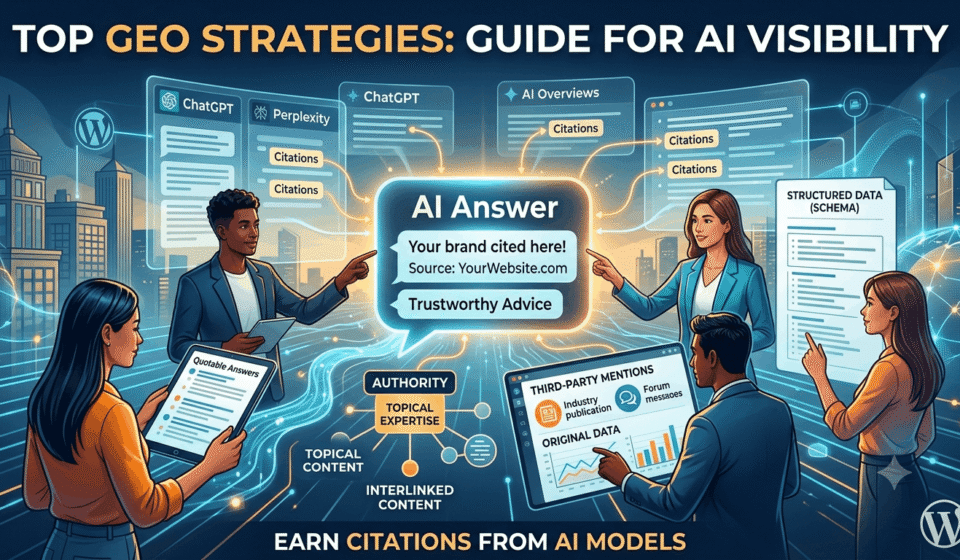
Structure Content Around Direct, Quotable Answers
AI models are essentially answer-extraction machines. They scan a page looking for a clean, self-contained statement they can lift and repurpose. If your key point is buried inside three paragraphs of throat-clearing, it’s going to get skipped in favor of a competitor who just said the thing plainly.
Start each section with a direct answer to the implied question, then explain further underneath. Think of it like answering a friend’s text message first, then adding context after. That single habit alone can meaningfully increase your citation odds.
Build Topical Authority Instead of Chasing Single Keywords
Generative engines don’t just evaluate one page; they evaluate your whole site’s depth on a subject. A single well-optimized blog post won’t cut it anymore if the rest of your domain has nothing to back it up.
Ways to build that depth include:
- Publishing a genuine content cluster around your core topic, not just scattered one-off posts
- Interlinking related pages so crawlers and AI models can map your expertise
- Covering adjacent subtopics your audience actually searches for, not just your primary keyword
- Updating older content regularly so the freshness signal stays strong
Format for Machine Readability, Not Just Human Skimming
Humans skim with their eyes. Machines skim with structure. Have you ever noticed how AI answers often come back as tidy bullet points or numbered steps? That’s not a coincidence; it mirrors how the source content was likely formatted.
Use clear headers, short paragraphs, bullet lists for anything list-shaped, and tables where comparison data belongs. FAQ sections deserve special attention here too, since they map almost perfectly onto how people phrase questions to AI tools.
Earn Mentions on High-Trust Third-Party Sites
Generative engines weigh source credibility heavily, and that credibility often comes from outside your own domain. A glowing paragraph on your homepage means far less than a neutral mention on a site the model already trusts.
Focus your outreach on:
- Industry publications and respected trade blogs in your niche
- Reddit threads and niche forums where genuine discussion happens
- Wikipedia and Wikipedia-adjacent reference sites, where accuracy standards are strict
- Review platforms and comparison sites relevant to your category
Add Structured Data That Speaks the Model’s Language
Schema markup used to be a nice-to-have for rich snippets. Now it’s closer to a translator, helping AI crawlers parse exactly what your content means without guessing. FAQ schema, HowTo schema, and Article schema all give models a clean, labeled version of your content to work from.
If your developer hasn’t touched schema in a while, this is the moment to revisit it. It’s a relatively small technical lift with outsized payoff for machine comprehension.
Demonstrate First-Hand Experience and Original Data
Generic, recycled advice rarely gets cited, because a dozen other sites already say the same thing in nearly the same words. What stands out is a specific data point, an original survey, a case study, or a genuinely tested opinion nobody else has published.
Ask yourself honestly: does this piece of content say something your five closest competitors haven’t already said? If the answer is no, that’s the gap to close.
Understanding AEO: The Close Cousin of GEO Strategies
You can’t talk about GEO for long without bumping into Answer Engine Optimization, or AEO. The two overlap so heavily that people often use the terms interchangeably, though there’s a subtle distinction worth understanding.
How AEO Differs From GEO in Practice
AEO focuses specifically on optimizing for direct-answer formats; think featured snippets, voice search results, and the short answer boxes that appear before a full AI-generated response. GEO is the broader umbrella, covering how your content gets used, cited, or synthesized across the entire generative AI landscape.
In plain terms, AEO is about winning the one clean answer. GEO is about winning the ongoing conversation an AI model has with the user across multiple exchanges. You genuinely need both working together, not one instead of the other.
Practical Ways to Strengthen Your AEO Alongside GEO
- Answer the exact question a searcher would type, using natural phrasing rather than stiff keyword strings
- Keep your direct answers between 40 and 60 words, the sweet spot for snippet and voice extraction
- Use question-based subheadings that mirror real conversational search queries
- Test your content against actual voice assistants to see how it gets read aloud
Keeping Your GEO Strategy Consistent Across Every Platform
A strategy that works beautifully on one platform can fall flat on another if you’re not paying attention. AI models don’t all pull from the same sources or weigh the same signals, so treating GEO as a single, one-size-fits-all checklist is a mistake worth avoiding.
Why Cross-Platform Consistency Strengthens Every Other Strategy
ChatGPT, Perplexity, and Google’s AI Overviews each lean on different mixes of web crawling, licensed data, and real-time search. A page that gets cited constantly in one tool might barely register in another, simply because the underlying data sources differ.
That’s exactly why consistency matters so much. If your messaging, facts, and positioning shift from page to page or platform to platform, you make it harder for any single model to build confidence in what you’re saying. Mixed signals rarely earn a citation.
Simple Habits That Keep Your Signals Aligned
- Use the same core facts, figures, and terminology across your website, social profiles, and any guest content
- Revisit older posts periodically to make sure they still match your current messaging and offerings
- Keep author names, credentials, and bios consistent wherever your content appears online
- Monitor how different AI tools currently describe your brand, then correct any outdated or inaccurate framing you find
Small inconsistencies might seem harmless, but generative engines are quietly cross-referencing everything. The tighter your story is everywhere, the easier it becomes for any model to trust and repeat it.
Bringing It All Together
GEO isn’t a single trick you apply once and forget about. It’s a layered approach, part structure, part authority, part technical groundwork, all working together to make your content the obvious pick when an AI model is deciding what to reference.
Start small if you need to. Pick one strategy from this guide, maybe reformatting your top-performing page for direct answers, and see what happens over the next few weeks. Momentum in GEO tends to build once you get the first few pieces right.
The brands winning this new visibility game aren’t necessarily the biggest ones. They’re the ones paying attention early, while everyone else is still treating this as optional.
FAQs
Is GEO going to replace traditional SEO completely?
No, GEO works alongside SEO rather than replacing it. Traditional search rankings still drive significant traffic, while GEO captures a separate, growing channel of AI-generated visibility that complements your existing efforts.
How long does it typically take to see GEO results?
Most brands notice early citation shifts within a few months of consistent effort, though timelines vary by industry, competition level, and how much authority your domain already carries with search engines.
Can small businesses realistically compete with big brands in GEO?
Yes, absolutely. AI models often favor specific, well-documented expertise over generic corporate content, giving smaller, niche-focused businesses a genuine opportunity to earn citations larger competitors might miss entirely.
Do I need separate content for GEO versus regular SEO content?
Not usually. Well-structured, genuinely useful content tends to satisfy both goals simultaneously, though adding clearer formatting and direct answers specifically strengthens your odds with generative engines.
Which industries benefit most from investing in GEO strategies right now?
Information-heavy industries like finance, healthcare, technology, and professional services see the strongest early returns, since users frequently turn to AI tools for research before making decisions in these fields.