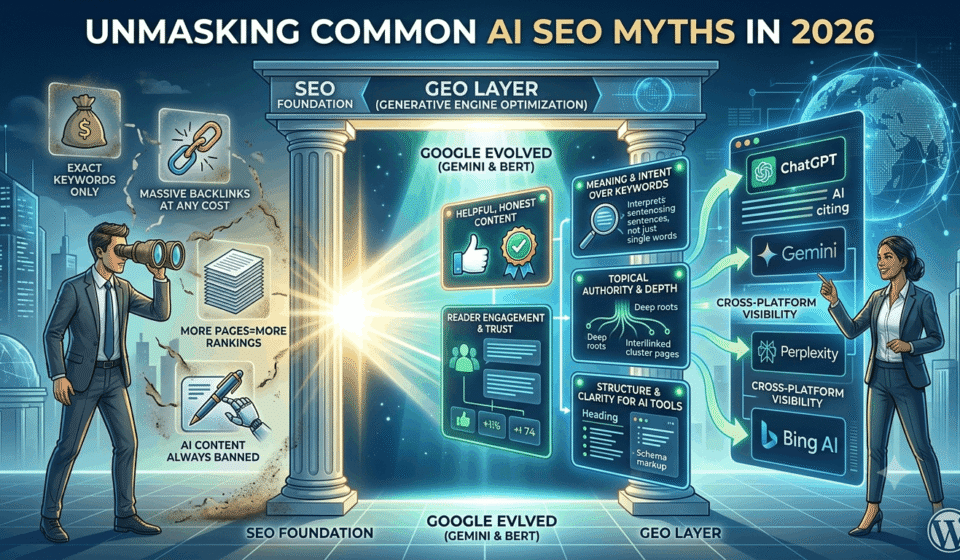

Google has evolved. It doesn’t just look for keywords on a page anymore. Now it relies on AI, like Gemini and other smart systems, to figure out what a page really means and whether it really helps people.
This change means a lot of old advice for SEO doesn’t work anymore. But many people still believe it. These are wrong beliefs, myths. They can quietly ruin a website’s chances to appear in search results or AI answers.
Quick Answer
AI SEO myths are wrong ideas about how Google and AI tools rank websites today. Most of these myths come from old SEO rules that used to work but don’t anymore.
Here is a quick answer:
- AI-written content is not banned or punished. Bad content is.
- Keywords still help, but Google cares more about meaning now.
- Backlinks still count, but they are not the only thing that matters.
- Writing more pages does not automatically help you rank higher.
- Showing up on Google does not mean you’ll show up in AI answers too.
Now let’s go through each myth one by one.
Myth 1: AI Content Always Gets Penalized
Many people believe Google punishes any content written by AI. That’s not true.
Google does not care if a human or an AI wrote your content. What Google actually checks is whether the content is helpful, honest, and answers the reader’s question well.
Think of it like a teacher grading an essay. The teacher doesn’t ask who held the pen. The teacher checks if the essay actually answers the question and makes sense.
So if AI helps you write something useful and clear, it can still rank just fine. What gets punished is lazy, copied, or confusing content, whether a person or a robot wrote it.
Myth 2: Keywords Are All That Matter
This myth is half true, which is why it’s so easy to believe. Keywords still matter a little. But they are no longer the main thing Google looks at.
Today, Google tries to understand the meaning behind a search, not just the exact words. This is done through AI tools like BERT and MUM, which read sentences the way a person would.
So if someone searches “how to fix a leaking tap,” your page doesn’t need those exact words everywhere. It just needs to genuinely explain how to fix a leaking tap, using the natural language a real person would use.
Simple tip: Write for the reader first. Use related words naturally. Don’t repeat the same phrase over and over.
Myth 3: Backlinks Still Control Everything
Backlinks are links from other websites pointing to yours. For a long time, more backlinks meant higher rankings, almost no matter what.
That’s changed. Backlinks still help, but they’re just one part of a much larger picture now. Google also looks at how helpful your content is, how trustworthy your website seems, and how real users respond to it.
Here’s a simple way to picture the shift:
|
What Matters |
Traditional SEO |
AI Search Today |
|
Backlinks |
Very important |
Somewhat important |
|
Exact keywords |
Very important |
Less important |
|
Deep, useful content |
Not very important |
Very important |
|
Being a trusted source |
Rarely checked |
Checked closely |
|
Readers actually liking it |
Rarely checked |
Checked closely |
A page with fewer backlinks but genuinely helpful, well-explained content can now beat a page with hundreds of backlinks but weak writing.
Myth 4: Publishing More Pages Means More Rankings
Some people think the secret to ranking is simple: publish as many pages as possible. More pages, more chances to rank, right?
Not anymore. Google now prefers a smaller number of well-written, deeply useful pages over a huge pile of thin, rushed ones.
Imagine two students. One writes ten short, rushed answers. The other writes three answers, but each one is clear, complete, and easy to follow. The second student usually gets the better grade.
What actually helps:
- Cover one topic really well before moving to the next.
- Fix or improve old, weak pages instead of only adding new ones.
- Focus on depth, not just word count.
Myth 5: AI SEO Just Means Using AI Tools to Write
Using tools like ChatGPT or Claude to write your blog does not automatically make your strategy “AI SEO.” That’s a common mix-up.
AI SEO actually means something different. It means shaping your content so that AI systems can easily read it, understand it, and use it to answer people’s questions.
This includes things like using clear headings, giving direct answers early, and organizing information so both humans and machines can follow it easily. The tool you use to write is far less important than how you structure what you write.
Myth 6: Ranking on Google Is the Only Thing That Matters
People no longer search only on Google. Many now ask questions directly to ChatGPT, Perplexity, Gemini, or Bing’s AI chat.
Each of these tools looks at different sources and picks answers in its own way. A page that ranks well on Google might not get picked up by ChatGPT or Perplexity at all.
That’s why it’s smart to think beyond just Google. Structuring your content clearly helps more of these AI tools pick it up, not just one search engine.
Myth 7: Good Technical SEO Alone Is Enough
A fast website, a clean layout, and mobile-friendly design still matter. But they’re not the full picture anymore.
Google’s AI now checks something deeper: does this page actually help people? A website can load in one second and still get skipped by AI Overviews if the content itself is shallow or unclear.
Technical SEO audit is like a well-built house. It’s a strong foundation, but it still needs something worth putting inside it.
Myth 8: GEO Replaces Old-School SEO Completely
GEO stands for Generative Engine Optimization. It’s newer, and some people think it replaces regular SEO entirely. It doesn’t.
Think of GEO as an extra layer built on top of SEO, not a replacement for it. You still need the basics: a well-built website, good structure, and helpful content. GEO simply adds extra focus on how AI tools read and quote that content.
Both work together. Skipping the SEO basics to focus only on GEO usually backfires.
Myth 9: Only Big, Famous Brands Can Win
It’s easy to assume that only huge, well-known companies show up in AI answers. That’s not really how it works.
AI systems care about how relevant, clear, and useful your content is, not how big or famous your brand is. A small business with a genuinely helpful, well-organized page can absolutely beat a giant brand with vague, generic content.
Being small doesn’t limit you here. Being unclear or unhelpful does.
Myth 10: Ranking High Always Means You’ll Show Up in AI Answers
This is one of the trickiest myths, because it seems logical. If you rank first on Google, surely you’ll appear in the AI Overview too, right? Not always.
AI Overviews and chatbot answers use their own separate rules. They look for content that gives a clear, direct answer near the top, something they can easily lift and summarize.
A page can rank first in regular search and still get skipped by AI Overviews if the answer isn’t clear or direct enough near the beginning.
Myth vs. Reality: Quick Recap
|
Myth |
What’s Actually True |
|
AI content gets punished |
Only unhelpful content gets punished |
|
Keywords control rankings |
Meaning and intent matter more |
|
Backlinks decide everything |
Backlinks are just one factor now |
|
More pages equal more traffic |
Depth beats volume |
|
AI SEO is just using AI tools |
It’s about structure and clarity |
|
Google ranking is enough |
Other AI platforms matter too |
|
Technical SEO guarantees visibility |
It supports, but doesn’t replace, good content |
|
GEO replaces SEO |
GEO builds on top of SEO |
|
Only big brands succeed |
Relevance beats brand size |
|
High ranking equals AI visibility |
AI Overviews use different rules |
Why Do These SEO Myths Even Exist?
For years, SEO worked in a simple way. Use the right keywords, get some backlinks, and publish often, and you’ll climb the rankings. People got used to the routine.
Then Google added AI. Tools like Gemini and BERT started reading pages more like a human would. They try to understand the meaning behind a search, not just match words.
This shift happened fast. Old habits stuck around because they used to work. That’s exactly why these myths are still so common today.
Simple Steps to Avoid These AI SEO Myths
- Answer real questions people actually ask, in plain language.
- Place the clearest, most direct answer at the top of the page.
- Go deep on fewer topics instead of writing many shallow pages.
- Keep your website fast and easy to use, but don’t stop there.
- Check how your content performs across Google, ChatGPT, and other AI tools separately.
Frequently Asked Questions
Does Google punish content written by AI?
No, it doesn’t. Google only punishes content that is unhelpful or confusing. If AI helps you write something clear and useful, it can rank just as well as anything written by a person.
Are keywords still useful for SEO?
Yes, a little. But Google now cares more about what your content actually means than the exact words you use. Write naturally, and the right words will usually show up on their own.
Do backlinks still help my website rank?
Yes, backlinks still help. But they’re no longer the biggest factor. Google also looks closely at how useful, clear, and trustworthy your content is.
Will writing more blog posts help me rank higher?
Not by itself. Writing a few deep, well-explained posts usually works better than publishing many short, rushed ones. Quality beats quantity here.
Is using AI writing tools the same as doing AI SEO?
No. Using AI to write is just one tool. AI SEO means organizing your content clearly so AI systems can easily read it and use it to answer questions.
Do I only need to worry about ranking on Google?
No. People also ask questions through ChatGPT, Gemini, and Perplexity. Structuring your content well helps it show up across more of these tools, not just Google.
Is a fast, well-built website enough to rank well?
No, not alone. A fast website helps, but Google still checks if your content is genuinely useful. Speed without good content isn’t enough anymore.
Does GEO completely replace traditional SEO?
No. GEO adds a new layer focused on AI systems, but it still relies on strong SEO basics like good structure and helpful writing underneath it.
Can a small website really beat a big, famous brand in search?
Yes. AI tools care about how clear and useful your content is, not how big your brand is. A small site with a great answer can outrank a big brand with a weak one.
Why doesn’t my top-ranking page show up in AI Overviews?
AI Overviews use their own rules. They look for a clear, direct answer near the top of the page. If your answer isn’t clear enough early on, AI tools may skip it even if you rank first on Google.