
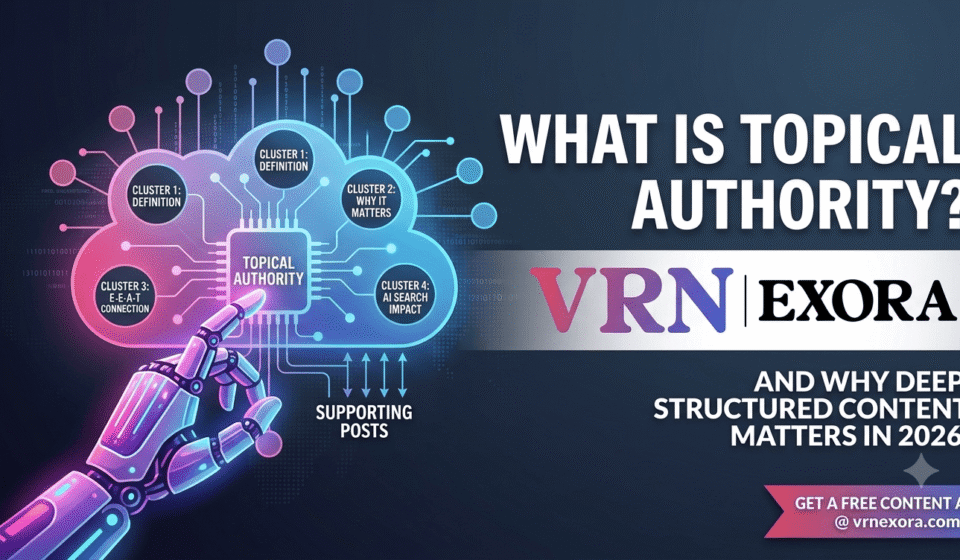

Topical authority is the depth and breadth of coverage a website builds around a specific subject, the signal that tells search engines a site genuinely understands a topic rather than having produced one isolated page about it. This guide is for marketers, content teams, and business owners who keep hearing the phrase and want a clear, honest answer to what it actually means, how it differs from related concepts like domain authority, and why it has become more important to modern SEO than it used to be. You will learn how search engines actually evaluate topical authority, how it connects to E-E-A-T, and why it matters even more now that AI search engines have entered the picture.
Topical Authority Definition: The Short Answer
Topical authority means a website is recognized as a trusted, comprehensive source on a specific subject, built through the accumulated weight of related, well-connected content rather than through any single article on its own. A single well-written page is not topical authority, it is only the starting point. Authority accumulates when a site covers a subject from multiple genuine angles, connects those angles to each other clearly, and demonstrates that it understands how the pieces of that topic relate, not just that it can produce content mentioning the right keywords.
Topical Authority vs Domain Authority
These two terms get confused constantly, but they measure genuinely different things. Domain authority is a site-wide score, popularized by Moz, that reflects the overall strength of a site’s backlink profile, heavily influenced by the number and quality of external sites linking to it. Topical authority is narrower and subject-specific, earned by how deeply and clearly a site covers one particular topic, largely independent of the site’s broader backlink profile or general reputation.
This distinction has a real practical consequence: a site with a comprehensive, well-structured content cluster and a relatively modest backlink profile will often outrank a site with a strong overall backlink profile but shallow, disconnected content on the same specific subject. Link power without topical foundation increasingly delivers diminishing returns, while topical depth with a comparatively lighter backlink profile continues to produce strong, consistent results, especially for informational and AI-driven queries.
Topical Authority vs Topical Relevance
Topical relevance is a related but smaller concept: how closely a single piece of content matches a specific subject and the intent behind a specific search. Topical authority is the accumulated, site-wide version of that same idea, built up over time through many pieces of connected, relevant content rather than achieved by any one page in isolation. A site can be topically relevant to a search with a single well-optimized page while still lacking genuine topical authority on the broader subject that page belongs to.
How Google Actually Evaluates Topical Authority
A common misunderstanding is that topical authority is primarily about publishing volume, more posts, more pages, more keyword variations. It is not. What search engines are actually evaluating is coverage: does the site make it clear it understands a topic from multiple genuine angles, does it connect related ideas in a way that makes logical sense, and does the overall picture feel complete rather than scattered. A site can publish a large volume of content and still show weak topical authority if that content is disconnected, repetitive, or leaves obvious, significant gaps in coverage that a genuine expert on the subject would not have left.
There is no single fixed number of articles that guarantees topical authority, since it depends heavily on competition and niche difficulty, but many sites begin to see genuine, compounding progress once they have published somewhere in the range of fifteen to thirty well-connected articles on the same subject, with more competitive niches typically requiring more. The key signal search engines are actually looking for is whether the site can be trusted as a complete, reliable reference, not whether it has hit any specific content quota.
Why Topical Authority Matters More in 2026
Topical authority matters more now for a structural reason: Google’s ranking systems continue to update, test, and re-evaluate constantly, and in that environment, search engines are specifically looking for signals they can trust consistently over time rather than a single strong page that might have gotten lucky. A site with genuine, demonstrated topical authority earns a form of accumulated trust that makes new content on that same subject easier to rank, and it also improves the performance of existing pages within that same cluster, since the whole collection reinforces every individual piece rather than each page competing entirely on its own.
It is also becoming considerably harder to rank a single, isolated page for a genuinely competitive term without that broader support behind it. When an entire content ecosystem supports a site’s primary subject matter, rankings tend to rise across the board for that topic, rather than one page succeeding in isolation while everything around it remains invisible.
How Topical Authority Connects to E-E-A-T
Topical authority directly supports E-E-A-T, Google’s framework for evaluating experience, expertise, authoritativeness, and trustworthiness. Publishing comprehensive, accurate, and genuinely interconnected content on a subject is one of the clearest ways a site can demonstrate real, first-hand expertise rather than simply asserting it. Without this kind of structured depth, a site’s underlying trust signals weaken, which matters especially for topics where a searcher’s decision carries real financial, health, or safety consequences, since Google applies more scrutiny to trust signals in those categories specifically.
Topical Authority and AI Search
Topical authority’s importance has grown further with the rise of AI-driven search. AI systems and generative answer engines specifically reward sites that demonstrate deep, connected expertise across a whole subject, since these systems are trying to identify genuinely reliable sources to cite, not just individually well-optimized pages. A site built around a real topical authority structure, with a clear pillar, complete supporting coverage, and consistent internal connections between related pieces, is considerably more likely to be treated as a trustworthy reference by an AI system than a site with scattered, disconnected content covering the same ground unevenly.
Common Misconceptions About Building It
The most persistent misconception is that topical authority is primarily a volume game, when it is actually a structure and completeness game. A second common misconception is that domain authority and topical authority are the same thing, or that a strong overall backlink profile automatically produces topical authority on any specific subject a site happens to publish about. A third misconception is that topical authority is only relevant for large sites with substantial content budgets, when in reality a smaller business focused on a genuinely narrow niche, targeting specific long-tail terms and building content clusters around real customer problems, can build meaningful topical authority within that focused area without needing the resources of a much larger competitor.
Frequently Asked Questions
Is topical authority the same as domain authority?
No. Domain authority is a site-wide score largely driven by backlink profile strength. Topical authority is subject-specific, earned through depth and connected coverage of a particular topic, and it can be strong even on a site with a comparatively modest overall backlink profile.
How many articles does a site need to build topical authority?
There is no fixed number, since it depends on competition and niche difficulty, but many sites begin to see meaningful, compounding progress somewhere in the range of fifteen to thirty well-connected articles on the same subject, with more competitive topics typically requiring more.
Can a small business realistically build topical authority?
Yes. A small business focused on a genuinely narrow niche, targeting long-tail keywords and building content clusters around specific customer problems, can build real topical authority within that focused area, since clear structure and depth matter more than overall content volume or company size.
Does topical authority replace the need for backlinks?
Not entirely, but its relative importance has grown. A site with strong, well-structured topical coverage and a lighter backlink profile can often outperform a site with strong backlinks but shallow, disconnected content on the same subject, though backlinks still contribute real value alongside topical depth.
How is topical authority different from topical relevance?
Topical relevance describes how well a single page matches a specific search and its intent. Topical authority is the accumulated, site-wide version of that concept, built through many connected pieces of content over time rather than achieved by any one page alone.
Does topical authority matter for AI search, not just Google rankings?
Yes, increasingly so. AI-driven search engines specifically favor sources that demonstrate deep, connected expertise across an entire subject when deciding what to cite, which makes genuine topical authority relevant to both traditional rankings and AI search visibility.
Get a Free Expert Review of Your Content Coverage
Understanding topical authority is the first step, seeing where your own content coverage actually stands is the next one. If you want a faster starting point, get a free SEO audit from VRN Exora and see exactly how complete your current topic coverage really is.