
A semantic content network is a structured system of interconnected pages linked by meaning, context, and entity relationships, rather than by navigation alone, designed to help search engines and AI systems understand a site as a genuinely coherent, authoritative source on a subject. This guide is for content strategists, SEO managers, and site owners who want a clear explanation of what a semantic content network actually is, how it differs from a simpler topic cluster, and why its underlying structure has become central to how modern search engines and AI platforms evaluate expertise. You will learn the core building blocks of a semantic content network, how pages within it actually connect, and why the quality of every individual page affects how the entire network performs.
Semantic Content Network Definition: The Short Answer
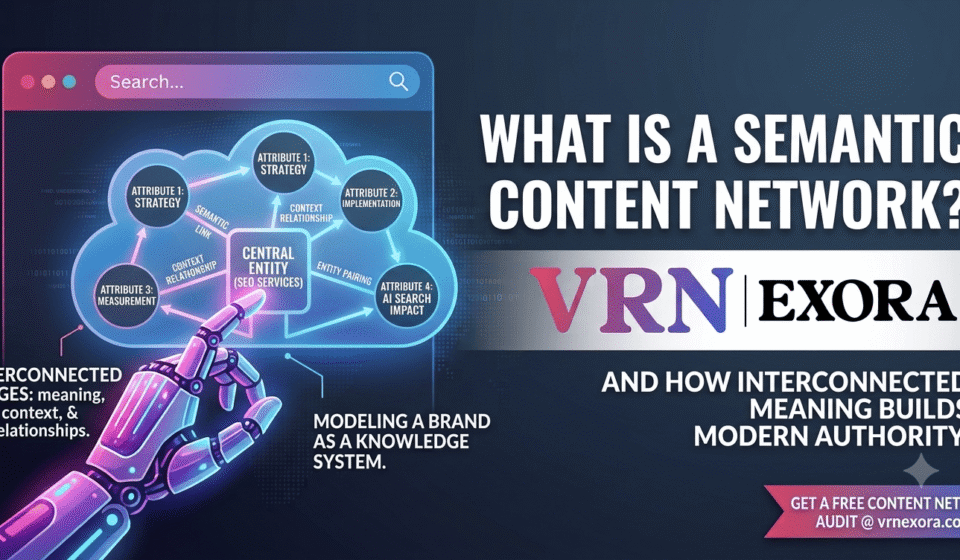
A semantic content network connects pages based on meaning and entity relationships rather than treating each page as an isolated unit competing for its own keyword. Instead of publishing scattered articles that happen to share a general subject, a semantic content network organizes content around a central entity and its attributes, structuring the relationships between pages so that a search engine or an AI system can interpret the entire site as one coherent knowledge system rather than a loose pile of individually optimized posts.
How a Semantic Content Network Differs From a Topic Cluster
A traditional topic cluster, built around a pillar page linking out to several supporting articles, is a genuine step toward a semantic content network, but it is a simpler, less rigorous version of the same underlying idea. A full semantic content network goes further by explicitly modeling entities and their attributes using structured data relationships, organizing content into distinct layers, typically core, supporting, and long-tail content, and connecting pages specifically through meaningful, contextually relevant links rather than generic navigation alone. The distinction matters in practice: even genuinely high-quality content can fail to rank well if it lacks these deliberate contextual connections to the rest of the site’s coverage on the same subject.
The Building Blocks: Central Entity, Attributes, and Context
Every semantic content network is organized around a central entity, the specific person, product, service, or concept the network exists to demonstrate authority on. That central entity is described through its attributes, the specific characteristics, subtopics, and facts that define it, often modeled using an entity-attribute-value structure that mirrors how search engines and knowledge graphs themselves represent information internally rather than how a traditional keyword list would organize it.
Context matters as much as the entity itself. A page’s source context, meaning the specific angle or use case it addresses, needs to connect clearly back to the central entity so a search engine can recognize how that individual page fits within the site’s broader coverage of the subject. Content that tightly groups related entities and their attributes together helps a search engine map the page against its own knowledge graph, reinforcing the site’s position as a trusted, well-understood source rather than an unfamiliar or ambiguous one.
How Pages Connect Within the Network
A semantic content network functions through deliberate internal connection, not simply through shared subject matter. Pages link to each other based on genuine relevance and meaning, so a page discussing one specific attribute of the central entity naturally links to other pages covering closely related attributes, reinforcing the relationship between them rather than linking only up to a single pillar page and nowhere else. This internal linking architecture controls how authority actually flows through the network and signals to a search engine how the individual pieces relate to one another as a connected whole.
Anchor text plays a specific, deliberate role in this structure too. Consistent, descriptive anchor text carrying real synonym value, rather than generic or purely branded phrasing, helps reinforce exactly which entity and attribute a given link is reinforcing, strengthening the semantic signal the network is trying to send rather than diluting it with vague, interchangeable link text.
Why Quality of Every Page Affects the Whole Network
One of the more counterintuitive properties of a semantic content network is that its quality is genuinely collective, not merely additive. Low-quality or thin pages within the network do not simply fail to help, they can actively drag down the performance of the genuinely strong pages connected to them, since the network is evaluated as a whole rather than as a simple sum of independent pages. This is a meaningful departure from older SEO thinking, where a weak page was assumed to be, at worst, neutral for the rest of a site. In a semantic content network, publishing quickly and inconsistently, or padding the network with thin, low-value pages just to increase volume, can genuinely undermine the pages that would otherwise perform well on their own.
How a Semantic Content Network Is Built
The planning layer for any semantic content network is a topical map, a structured, hierarchical framework that organizes the central entity, its attributes, and every planned supporting page before any content gets written. The map does not just suggest what would be nice to publish, it defines what genuinely needs to exist for the site to become eligible for real authority on the subject, connecting a central hub to its supporting pages through the meaningful internal links described above. Building the network in practice means creating individual content briefs for each node in that map, ensuring every planned page has a clearly defined role, entity focus, and connection back to the rest of the structure before writing begins, rather than deciding those connections retroactively after publishing.
Why This Matters for AI Search
Semantic content networks matter even more directly for generative and answer engine optimization than they historically did for traditional Google rankings alone. AI systems and large language models are specifically built to interpret meaning and relationships between concepts, not to match literal keyword strings, which means a site structured as a genuine semantic network, rather than a collection of disconnected keyword-targeted posts, is considerably easier for these systems to interpret as an authoritative, citable source. Content that is well connected within a real semantic network also tends to hold up more reliably across broad core algorithm updates, since the site’s authority is distributed across a resilient, interconnected structure rather than concentrated in a small number of isolated pages vulnerable to any single ranking shift.
How Long It Takes to Build
Building a fully recognized semantic content network is a genuine long-term investment, not a quick technical fix. While an individual page can sometimes rank quickly if competition for that specific query is low, a fully connected, recognized network typically takes something in the range of three to six months of consistent, deliberate publishing to establish, closely mirroring the broader timeline expected for building topical authority generally. Rushing this process by publishing a large volume of loosely connected content quickly tends to produce a weaker result than publishing fewer, more deeply connected pages at a steadier, more deliberate pace.
Frequently Asked Questions
Is a semantic content network the same thing as a topic cluster?
They are related but not identical. A topic cluster is a simpler structure built around a pillar page and supporting articles. A semantic content network goes further, explicitly modeling entities and attributes and connecting pages through deliberate, meaning-based internal links across defined content layers.
Can one weak page hurt the rest of a semantic content network?
Yes. Because the network is evaluated collectively rather than as a simple sum of independent pages, low-quality or thin content connected to genuinely strong pages can drag down how well those stronger pages perform, not merely fail to add value on its own.
What is a topical map’s role in building a semantic content network?
The topical map is the planning layer that defines the central entity, its attributes, and every supporting page needed before content gets written, connecting the hub to its supporting pages through meaningful internal links rather than leaving that structure to be figured out after publishing.How long does it take to build a genuine semantic content network?
Typically three to six months of consistent, deliberate publishing, closely mirroring the timeline generally expected for building broader topical authority, though an individual low-competition page can sometimes rank faster on its own.
Why does a semantic content network matter more for AI search specifically?
AI systems interpret meaning and relationships between concepts rather than matching literal keywords, which makes a genuinely connected semantic network easier for them to recognize as an authoritative, citable source compared to a collection of disconnected, keyword-targeted pages.
Does Latent Semantic Indexing have anything to do with a semantic content network?
No. Latent Semantic Indexing, often abbreviated LSI, is an outdated concept that does not reflect how modern search engines actually work. Semantic content networks rely on genuine entity relationships and modern natural language processing, not simple word co-occurrence patterns.
Get a Free Expert Review of Your Content Structure
Understanding a semantic content network is the first step, seeing how connected your own content actually is comes next. If you want a faster starting point, get a free SEO audit from VRN Exora and see how your current content structure holds up.