
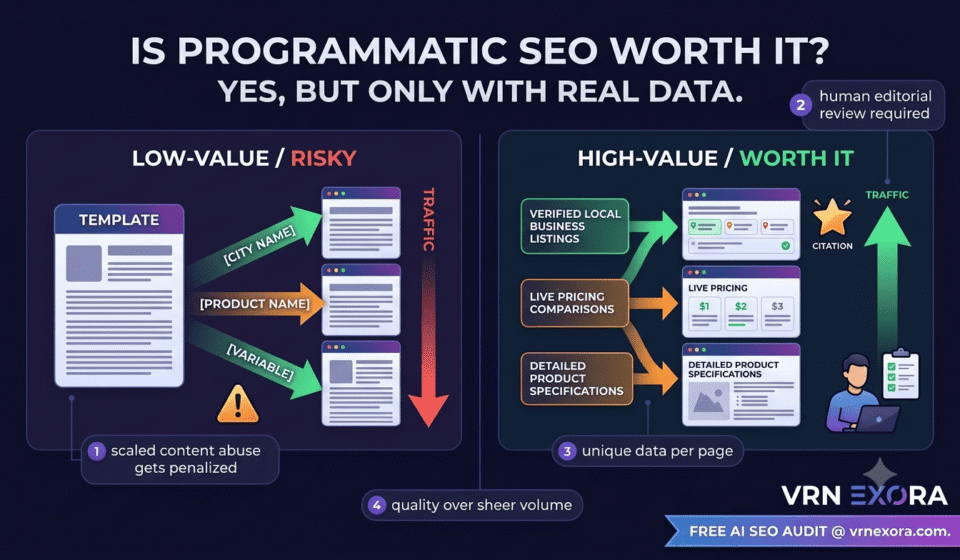

Yes, but only the disciplined version. Programmatic SEO, generating many pages from structured data through a shared template, remains a genuinely powerful growth channel for a niche website in 2026, but the “publish ten thousand pages and see what sticks” version that worked a few years ago is not just declining, it has become actively dangerous.
This guide is for niche site owners and marketers deciding whether programmatic SEO is still worth building, after a real, well-documented reckoning reshaped the discipline earlier in 2026. You will learn exactly what changed, how to tell legitimate programmatic SEO from the pattern Google now actively penalizes, and how a niche site can use this approach safely.
The Short Answer
Programmatic SEO is not dead, but the low-value version of it very much is. Google’s scaled content abuse policy, first introduced in 2024 and enforced far more aggressively through a major core update in March 2026, specifically targets pages generated primarily to manipulate rankings with only slight variation between them. Sites running that pattern lost fifty to ninety percent of their organic traffic within roughly two weeks of the update, while sites built on genuinely unique, structured data per page, real business directories, live pricing comparisons, actual inventory data, kept ranking and in many cases began earning AI citations as well.
What Changed: The March 2026 Reckoning
Before 2026, the classic programmatic SEO playbook was simple and, for a while, genuinely effective: feed a database into a template, publish thousands of pages at once, and watch rankings climb while Google’s classifiers struggled to keep pace with the volume. The March 2026 core update closed that gap decisively. Google’s scaled content abuse policy is not new, it has applied since 2024, but the update’s enforcement was sharper and more comprehensive than anything that came before it, and sites that had built their entire growth model around swapping a city name or product name into an otherwise identical page lost their foundation almost overnight, not just a portion of their traffic.
Scaled Content Abuse vs Legitimate Programmatic SEO
The critical distinction the update reinforced is not about automation itself, it is about whether each individual page adds genuine, distinct value. Google’s own policy defines scaled content abuse as generating many pages where the content is only slightly different, primarily to manipulate search rankings rather than genuinely help users, and this definition applies identically whether the pages were generated by AI, a template, or written by hand.
Legitimate programmatic SEO, the kind that survived and in some cases thrived through the update, is built on pages with real data differentiation: verified local business listings, comparison tools reflecting live pricing, or travel guides built on genuine, current inventory data. The threshold that separates the two is whether each page answers a distinct question that no other page on the same site already answers.
What Still Works: The Data Differentiation Test
The programmatic page types still performing well in 2026 share a consistent throughline: defensible, hard-to-replicate data. Salary and compensation pages built on genuine survey data, pricing comparison pages reflecting live, current figures, location-specific statistics pages built on real regional data, and detailed product specification pages all continue to rank well, because the underlying dataset genuinely differs from page to page, even though the layout is shared. A templated structure is entirely fine, and remains one of programmatic SEO’s real strengths, when each instance built from that template is meaningfully different because the data behind it is meaningfully different, not because a city name was swapped into an otherwise identical paragraph.
A Simple Test: Would This Page Exist Without the Template?
A practical diagnostic borrowed directly from how practitioners now evaluate their own programmatic pages: if a user lands on this specific page from a search engine, will they genuinely find what they were looking for on this page, or would they be equally well served by any other page in the same template? If the honest answer is that most pages in the batch are functionally interchangeable, differing only in a swapped variable with no real per-page substance, that pattern is precisely what Google’s classifiers are now specifically trained to identify and suppress.
Why Weak Pages Now Drag Down the Whole Domain
One of the more consequential shifts since the update is how weak pages within a programmatic inventory now affect the rest of the domain. Before March 2026, a site with tens of thousands of programmatic pages could still benefit from the sheer aggregate crawl activity and internal linking density those pages generated, even if many individual pages were weak. After the update, the quality signal from the weakest pages in a large inventory drags down domain-level authority rather than simply being discounted or ignored on its own. This means a niche site can no longer treat a large batch of low-effort programmatic pages as a harmless volume play, since those weak pages now carry a genuine cost to the site’s stronger, more valuable content as well.
How to Do Programmatic SEO Safely in 2026
The workflow that has emerged among sites surviving and growing through this shift follows a consistent pattern: structured data extraction from a genuinely reliable, ideally proprietary or uniquely aggregated source, AI-assisted draft generation from that data, a real human editorial review step, a quality check specifically confirming each page adds distinct value, and only then publishing, followed by active monitoring of indexation and AI visibility rather than assuming success once a page goes live.
Skipping the human review step is consistently identified as the shortest path back into a scaled content abuse problem, regardless of how good the underlying data or template might otherwise be.
Start any new programmatic effort with a genuinely small batch, commonly somewhere in the range of a hundred to five hundred pages, and measure indexation rate, impressions, click-through rate, and any duplication issues before scaling further. Scaling a flawed pattern before validating it at small scale is consistently identified as the single most expensive mistake teams make with programmatic SEO in the current environment.
Is It Worth It for a Niche Site Specifically?
For a niche site, programmatic SEO remains genuinely valuable precisely because niche sites are more likely to have access to the kind of specific, defensible data that survives this new standard, real local listings, genuine community-specific statistics, or detailed product or service data within a narrow category that a larger, more generalized competitor has not bothered to aggregate.
The opportunity has not shrunk, it has become more selective, rewarding niche sites willing to do the real work of collecting or structuring genuinely unique data over sites simply reformatting information that already exists elsewhere on the web.
Frequently Asked Questions
Is programmatic SEO still viable after the March 2026 update?
Yes, for pages built on genuinely unique, structured data. The update specifically targeted scaled content abuse, meaning thin, near-duplicate pages with only slight variation, not programmatic SEO as a discipline. Sites with real data differentiation per page continued to rank and in some cases grew.
How much traffic did low-value programmatic sites actually lose?
Sites running the classic thin, template-swap pattern reportedly lost fifty to ninety percent of their organic traffic within roughly two weeks of the March 2026 core update, a loss severe enough in many cases to eliminate the site’s entire growth model.
Can I still use AI to help build programmatic pages?
Yes, but with a required human review step. Using AI for research, structuring, drafting, and formatting is fine, but Google’s guidance specifically warns against using generative AI to produce many pages without added value, and skipping human editorial review is the most common path back into a scaled content abuse penalty.
What is the simplest way to test whether a programmatic page is at risk?
Ask honestly whether a user landing on that specific page from search would find what they need there, or whether the page is functionally interchangeable with every other page built from the same template. If most pages in a batch only differ by a swapped variable with no real added substance, that pattern is a direct match for what Google’s classifiers now specifically target.
Can a few weak programmatic pages hurt an otherwise strong site?
Yes, in the current environment. Since the March 2026 update, the quality signal from a batch of weak pages drags down domain-level authority rather than being isolated or ignored on its own, which means low-effort programmatic pages now carry a real cost to a site’s stronger content as well.
How should a niche site start a new programmatic SEO project safely?
Start with a small validation batch, commonly a hundred to five hundred pages, and measure indexation, impressions, click-through rate, and duplication issues before scaling further. Scaling an unvalidated approach before confirming it performs well is the most expensive and common mistake teams make.
Get a Free Expert Review of Your Content Strategy
Knowing whether your programmatic pages carry real, defensible value takes an honest outside look. If you want a faster starting point, get a free SEO audit from VRN Exora and see exactly where your content stands against the current standard.

