
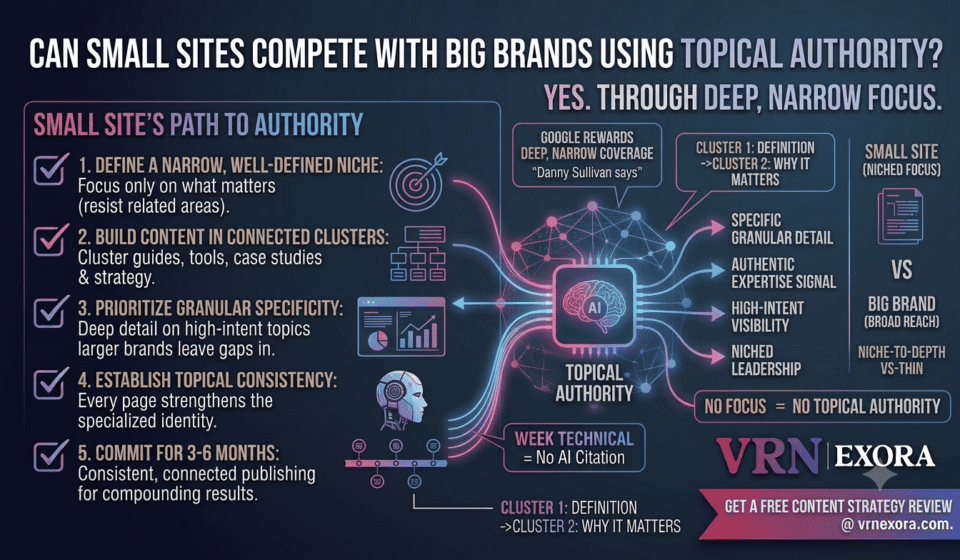

Yes, genuinely and consistently. A focused site with real topical depth in a narrow subject regularly outranks a much larger, higher-authority brand that only covers that same subject broadly. This guide is for small business owners, independent publishers, and marketers competing against much larger, better-funded competitors who want an honest answer to whether topical authority is a real strategic advantage or just an encouraging idea that does not hold up in practice. You will learn why big brands are structurally vulnerable to a focused competitor, how Google’s own systems reward this kind of depth, and a practical starting strategy for building it.
The Short Answer
A small, focused site consistently beats a much larger site on a specific, narrow subject, because the large site’s very size becomes a liability once you look at any single topic in isolation. A website covering only email marketing in genuine depth, guides, tools, strategy, common mistakes, and case studies, builds real topical authority in that narrow space. A larger site covering email marketing alongside a dozen unrelated subjects spreads itself thin, and even if both sites publish an article targeting the identical keyword, the narrowly focused site usually wins, because Google can clearly identify what it actually specializes in.
Why Big Brands Are Actually Vulnerable Here
Large, established brands typically go broad rather than deep, covering many subjects across a wide site footprint, which leaves real gaps at the level of granular, specific detail that a genuine expert would cover. A generic page on “accounting software” published by a large, well-funded competitor is genuinely vulnerable to a smaller, focused competitor building deep, specific coverage of “accounting software for the property industry,” a subject the larger brand has little incentive to cover with the same level of granularity. This specificity gap is the actual mechanism behind small-site wins, not some loophole or trick, it reflects a genuine difference in how thoroughly each site actually understands and serves that narrower audience.
The Mechanism: Why Google Rewards Focus Over Reach
Google’s own internal ranking signals, revealed through recent legal disclosures, reportedly include measures assessing how topically focused and consistent a site actually is, which confirms this is not simply a theory practitioners have developed independently, it reflects something Google’s systems are genuinely evaluating. A site that publishes consistently within a defined subject area strengthens its topical identity with every relevant new page, while publishing outside that core area is not neutral, it actively dilutes the authority signal the site has built. This is precisely why random, unfocused blogging has stopped producing reliable results, and why a narrowly scoped content strategy increasingly outperforms broad, scattered publishing even at a smaller total volume.
What “Going Narrow and Deep” Looks Like in Practice
The practical version of this strategy means deliberately choosing a specific, well-defined niche rather than attempting to compete broadly across an entire industry from the start. Rather than targeting a broad, expensive, highly competitive term, a focused site targets the more specific version of that term where deeper coverage is genuinely possible and larger competitors have left real gaps. This lower-competition entry point produces faster rankings and, frequently, considerably higher conversion rates, since visitors arriving through a highly specific search tend to have more precisely matched intent than visitors arriving through a broad, generic term.
Real Examples of Small Sites Winning This Way
The pattern shows up repeatedly in documented case studies. One ecommerce case study built genuine topical authority around meal planning, nutrition guidance, and dietary topics surrounding a meal delivery product line, reportedly achieving an extraordinarily strong return on investment through that focused approach rather than competing broadly against much larger food and nutrition publishers. A separate case tracked a site moving from a single page to over a thousand ranking keywords within roughly a year and a half through systematic, consistent topical authority building rather than a sudden content burst. These are not isolated flukes, they reflect the same underlying mechanism: sustained, connected coverage of a defined subject compounding over time into real, defensible visibility.
How Much Content It Actually Takes
There is no fixed magic number, since the right amount depends heavily on how comprehensively the specific subject needs to be covered and how established the competition already is. What the evidence consistently shows is that quality and genuine interconnection between pages matters considerably more than raw volume, ten thoroughly researched, deeply linked guides will typically build more real authority than fifty thin, disconnected pages published quickly.
Most practitioners recommend starting with comprehensive coverage of a core topic’s primary subtopics, commonly somewhere in the range of fifteen to twenty foundational pieces, before systematically expanding based on genuine keyword opportunity and competitive gaps rather than an arbitrary publishing schedule.
Where Big Brands Still Win
This advantage is real, but it is not unlimited. Large, established brands generally retain a real advantage on broad, high-competition, high-volume terms where sheer resources, existing backlink profiles, and brand recognition matter more than granular topical specificity. A small site’s realistic path is not to challenge a major competitor head-on for its broadest, most valuable terms, it is to claim the specific, underserved territory within that subject where a large competitor’s breadth becomes a genuine weakness rather than a strength.
A Practical Starting Strategy for a Small Site
Choose a genuinely narrow, well-defined niche rather than attempting to compete broadly from day one, and resist the temptation to publish outside that core area even when a tempting, unrelated topic seems likely to drive quick traffic, since doing so dilutes rather than builds the authority you are trying to establish.
Build content in clearly connected clusters with deliberate internal linking rather than as a series of disconnected, standalone posts, and prioritize original research, first-hand experience, and genuinely specific detail that a broader competitor’s more generic coverage of the same subject simply does not include. Expect this to be a genuine multi-month investment rather than a quick fix, with most practitioners reporting measurable, compounding results somewhere in the range of three to six months of consistent, connected publishing.
Frequently Asked Questions
Can a small site really outrank a major brand for the same keyword?
Yes, particularly for specific, narrower keywords within a subject the small site covers deeply. Google’s ranking systems reward focused, comprehensive topical coverage, which a large brand covering many unrelated subjects broadly often cannot match at the same level of granular depth.
How many articles does a small site need before it can genuinely compete?
There is no fixed number, but many practitioners recommend starting with roughly fifteen to twenty comprehensive, well-connected pieces covering a core topic’s primary subtopics, prioritizing quality and interconnection over raw volume.
Does publishing outside my niche ever help build broader authority?
Generally not, and it can actively hurt the topical authority already built within a defined niche. Publishing consistently within a focused subject area strengthens the site’s topical identity, while unrelated content dilutes the clarity of what the site actually specializes in.How long does it take a small site to see results from a topical authority strategy?
Most practitioners report meaningful, measurable progress somewhere in the range of three to six months of consistent, connected publishing, though results depend heavily on niche competitiveness and how comprehensive the existing coverage already is.
Are there subjects where a small site cannot realistically compete with a big brand?
Yes. Broad, high-competition, high-volume terms typically still favor large, established brands with substantial existing authority and resources. A small site’s more realistic path is claiming the specific, underserved territory within a subject rather than competing head-on for the broadest terms.
Does this strategy work for local and service-based small businesses too?
Yes. A focused topic ecosystem built around a specific service or specialty, paired with dedicated, in-depth content for each niche served, allows a local business to demonstrate deep expertise that a larger, more generalized national competitor typically cannot replicate at the same regional, specific level.
Get a Free Expert Review of Your Content Strategy
Knowing exactly where your niche has real opportunity takes a genuine look at the competitive gaps. If you want a faster starting point, get a free SEO audit from VRN Exora and see where your site could realistically build topical authority against larger competitors.

