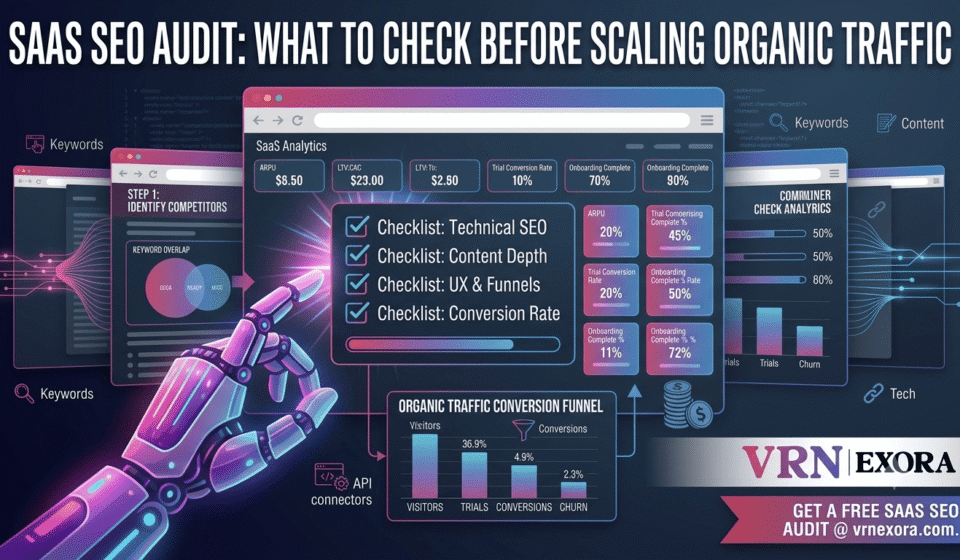

Before you scale Saas organic traffic, you need to check 12 things: technical SEO health, keyword and funnel alignment, on-page SEO, content strategy, backlinks and off-page authority, conversion rate, international targeting, reviews and social proof, YouTube and video presence, AI search readiness, community presence, and measurement.
If you skip any of these steps, scaling is just adding more traffic to a funnel that isn’t working well.
Many SaaS teams make the same mistake. They start writing more content or buying more links before checking if their existing setup can actually support growth. That’s like adding more water to a bucket with a hole in it.
Let’s go through what to check before scaling organic traffic step-by-step first.
1. Check Your Technical SEO Foundation First
If search engines and AI crawlers can’t properly crawl and index your site, nothing else matters. This is the base layer of every SaaS SEO audit, and skipping it is the most common reason organic growth stalls.
Here’s what to look at:
- Confirm your XML sitemap is submitted and error-free in Google Search Console
- Check robots.txt for accidental blocks on important pages, and make sure AI crawlers aren’t blocked either
- Find orphan pages, meaning pages with no internal links pointing to them
- Fix broken links, redirect loops, and outdated 404 pages on high-value URLs
- Review Core Web Vitals: page speed, load stability, and how fast the page responds to interaction
- Check whether your important content loads properly with JavaScript disabled, since some crawlers can’t process JS-heavy pages
A quick technical fix can sometimes do more for your rankings than five new blog posts. That’s why this step always comes first in a proper SaaS SEO audit.
2. Check If Your Content Matches the Buyer Journey
SaaS buyers don’t convert on the first visit. They move through stages, from learning about a problem to comparing options to picking a product. Your content needs to match each of these stages, or you’ll get traffic that never converts.
|
Funnel Stage |
What the Buyer Is Doing |
Example Keywords |
|
Top of funnel |
Learning about a problem |
“how to reduce customer churn” |
|
Middle of funnel |
Comparing options |
“[category] tools for small teams” |
|
Bottom of funnel |
Ready to decide |
“[product] pricing”, “[product] vs [competitor]” |
If most of your content sits at the top of the funnel and almost none at the bottom, you’re likely getting traffic that never turns into demo requests or signups.
Before scaling, map out how many pages you have at each stage and where the gaps are.
3. Check Your On-Page SEO Basics
On-page SEO is where your keyword strategy actually shows up on the page. SaaS websites often leave this part half-done, especially on product and feature pages that they create quickly and never revisit.
Run through this list for your most important pages:
- One clear H1 per page, with your primary keyword included
- Unique title tags and meta descriptions for every page, no duplicates
- Headings that follow a logical order and answer real user questions
- Short paragraphs, ideally two to three sentences each
- A direct answer near the top of each section, not buried at the bottom
- Internal links connecting related pages, guiding readers toward your pricing or demo pages
This last point matters more than people think. A blog post that never links to a relevant product or feature page is a missed opportunity sitting right there on your own site.
4. Check Whether Your Content Is Actually Good Enough to Rank
Volume alone doesn’t move rankings anymore. A stack of thin, generic blog posts can actually hurt more than help, especially with how selective both search engines and AI answer engines have become about what they surface.
Ask these questions about your existing content:
- Does it include real data, examples, or first-hand experience, not just general statements?
- Is it genuinely updated, or just republished with a new date?
- Does each page fully answer the question it’s targeting, without forcing the reader to look elsewhere?
- Are your best-performing topics backed by supporting pages that build real depth around the subject?
If most of your content reads like it could belong to any competitor’s website, that’s a sign it needs a rework before you invest in producing more of it.
5. Check Your Backlinks and Brand Mentions
Links and mentions are still one of the strongest trust signals for both search engines and AI tools. If your site has almost no backlinks or brand mentions outside your own domain, scaling content alone won’t be enough to build authority.
What to check:
- How many quality backlinks point to your key pages, and where do they come from
- Whether competitors have significantly more backlinks or brand mentions than you
- If your brand shows up on review platforms like G2 or Capterra, since AI tools often pull recommendations from these
- Whether you have any broken or toxic backlinks that need disavowing
Brand mentions matter even without a link attached. AI systems increasingly notice how often a brand gets talked about, not just how many links point back to it.
6. Check If Your Site Is Ready for AI Search
Search behavior has genuinely changed. People now ask ChatGPT, Perplexity, and Google’s AI Overviews directly, instead of typing a query and scrolling through results. If your site isn’t set up for these changes, you’re invisible in a growing share of searches, no matter how well you rank traditionally.
Here’s what to verify:
- AI crawlers like GPTBot and Google-Extended aren’t accidentally blocked in your robots.txt
- Key pages lead with a direct, clear answer near the top, not several paragraphs of setup first
- FAQ sections exist on important pages, since these are easy for AI tools to pull and cite
- Structured data, like FAQ schema and Organization schema, is implemented correctly
- Your content is factual and specific enough to be quoted confidently by an AI system
Getting this right isn’t optional anymore for SaaS companies that want visibility beyond the traditional search results page. This is one of the areas where a proper technical review pays off fast.
VRN Exora checks robots.txt for blocked AI crawlers, reviews FAQ and Organization schema, and audits whether key pages lead with a direct answer, as part of every SEO audit it runs for SaaS websites.
7. Check Your Conversion Setup, Not Just Traffic
Scaling traffic without checking conversion paths is one of the most expensive mistakes a SaaS team can make. More visitors to a page that doesn’t guide them anywhere just means more people leaving without taking action.
Quick things to check:
- Every important page has a clear call to action above the fold
- Your pricing page is public and easy to find, since hidden pricing hurts both trust and SEO value
- Blog posts include contextual links to relevant product or feature pages, not just a generic link at the very end
- Forms are short and simple, asking only for what you truly need
Traffic is a vanity metric on its own. What actually matters for a SaaS business is how many of those visitors turn into trial signups, demo requests, or paying customers.
8. Check What You’re Actually Measuring
Many SaaS teams monitor traffic and keyword rankings closely but never connect that data back to the pipeline or revenue. Before you scale, ensure you’re measuring the right metrics that truly reflect business impact.
Track these alongside your usual SEO metrics:
- Organic-to-demo or organic-to-signup conversion rate
- Which content pieces are actually influencing the pipeline, not just driving pageviews
- Whether your brand is appearing in AI-generated answers for relevant queries
- Core Web Vitals and crawl health on a regular, ongoing basis
If you can’t answer “which pages actually contributed to a closed deal,” it’s genuinely hard to know what’s working, and even harder to know what to scale.
9. Check Your Reviews and Social Proof
AI tools frequently pull recommendations from review platforms when someone asks for the best software in a category. If your presence there is thin, you’re losing visibility in exactly the moments buyers are deciding.
What to check:
- How many recent, genuine reviews do you have on platforms like G2 and Capterra
- Whether your review profiles are fully filled out, not just claimed and abandoned
- Whether case studies and testimonials on your own site include specific, real numbers
- Whether trust badges like SOC 2 or GDPR compliance are visible where they’re relevant
A handful of detailed, recent reviews does more for both buyer trust and AI visibility than a large pile of old, generic ones.
10. Check Your YouTube and Video Presence
Video content, especially on YouTube, gets pulled into AI answers far more often than most SaaS teams realize. If you have no video presence at all, you’re skipping a channel that’s increasingly feeding AI search results.
What to check:
- Whether you have product demos, tutorials, or explainer videos published anywhere
- Whether video titles and descriptions are written with real keywords in mind
- Whether transcripts are available publicly, since AI tools can parse these for citations
- Whether videos are linked back to relevant blog posts or product pages
Even a small library of well-titled, transcript-included videos can meaningfully add to your visibility across both YouTube search and AI answer engines.
11. Check If You Need International SEO
If you’re only selling in one country, this section matters less. But if you’re expanding into new regions, this is an easy area to get wrong.
Things to verify:
- Hreflang tags are set up correctly if you have multi-region or multi-language pages
- Regional content is genuinely localized, not just translated word for word
- Currency, compliance references, and examples match the region you’re targeting
- Each region has its own clear URL structure, like subdirectories per country or language
Skipping this step often leads to duplicate content issues across regions, or worse, showing the wrong currency and compliance details to buyers in a different country.
12. Check Your Presence in Communities Where AI Models Learn
AI models don’t just learn about brands from company websites. They pick up signals from Reddit threads, LinkedIn posts, Quora answers, and similar spaces where real conversations happen.
What to check:
- Whether your brand or team members are active in relevant subreddits or LinkedIn discussions
- Whether you’re answering real questions on Quora related to your category
- Whether developer-focused content exists on platforms like GitHub or Dev.to, if relevant to your product
- Whether you’re building integrations or partnerships that get you mentioned on other platforms
One of the more overlooked areas in a SaaS SEO audit, mostly because it doesn’t seem like traditional SEO. But it’s the kind of signal that artificial intelligence systems are paying more and more attention to.
Full SaaS SEO Audit Checklist
Here’s the complete summary, all 12 areas in one place, to use as a quick reference before you plan your next quarter of SEO work.
|
Area to Check |
What You’re Looking For |
|
Technical SEO |
Crawlability, indexing, site speed, broken links |
|
Keyword & funnel alignment |
Content covering top, middle, and bottom of funnel |
|
On-page SEO |
Titles, headings, meta descriptions, internal links |
|
Content strategy |
Topical depth, freshness, real data, first-hand insight |
|
Backlinks & off-page authority |
Link quality, brand mentions, earned coverage |
|
Conversion rate optimization |
CTAs, pricing visibility, contextual linking |
|
International SEO |
Hreflang, localization, region-specific structure |
|
Reviews & social proof |
G2 and Capterra presence, testimonials, trust badges |
|
YouTube & video SEO |
Demos, tutorials, transcripts, video linking |
|
AI search readiness |
Crawler access, direct answers, structured data |
|
Community & ecosystem |
Presence on Reddit, LinkedIn, Quora, GitHub |
|
Measurement & analytics |
Pipeline attribution, not just traffic numbers |
The Bottom Line
Scaling organic traffic works best when it’s built on a foundation that’s already solid. Technical health, funnel-aligned content, real backlink authority, and AI search readiness all need to be in place first, or the extra traffic you’re chasing won’t turn into real pipeline.
If you’re not sure where your own site currently stands, it’s worth getting an outside audit before investing further.
VRN Exora’s free SEO audit covers these checkpoints, so you know exactly what to fix before you scale, rather than discovering issues after the budget’s already spent.
Frequently Asked Questions
What should I check before scaling SaaS organic traffic?
Check technical SEO health, keyword and funnel alignment, on-page SEO, content depth, backlinks, conversion setup, international targeting, reviews, video presence, AI search readiness, community presence, and measurement. Scaling before fixing these areas usually wastes budget instead of growing the pipeline.
How is a SaaS SEO audit different from a regular SEO audit?
A SaaS SEO audit covers a wider set of areas than a typical audit, including funnel-stage content mapping, review platform presence, AI search readiness, and pipeline attribution, since SaaS buying cycles are longer and involve more research before a decision.
How often should a SaaS company run an SEO audit?
Most SaaS companies benefit from a full audit every quarter, with lighter technical checks done monthly. Search behavior and AI crawling patterns are changing quickly, so a yearly audit alone tends to leave gaps unnoticed for too long.
Does AI search readiness really matter for SaaS SEO?
Yes. A growing number of buyers now research software directly through tools like ChatGPT and Perplexity instead of typing into Google. If your site blocks AI crawlers or doesn’t structure its content clearly, your brand simply won’t show up in those answers, regardless of how well you rank traditionally.
What’s the biggest mistake SaaS companies make before scaling SEO?
The most common mistake is producing more content without fixing the technical or conversion issues underneath it. More traffic to a broken funnel doesn’t create more pipeline; it just creates more visitors who leave without converting.