
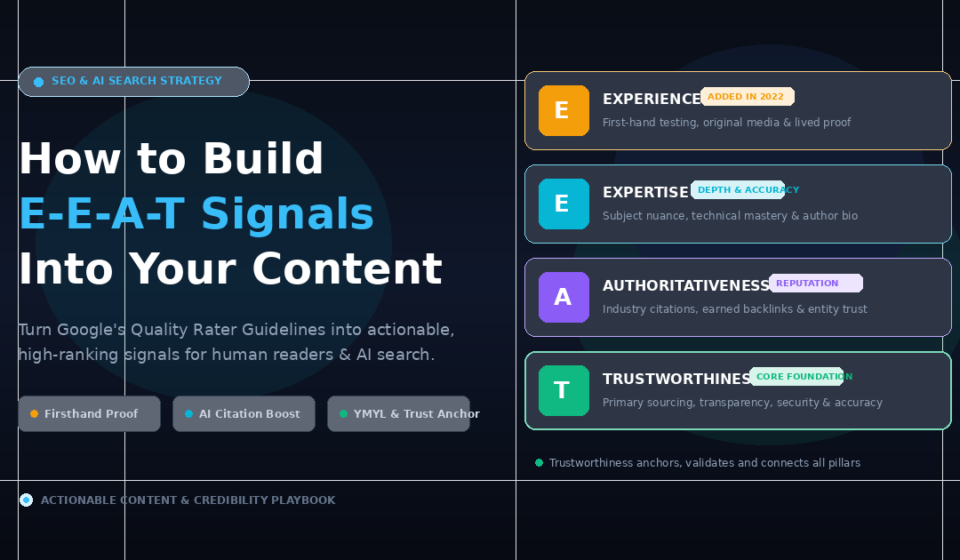

E-E-A-T stands for Experience, Expertise, Authoritativeness, and Trustworthiness, the framework Google’s human quality raters use to evaluate whether content is genuinely helpful and credible or simply well-optimized filler. This guide is for content teams, SEO managers, and site owners who have heard the term constantly but want a concrete, actionable answer for how to actually build each pillar into their content and site, not just add an author bio and call it done. You will learn what each component genuinely means, how to demonstrate it in practice, and how E-E-A-T now shapes AI search citation alongside traditional rankings.
What E-E-A-T Actually Is, and Isn’t
E-E-A-T is not a direct algorithmic ranking factor, and Google does not calculate a single numeric “E-E-A-T score” for any page. It is a quality evaluation framework, defined in Google’s Search Quality Rater Guidelines, that human raters use to assess content quality, and the underlying signals it describes, author credentials, backlinks from authoritative sites, accurate information, positive reputation, genuinely do feed into Google’s actual ranking algorithms even though E-E-A-T itself is a rating framework rather than a formula. Think of E-E-A-T as a description of what high-quality, trustworthy content actually looks like, not a checklist item you can complete once and forget.
Why Experience Was Added in 2022 and Matters More Now
The original framework, E-A-T, covered only Expertise, Authoritativeness, and Trustworthiness, and Google added the second “E” for Experience in December 2022 specifically to distinguish content written by someone with genuine, first-hand knowledge from content that merely synthesizes existing information competently. This addition has become considerably more consequential as AI-generated content has proliferated across the web, since a mechanically produced article can summarize a topic with real precision but cannot testify to having actually used a product, visited a location, or navigated a real situation. Experience is the pillar that most directly separates authentic content from generic AI output, which is exactly why it has become more heavily weighted as that distinction has grown more important.
How to Demonstrate Experience
Experience asks whether the author or site genuinely has firsthand involvement with the topic being discussed. Write experience as specific, first-person detail, describing what actually happened when you tested a product, applied a methodology, or navigated a real situation, rather than a generic summary that could have been written by anyone with access to the same public information. Original photos or videos, documented processes, real customer interactions, and specific, concrete examples all signal that content comes from lived involvement rather than research alone. This is genuinely the hardest pillar to fake convincingly, and it is also the one where a small amount of real, specific detail does more work than a large amount of generic polish.
How to Demonstrate Expertise
Expertise reflects deep, well-developed knowledge in a subject area, shown through content depth, nuance, and demonstrated competence rather than simply claiming credentials. Add a detailed author bio to every significant piece of content, linking that bio to an About page with real, verifiable credentials, and use accurate technical terminology that signals genuine familiarity with the subject rather than surface-level paraphrasing. Show expertise through depth and nuance in the writing itself, explaining concepts clearly, addressing edge cases and exceptions a genuine expert would know to mention, and citing authoritative sources to support specific claims, rather than relying on credential-claiming alone to carry the weight.
How to Build Authoritativeness
Authoritativeness is fundamentally about reputation within an industry, how recognized and trusted a person or brand is by others in the same field, not just by the content’s own claims about itself. Earn backlinks from other authoritative, topically relevant sites, build a genuine, recognizable author reputation across multiple pieces of published work rather than a single anonymous post, and accumulate real third-party validation such as reviews, citations, and mentions from other credible sources in the same space. Convey authority through clear, decisive writing rather than boasting, since confident, well-supported statements read as more authoritative than language that oversells a claim without backing it up.
How to Establish Trustworthiness
Trustworthiness ties the other three pillars together and is widely considered the most important of the four, since experience, expertise, and authoritativeness can all be genuinely present and still undermined if the surrounding site or content itself feels unreliable. A recognized expert publishing on a site with no privacy policy, no legal disclosures, or factually inaccurate information will still see its overall trust signal weakened, because trust evaluates the whole picture, not just the individual author’s credibility. Practically, this means citing primary sources and named studies rather than vague attribution like “studies show” or “experts agree,” being transparent about limitations or areas of genuine uncertainty rather than overstating confidence, maintaining HTTPS, a clear privacy policy, and accessible contact information, and linking out to other high-authority sources that support your own claims. Trust is also the pillar that genuinely cannot be faked, since it depends on sustained accuracy and transparency over time rather than a single well-written page.
Writing E-E-A-T Into the Actual Words, Not Just the Plumbing
Most E-E-A-T advice focuses heavily on site infrastructure, author bios, schema markup, backlink building, and treats this as the whole solution. That infrastructure matters, but E-E-A-T is also expressed directly in how content is written, not just in what surrounds it. A page can carry a perfectly formatted author bio and still read as generic, uncertain, or evasive if the actual prose hedges every claim, avoids specificity, or reads as though it could have been written about any topic with minor substitutions. Genuine E-E-A-T shows up in decisive, specific writing that commits to a clear point of view, backs it with real sourcing, and is honest about where the evidence is limited, rather than in the presence of a bio box alone.
E-E-A-T for YMYL Content
YMYL, or “your money or your life” content, covering health, financial, legal, and safety topics, receives meaningfully stricter E-E-A-T scrutiny than lower-stakes content, since inaccurate information in these categories carries genuine real-world consequences for the reader. Content in these areas needs more rigorous sourcing, more clearly credentialed authorship, and considerably more caution around any claim that could mislead a reader into a harmful decision. A generic wellness blog post can tolerate more looseness in sourcing than an article discussing medication dosages or investment strategy, and Google’s quality evaluation reflects that difference in risk directly.
E-E-A-T’s Role in AI Search Citation
AI search engines including ChatGPT, Perplexity, and Google’s own AI Overviews increasingly factor E-E-A-T-like quality signals into which sources they choose to cite, favoring content from identifiable, credible experts over anonymous or generic content. Person schema markup, named author attribution, and verified business entity data all support both traditional ranking and AI citation rates simultaneously, which means the same E-E-A-T work already being done for Google’s traditional quality raters also strengthens a brand’s odds of being cited directly inside a generated AI answer.
Realistic Timeline for Building E-E-A-T
Some E-E-A-T improvements show results within weeks, adding author bios, ensuring HTTPS, publishing a privacy policy, and providing clear contact information are all quick, mechanical fixes. Building genuine authority and expertise recognition is a considerably longer process, typically requiring somewhere in the range of three to twelve months of consistent effort, and for a genuinely new site building an E-E-A-T reputation from scratch, the full process can extend to six to eighteen months. This reflects the reality that authoritativeness and trust are earned incrementally through accumulated backlinks, author reputation, and genuine reviews, not established through a single content update.
Frequently Asked Questions
Is E-E-A-T a direct Google ranking factor?
No. E-E-A-T is a quality evaluation framework used by Google’s human quality raters, not a formula the ranking algorithm calculates directly. However, the underlying signals it describes, credentials, sourcing, accuracy, reputation, do feed into Google’s actual ranking systems.
What is the fastest E-E-A-T improvement I can make?
Adding detailed author bios with real credentials, ensuring HTTPS, publishing a clear privacy policy, and providing accessible contact information are all quick, mechanical fixes that can show results within weeks, though they represent only the foundational layer of a fuller E-E-A-T strategy.
Why was “Experience” added to E-A-T in 2022?
Google added Experience specifically to distinguish content written by someone with genuine, first-hand knowledge of a topic from content that merely synthesizes existing information well. This distinction has become more important as AI-generated content, which cannot testify to lived experience, has proliferated across the web.
Which E-E-A-T pillar matters most?
Trustworthiness is widely considered the most important, since it ties the other three pillars together. Genuine experience, expertise, and authoritativeness can all be present and still undermined if the surrounding content or site feels inaccurate, opaque, or unreliable.
Does E-E-A-T matter more for certain types of content?
Yes. YMYL content, covering health, financial, legal, and safety topics, receives stricter E-E-A-T scrutiny than lower-stakes content, since inaccurate information in these categories carries real consequences for the reader.
Does E-E-A-T affect whether AI systems cite my content?
Yes, increasingly. AI search engines including ChatGPT, Perplexity, and Google’s AI Overviews favor citing content from identifiable, credible experts, which means named authorship, verified credentials, and structured entity data support both traditional ranking and AI citation at once.
Get a Free Expert Review of Your Content
Knowing exactly where your content’s E-E-A-T signals are strong and where they fall short takes a genuine content audit. If you want a faster starting point, get a free SEO audit from VRN Exora and see where your credibility signals stand today.