
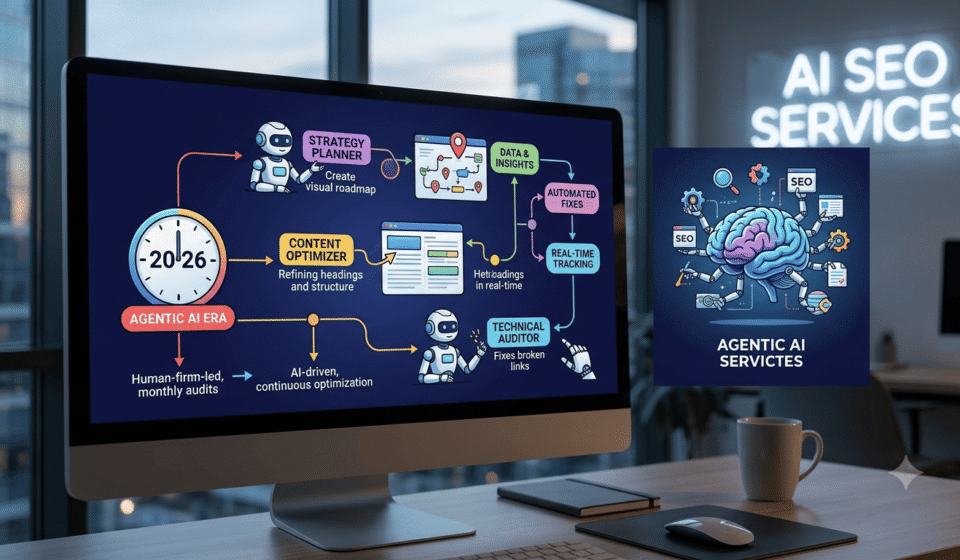

Search engine optimization has always meant writing for people and pleasing search engine algorithms. In 2026, a new player has entered the picture: agentic AI. These are AI systems that can act on their own, completing full tasks instead of just answering a single question, and they are quietly reshaping how websites get found, read, and chosen online.
What Agentic AI Actually Means
Most people have used a regular AI chatbot before. You type a question, and it gives you an answer. Agentic AI works differently. Instead of just answering, it can plan a series of steps, carry out those steps on its own, and adjust along the way, all with very little human input at each stage.
Picture the difference this way. A regular AI tool is like a helpful assistant who answers your question when asked. An agentic AI tool is more like a personal shopper who goes out, compares several stores, checks prices, reads reviews, and comes back with one final recommendation, without you needing to guide each step. This shift from simply answering to actually acting is the whole reason agentic AI is changing SEO so quickly this year.
In marketing specifically, this shows up in two forms. The first is agentic SEO tools, which are software systems that plan and carry out optimization tasks on your own website with little human oversight. The second, and arguably bigger shift, is agentic AI shopping and research agents, tools like ChatGPT’s agent mode or Perplexity’s browsing agent, which search the web, compare options, and sometimes even complete a purchase on a person’s behalf.
From Search Engines to Search Agents
For nearly three decades, ranking well meant showing up on the first page of Google for a human to click on. That goal has not disappeared, but it is no longer the whole story. A growing share of search activity now happens through AI agents that browse, compare, and decide, often without a human ever opening a browser tab.
Industry data backs up how fast this shift is happening. Research shows nearly a third of marketers have already noticed a drop in search traffic as more people turn to AI tools instead of traditional search, and the overwhelming majority say they are now working to optimize for both classic search results and AI-powered surfaces at the same time.
This matters because an AI agent shopping on someone’s behalf behaves very differently from a human visitor. A human might browse your homepage, look at a few photos, and read some reviews before deciding. An AI agent moves faster and more mechanically. It often pulls information from several sources at once, compares facts side by side, and picks a winner based on which page gave it the clearest, most trustworthy answer. It rarely lingers to admire your design or your branding. It simply wants clean, accurate, easy-to-extract information.
Meet the New Visitors: AI Crawlers and Agent Bots
Every website owner is used to Googlebot, the crawler that quietly visits pages to build Google’s search index. In 2026, an entire new family of bots has joined the traffic on most websites, and each one behaves a little differently.
Broadly, these bots fall into a few groups:
Training bots, such as GPTBot and Google-Extended, collect content to help build and improve AI models.
Search bots, such as OAI-SearchBot and PerplexityBot, fetch pages specifically to answer real user questions inside chat tools.
Agent bots, sometimes called retrieval or action bots, visit a page in real time while an AI assistant is actively helping someone complete a task, like comparing products or booking a service.
The scale of this new traffic is genuinely surprising. Recent data shows bots now account for more than half of all web requests, a milestone that marks the first time automated traffic has outpaced human browsing. Among AI bots specifically, one detailed 2026 traffic study found that agent-style visits made up the largest single share of all AI bot activity, ahead of both training and simple search crawling.
Why This Split Matters for Your Website
Not every bot deserves the same treatment, and understanding the difference has become an essential part of technical SEO in 2026.
- Training bots feed AI models but rarely send any traffic back to your site
- Search bots power citations inside AI answers, which can bring real visitors your way
- Agent bots complete live tasks for users and often decide, in real time, whether your business gets chosen
Blocking the wrong bot by mistake can quietly remove your website from AI search results altogether. As one detailed AI crawler analysis put it plainly, blocking a citation-relevant search bot can remove a website from an AI tool’s answers entirely, even while blocking a pure training bot has little downside at all.
How Agentic AI Is Reshaping SEO Work Itself
Beyond changing who visits a website, agentic AI is also changing how SEO work actually gets done behind the scenes. Traditional SEO tools have always given reports. A human then had to read that report, decide what mattered most, and manually make the fix. Agentic SEO tools skip several of those steps.
These newer tools can scan a website, spot a crawl issue, and in many cases apply a fix automatically, all without someone approving each individual change. Common tasks now being handled this way include rewriting weak meta descriptions, adjusting internal links between related pages, and flagging or even correcting broken links as soon as they appear.
A Simple Comparison of Old vs New SEO Work
|
Traditional SEO Approach |
Agentic SEO Approach |
|
Human runs a monthly site audit |
AI agent monitors the site continuously |
|
Human reads the report and decides fixes |
AI agent identifies and prioritizes issues itself |
|
Human manually edits pages one by one |
AI agent applies routine fixes automatically |
|
Updates happen in scheduled batches |
Updates happen in near real time |
This does not mean human SEO experts are becoming unnecessary. It means their role is shifting. Instead of spending hours on repetitive checks, skilled marketers are now focused on setting the right goals, reviewing what the AI agent decided, and handling the creative and strategic thinking that no automated system can fully replace on its own.
Writing Content That AI Agents Can Actually Trust
If AI agents are now reading, comparing, and choosing between websites on behalf of real people, then content needs to be written with those agents in mind, not just human readers. This does not mean throwing out good writing. It means being extra clear, structured, and factual.
AI agents tend to favor content that answers a question directly, states facts plainly, and avoids vague marketing language that sounds nice but says very little. A paragraph packed with buzzwords but no real numbers or specifics is far less useful to an agent trying to compare options quickly. Structured data, the behind-the-scenes labeling that tells a machine exactly what a piece of content means, has also become more important, since it helps agents extract facts accurately instead of guessing.
Practical Habits Worth Building Now
A few habits are becoming standard practice for websites that want to stay visible to AI agents:
- State prices, availability, and specifications clearly, rather than burying them in vague phrases
- Keep product and service pages updated in real time, since agents compare live data, not old snapshots
- Use clear headings and short, direct answers near the top of a page, so agents can extract information quickly
- Add proper structured data markup so machines can read page details accurately
Managing Bot Traffic Without Losing Visibility
With so many new bots visiting websites, managing that traffic has become its own small discipline within SEO. The robots.txt file, a simple text file that tells crawlers which parts of a site they may visit, has taken on a much bigger role in 2026 than it ever had before.
The tricky part is that robots.txt works on an honor system. Well-behaved bots follow its rules, but not every bot does. Some research suggests a large share of AI crawlers do not fully respect robots.txt instructions, which means website owners increasingly rely on server-level tools, not just a text file, for real protection against unwanted scraping.
A smarter approach many sites are now taking is separating bots by purpose rather than treating them all the same. Training bots that offer little direct benefit can be blocked without much cost. Search and agent bots that power real citations and referrals are usually worth allowing, since blocking them can remove a website from AI answers entirely. Getting this balance right requires regularly reviewing server logs to see exactly which bots are visiting and how often.
What This Means for Small and Local Businesses
It is easy to assume agentic AI only matters for huge global brands, but that is not accurate. Local businesses are affected just as much, sometimes even more, since many people now ask AI agents directly for local recommendations, such as a nearby plumber or a good local bakery, instead of typing a search query themselves.
For a small business, staying visible in this new landscape does not require a massive budget. It requires accuracy and consistency. Business hours, service details, pricing, and location information need to be correct and easy for an agent to find and confirm quickly. An AI agent comparing three local businesses on behalf of a user will likely favor the one with the clearest, most consistent information across its website and listings, simply because it is easier and faster to verify.
Looking Ahead: What to Watch in the Rest of 2026 and Beyond
The shift toward agentic AI in SEO is still unfolding, and a few developments are worth watching closely. More AI agents are expected to move from simply researching on a user’s behalf to actually completing transactions, meaning bookings, purchases, and sign-ups may increasingly happen without a human ever browsing a website directly.
At the same time, industry experts increasingly describe two related but distinct goals emerging side by side: traditional SEO, still focused on humans who browse and compare, and a newer discipline focused purely on helping AI agents find, trust, and use information without a human visitor ever showing up. Businesses that treat these as one and the same risk missing important, subtle differences in how each one actually works.
Conclusion
Agentic AI is not a small trend sitting on the sidelines of SEO in 2026. It is actively changing who visits websites, how those visitors behave, and how SEO work itself gets done day to day. Search engines are no longer the only audience that matters. AI agents, acting on behalf of real people, are now reading, comparing, and choosing between websites at a scale and speed no human team could match alone.
The businesses that adapt well will not be the ones that hand everything over to automation blindly. They will be the ones that combine smart AI tools with real human judgment, clear and accurate content, and a genuine understanding of how these new AI visitors actually behave. Staying curious, watching the data closely, and adjusting steadily will matter far more in this new era than chasing every single new trend the moment it appears.
Frequently Asked Questions
- What is the difference between agentic AI and a regular AI chatbot?
A regular AI chatbot answers a question when asked. Agentic AI can plan several steps, carry them out on its own, and adjust along the way, completing a full task like comparing products or fixing a website issue without constant human guidance.
- Should I block all AI bots from crawling my website?
No, blocking every AI bot can hurt your visibility. Training bots offer little direct benefit and can often be blocked safely, but search and agent bots power AI citations and referrals, so blocking them can remove your site from AI answers entirely.
- Do small businesses need to worry about agentic AI and SEO?
Yes, local businesses are affected too, since many people now ask AI agents for local recommendations directly. Keeping business details, hours, and pricing accurate and consistent helps AI agents find and trust a small business more easily.
- Will agentic AI replace human SEO experts completely?
No, agentic AI changes the role of SEO experts rather than replacing them. AI handles repetitive tasks like monitoring and routine fixes, while humans focus on strategy, creativity, and reviewing what the AI agent decided to do.
- What is the biggest content change needed for AI agents?
Content needs to be clear, factual, and well-structured, stating details like prices and specifications directly instead of using vague language. Structured data markup also helps AI agents extract accurate information quickly and reliably.