
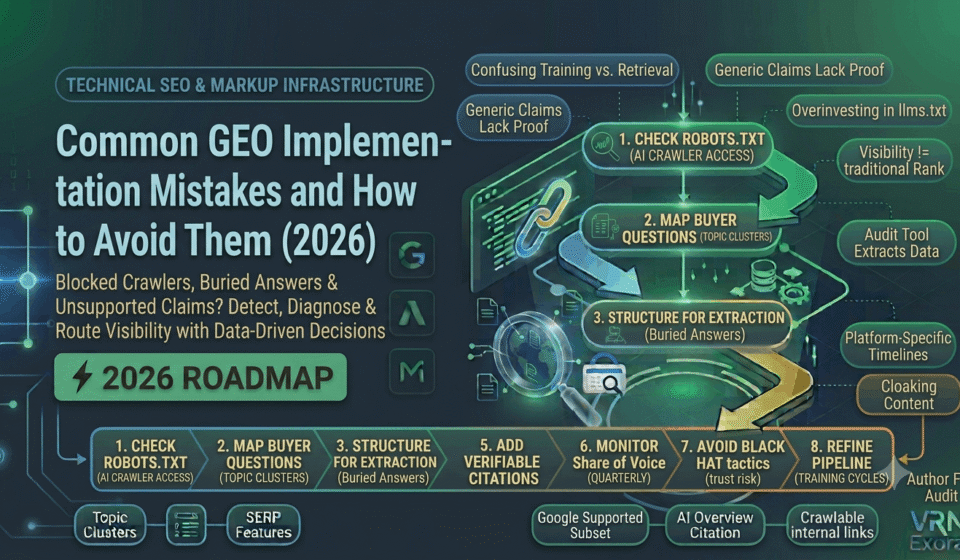

Generative engine optimization mistakes are harder to catch than traditional SEO mistakes because they rarely show up as a dramatic ranking drop. Instead, they quietly keep a brand invisible in ChatGPT, Perplexity, and Google AI Overviews for months while traditional search metrics look completely normal. This guide is for SEO managers, marketers, and site owners rolling out a GEO strategy who want to avoid the specific errors that keep undermining AI search visibility across otherwise well-run implementations. You will learn the technical, content, and strategic mistakes that show up most often, and exactly what to do instead.
Why GEO Mistakes Are Harder to Spot Than SEO Mistakes
A traditional SEO mistake usually announces itself through a ranking drop or a traffic dip that shows up clearly in Search Console. A GEO mistake tends to lurk in the background instead, since a brand can remain fully indexed and ranking well in traditional search while being entirely absent from AI-generated answers, and nothing in a standard analytics setup will flag that gap on its own.
This is compounded by a genuinely fragmented landscape. AI crawlers, robots.txt configurations, and content structure requirements have all evolved faster than most teams have updated their sites, which means many of the mistakes below are happening by default rather than by decision, often through settings nobody deliberately chose.
Mistake 1: Blocking AI Crawlers Without Realizing It
Blocking AI crawlers in robots.txt is widely considered the single biggest and most damaging GEO mistake, because if a crawler like GPTBot, ClaudeBot, or PerplexityBot cannot access your site, that platform cannot cite your content regardless of how well written or well structured it is. This is why large language model optimization should include making sure AI crawlers can access the content you want AI platforms to discover and reference.
The fix: Check yoursite.com/robots.txt directly and confirm whether GPTBot, PerplexityBot, ClaudeBot, and Google-Extended are actually allowed. This is typically a two-minute check, and correcting an accidental block is one of the fastest, highest-leverage fixes available in the entire GEO process.
Mistake 2: Confusing Training Crawlers With Retrieval Crawlers
Not all AI crawlers serve the same purpose, and treating them as interchangeable is a common and costly error. Training crawlers such as GPTBot and ClaudeBot collect data used to build model weights over time. Retrieval or search crawlers such as OAI-SearchBot, ChatGPT-User, and PerplexityBot fetch pages in real time specifically to answer a live user query with a citation. Blocking one type does not block the other, and mixing them up in robots.txt can eliminate your brand from real-time AI answers while you believe you are only opting out of model training.
The most common recommendation is a selective approach: block training crawlers if you want to limit how your content contributes to model weights, while explicitly allowing retrieval crawlers, since blocking those directly prevents your content from ever appearing in AI-generated answers with a citation attached.
The fix: Audit your robots.txt line by line against each specific AI crawler user agent rather than applying one blanket rule, and confirm retrieval crawlers like PerplexityBot and OAI-SearchBot remain explicitly allowed even if you choose to restrict training crawlers.
Mistake 3: Writing Content That Isn’t Structured for Extraction
Teams frequently produce genuinely high-quality content without considering how AI systems actually process and extract information from a page. The result reads well to a human but leaves AI systems struggling to locate a clear, specific answer, since the actual response to the query is buried several paragraphs deep behind introductory framing the model has to work through first.
The fix: Structure key content to answer the core question directly within the first hundred words or so, using clear H2 and H3 headings that map to the actual questions a reader or AI system would ask. Even a page that already ranks well in Google can be skipped by an AI system in favor of a lower-ranking competitor whose answer is simply easier to extract and cite cleanly.
Mistake 4: Skipping Statistics, Citations, and Verifiable Sources
Generic, unsupported claims give AI systems little reason to treat a page as a trustworthy source to cite. Research into what actually improves AI visibility has found that adding verifiable statistics and clear source citations each meaningfully improve how often a page gets cited in AI-generated answers, independent of the page’s traditional backlink profile.
The fix: Add specific, sourced statistics and clear citations to claims wherever genuinely relevant, rather than relying on vague, confident-sounding statements. This matters more than backlink volume for AI citation specifically, since a large share of pages cited by AI search engines carry relatively few traditional backlinks, which means strong content and clear sourcing can outperform authority signals that traditionally mattered most for Google rankings alone.
Mistake 5: Overinvesting in llms.txt
llms.txt, a proposed standard for giving AI systems a structured index of a site’s content, has seen real adoption interest, but large-scale testing has found no measurable correlation between having an llms.txt file and actual AI citation frequency. No major AI provider has confirmed their crawlers even read it, and Google has stated explicitly that no special AI text file is needed to appear in its own generative search features.
The fix: Treat llms.txt as a low-effort, low-priority addition if you choose to implement it at all, not a meaningful visibility lever on its own. Time spent perfecting an llms.txt file is generally better spent on the fixes that have demonstrated actual impact, particularly crawler access and content structure.
Mistake 6: Treating GEO as a One-Time Project
One of the most expensive GEO mistakes is treating it as a project with a defined end point rather than an ongoing system. AI models recrawl content and update their knowledge bases on their own schedules, and model updates can cause sudden, unexplained shifts in citation patterns that have nothing to do with anything you changed on your own site.
The fix: Build GEO into a recurring quarterly workflow rather than a single sprint: test your core buyer questions across AI engines, track which sources currently get cited, identify where your brand is missing, and update the relevant pages accordingly. Treating this as a compounding, ongoing practice rather than a lottery ticket sets realistic expectations for how results actually accumulate.
Mistake 7: Applying Traditional SEO Timelines to AI Search
Expecting GEO results on the same timeline as a traditional SEO campaign is a common source of premature disappointment. AI model training cycles and knowledge base updates operate on entirely different schedules than Google’s algorithm updates, and results genuinely vary by platform, with real-time search engines like Perplexity often reflecting changes within weeks, while other platforms relying more heavily on periodic training snapshots can take considerably longer.
The fix: Set platform-specific expectations rather than one blanket timeline. Technical fixes like correcting a robots.txt block can show measurable results within one to four weeks on a site with existing authority, while broader content and authority-building improvements more realistically take two to three months to meaningfully shift citation rates.
Mistake 8: Using Black Hat GEO Tactics
As GEO has matured, a set of manipulative tactics has emerged alongside it, and these carry real risk rather than shortcut value. Confirmed problematic tactics include cloaking content specifically for AI crawlers, meaning serving different content to GPTBot than real visitors see, fabricating author credentials or personas to simulate expertise that does not exist, and injecting structured data that does not match the actual visible content on the page.
The fix: Avoid all three entirely. These tactics tend to be discoverable, and the risk profile mirrors traditional black hat SEO, short-term visibility traded against long-term trust and potential penalties once detected. Genuine, verifiable expertise and accurate structured data remain the more durable path.
How to Build a GEO Implementation That Avoids These Mistakes
The biggest strategic mistake underlying most of the tactical ones above is treating GEO as a completely separate discipline from existing SEO, content, and brand workflows. GEO works best layered onto what already exists rather than rebuilt from scratch: the same content team, the same technical SEO foundation, and the same governance, extended to account for how AI systems specifically read, extract, and cite information.
Start with a focused pilot on your most important, highest-value topic areas rather than attempting to overhaul the entire site at once. Confirm crawler access first, since every other fix is wasted effort if the door is locked. Then move to content structure and sourcing, and finally build the quarterly monitoring habit that keeps the whole system responsive to how AI platforms continue to evolve.
Frequently Asked Questions
What is the single most damaging GEO mistake?
Accidentally blocking AI crawlers in robots.txt. If a retrieval crawler like PerplexityBot or ChatGPT-User cannot access your site, no amount of content quality or structure improvement matters, since the platform simply cannot reach the content to cite it.
Should I block all AI crawlers to protect my content?
Not if AI citation and visibility matter to your business. A selective approach, blocking training crawlers while explicitly allowing retrieval crawlers, is the most common recommendation, since it limits contribution to model training while still allowing your content to appear in real-time AI-generated answers.
Is llms.txt worth implementing?
Large-scale testing has found no measurable correlation between llms.txt and actual AI citation frequency, and no major AI provider has confirmed their crawlers read it. It is low-effort enough to add if you want to, but it should not be treated as a meaningful visibility lever.
How long does it take to see results from GEO changes?
It varies significantly by platform and change type. Technical fixes like unblocking a crawler can show results within one to four weeks on sites with existing authority, while broader content and authority improvements more realistically take two to three months.
Do backlinks matter as much for AI citation as they do for traditional rankings?
Less than many teams assume. A significant share of pages cited by AI search engines carry relatively few traditional backlinks, which suggests content clarity, verifiable statistics, and clear sourcing carry more weight for AI citation specifically than backlink volume alone.
What are examples of black hat GEO tactics to avoid?
Serving different content to AI crawlers than real visitors see, fabricating author credentials to simulate expertise, and injecting structured data that does not match the visible page content are all confirmed manipulative tactics that carry real detection and trust risk.
Get a Free Expert Review of Your AI Search Readiness
Catching accidental crawler blocks and structural gaps takes a systematic check most teams never run. If you want a faster starting point, get a free SEO audit from VRN Exora and see exactly where your GEO implementation stands today.