
How to Build Your Social Media Marketing Strategy: A Practical Step-by-Step Guide

Social media marketing can help a business become more visible, build relationships with customers, generate leads, and support sales. But simply creating profiles and publishing posts is not a strategy.
Without a clear plan, businesses often spend hours creating content without knowing who it is reaching, why people should care, or whether it is contributing to business growth.
A strong social media marketing strategy gives those activities a clear purpose. It connects your business goals with your target audience, chosen platforms, content, posting schedule, and performance metrics.
Whether you are a small business owner, marketer, freelancer, startup, ecommerce brand, professional, or established company, the basic process is similar: understand your audience, decide what you want to achieve, choose where to focus, create useful content, and continually improve based on evidence.
What Is a Social Media Marketing Strategy?
A social media marketing strategy is a structured plan that explains how a business will use social media to achieve specific marketing or business objectives.
It generally answers six questions:
- What do you want to achieve?
- Who do you want to reach?
- Which social media platforms should you use?
- What type of content should you publish?
- How will you engage with your audience?
- How will you measure success?
This is different from a social media content calendar.
A content calendar tells you what to publish and when. A strategy explains why you are publishing it, who it is for, what action you want people to take, and how you will determine whether it worked.
That distinction can prevent a common problem: confusing activity with progress.
A business can publish five times a week and still have no meaningful social media strategy.
Why Does Your Business Need a Social Media Strategy?
Social platforms are crowded. Your audience is exposed to a constant flow of videos, images, advertisements, recommendations, opinions, and brand messages.
Posting more does not automatically solve the problem.
A strategy helps you decide where your limited time and resources should go. It can help you:
- Build brand awareness
- Reach a specific audience
- Increase website traffic
- Generate leads
- Support product discovery
- Strengthen customer relationships
- Establish industry expertise
- Improve customer communication
- Support sales and conversions
It also gives your team a framework for making decisions.
Instead of asking, “What should we post today?” you can ask, “What does our audience need to know, and which content supports our current objective?”
That shift is one of the biggest differences between random posting and strategic social media marketing.
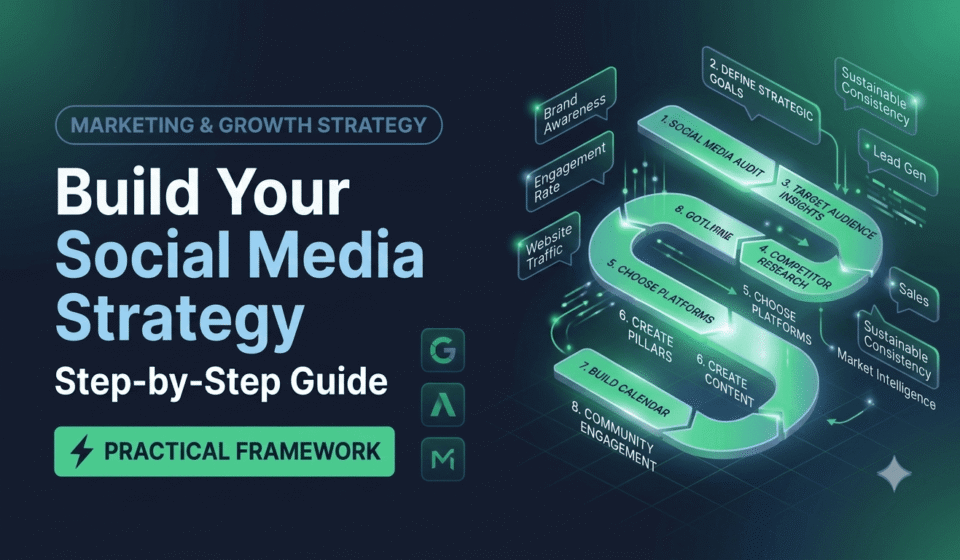
How to Build a Social Media Marketing Strategy
1. Start With a Social Media Audit
Before building something new, examine what you already have.
Review all of your existing social media accounts and record useful information such as:
- Platforms currently being used
- Follower numbers
- Posting frequency
- Engagement levels
- Best-performing content
- Lowest-performing content
- Website traffic from social media
- Leads or enquiries
- Audience demographics
- Existing campaigns
Do not look only at numbers.
Read comments and examine the actual content. Look for patterns.
Perhaps educational posts receive more saves than promotional posts. Maybe short videos attract new viewers while detailed posts generate more enquiries. You may also discover that one platform consistently produces better results despite having a smaller audience.
These observations provide a baseline for your new strategy.
Current social media strategy guidance also recommends auditing existing accounts before setting new goals because otherwise businesses risk building plans around assumptions rather than actual performance.
Ask These Questions During Your Audit
- Which platform produces the most useful results?
- Which topics receive meaningful engagement?
- Which posts generate website visits or enquiries?
- Are we reaching the right people?
- Are we publishing too much promotional content?
- Which accounts are no longer worth maintaining?
- What content should we create more often?
The goal is not to prove that everything you have done is working. The goal is to discover what the data and audience response are telling you.
2. Define Your Social Media Marketing Goals
A good strategy begins with a business objective, not a posting frequency.
For example, “increase Instagram followers” is an incomplete goal. Why do you want more followers?
If the real objective is generating customers, your social media goal might instead focus on qualified website traffic, enquiries, registrations, or sales.
Common objectives include:
Brand Awareness
If your business is relatively unknown, you may focus on increasing reach, impressions, brand mentions, or exposure to new audiences.
Engagement and Community
If relationships are the priority, you may track comments, shares, saves, direct messages, replies, or other meaningful interactions.
Website Traffic
If your website is central to your marketing funnel, social media can help bring relevant visitors to articles, product pages, landing pages, or resources.
Lead Generation
Professional services and B2B companies may use social media to generate consultations, enquiries, registrations, or downloads.
Sales
Ecommerce and product-based businesses may focus on conversions and revenue generated through social campaigns.
Use measurable goals wherever possible. Current strategy frameworks commonly recommend connecting social goals to broader business outcomes and assigning specific KPIs to them.
3. Understand Your Target Audience
You cannot create relevant social content if you do not understand the people you want to reach.
Start with basic information:
- Age
- Location
- Occupation
- Interests
- Industry
- Purchasing behavior
- Common challenges
Then go further.
What questions do they ask before buying? What prevents them from taking action? What information do they compare? What concerns do they have about your product or service?
This is where real customer information becomes valuable.
Review customer enquiries, sales conversations, reviews, website search data, comments, surveys, and support requests.
For example, suppose a home improvement company repeatedly receives questions about how long a particular installation takes. That question is not simply something customer service needs to answer. It is also a potential social media content topic.
You could create a post explaining the process, expected timeline, preparation requirements, and common delays.
One customer question can therefore become useful content for hundreds of potential customers.
4. Research Your Competitors
Competitor analysis should not be about copying.
Instead, look for patterns and gaps.
Examine:
- Which platforms competitors prioritize
- What subjects they discuss
- Which formats they use
- What posts receive strong engagement
- How often they promote products
- What questions appear in their comments
- Which customer concerns they rarely address
The gaps can be particularly useful.
Imagine that most competitors publish product announcements but very little educational content. You could differentiate your brand by explaining how to compare products, avoid common mistakes, understand pricing, or choose the right option for different situations.
Your competitor’s comment section can also reveal valuable content opportunities.
5. Choose the Right Social Media Platforms
One of the most common strategic mistakes is trying to maintain every social platform.
You do not have to be everywhere.
The right platform depends on your audience, industry, content strengths, available resources, and objectives.
- Instagram may suit businesses that depend heavily on visual content, product discovery, lifestyle content, or short-form video.
- LinkedIn can be valuable for B2B brands, professionals, recruiters, consultants, technology companies, and thought leadership.
- YouTube can work well when tutorials, demonstrations, education, or detailed explanations are important.
- Facebook can remain useful for community building, local businesses, broad consumer audiences, and customer communication.
- TikTok may suit brands that can produce engaging short-form content and connect naturally with its audience.
The important question is not “Which platform is biggest?”
Ask:
Where does my target audience spend attention, and can I consistently create content that fits that environment?
Doing two platforms well can be more effective than doing five poorly. Recent strategy guidance similarly emphasizes choosing fewer platforms strategically rather than spreading resources too thinly.
6. Create Clear Content Pillars
Once you know your audience and platforms, decide what you will talk about.
This is where content pillars become useful.
Content pillars are recurring subject categories that provide structure to your social media content.
For example, a professional services company might use:
- Educational advice
- Industry insights
- Client success stories
- Frequently asked questions
- Company expertise
- Service-related content
An ecommerce brand might use:
- Product education
- Demonstrations
- Customer reviews
- Styling or usage ideas
- Behind-the-scenes content
- Promotional campaigns
Three to five strong content pillars are often enough to create variety without making your strategy difficult to manage. Current social media planning guidance also commonly recommends using a small set of recurring content themes.
Do Not Make Every Post a Sales Pitch
A social account that constantly says “Buy now” can quickly become repetitive.
Instead, create content for different stages of the customer journey.
Some posts can introduce a problem.
Others can educate people about possible solutions.
Some can demonstrate expertise or provide proof.
Promotional posts can then encourage people who are ready to take action.
The result is a more balanced social media content strategy.
7. Create a Social Media Content Calendar
Your content calendar turns your strategy into an actual publishing plan.
A simple calendar might include:
|
Day |
Platform |
Topic |
Format |
Objective |
|
Monday |
|
Industry insight |
Text post |
Awareness |
|
Tuesday |
|
Product tip |
Reel |
Education |
|
Wednesday |
|
Customer question |
Image + caption |
Engagement |
|
Thursday |
|
Case study |
Carousel |
Trust |
|
Friday |
|
FAQ |
Short video |
Consideration |
Your schedule does not need to be identical every week.
The important thing is to create a realistic system.
If your team can comfortably produce three high-quality posts each week, do not commit to publishing three times a day simply because another brand does.
Consistency should be sustainable.
8. Adapt Content for Each Platform
Repurposing content can save time, but copying the exact same post across every platform can make your brand feel generic.
Instead, adapt one central idea to different environments.
For example, a blog post about choosing the right software could become:
- A LinkedIn educational post
- An Instagram carousel
- A short video explaining three key factors
- A YouTube tutorial
- A Facebook discussion
- A series of FAQ posts
The subject remains consistent, but the presentation changes.
This approach allows you to get more value from original research without forcing audiences on every platform to consume identical content.
9. Make Your Content Useful and Search-Friendly
People increasingly use social platforms to discover information, products, businesses, and recommendations.
That makes question-focused content particularly useful.
Consider creating posts around queries such as:
- What should I know before buying this?
- How does this process work?
- What does this service include?
- What mistakes should I avoid?
- Which option is right for my needs?
- How much does it typically cost?
- What is the difference between these two choices?
Answer the question directly before adding supporting information.
This approach is useful not only for social audiences but also for broader content visibility because clear, well-structured answers are easier for search systems and AI-powered search experiences to understand.
10. Combine Organic and Paid Social Media
Organic social media and paid advertising do not have to compete with each other.
They can perform different roles.
Organic content can help establish your brand voice, educate your audience, build community, and demonstrate expertise.
Paid campaigns can help you reach defined audiences and promote specific offers, products, resources, or lead-generation campaigns.
If your budget is limited, start small.
Do not put money behind every post. First identify content that demonstrates genuine audience interest, then test whether additional distribution produces useful results.
Paid promotion should have a clear objective and measurement system.
11. Focus on Community, Not Just Followers
Follower count is easy to display but difficult to interpret without context.
A smaller audience that trusts your brand and regularly interacts with it can be more valuable than a large audience with little interest in what you offer.
Community building involves:
- Responding to comments
- Answering questions
- Replying to direct messages
- Encouraging useful discussions
- Sharing customer experiences
- Recognizing loyal customers
- Asking for feedback
- Responding professionally to criticism
These interactions also provide market research.
A repeated question in your comments may indicate a knowledge gap. A recurring complaint may reveal a customer experience problem. A frequently requested feature may suggest a product opportunity.
Social media can therefore function as both a marketing channel and a source of customer intelligence.
12. Measure the Metrics That Matter
Your analytics should help you make better decisions.
The metrics you prioritize should depend on your goals.
For awareness, consider:
- Reach
- Impressions
- Audience growth
- Video views
- Brand mentions
For engagement, consider:
- Shares
- Saves
- Comments
- Replies
- Direct messages
- Engagement rate
For traffic, consider:
- Link clicks
- Click-through rate
- Website sessions
- Landing-page visits
For lead generation, consider:
- Leads
- Enquiries
- Sign-ups
- Conversion rate
- Cost per lead
For sales, consider:
- Purchases
- Revenue
- Conversion rate
- Return on ad spend
Do not automatically treat follower growth or likes as the most important indicators.
A post with 50,000 views but no relevant business outcome may be less valuable than a post with 5,000 views that generates several qualified enquiries.
13. Review and Improve Your Strategy
Your first social media marketing strategy will not be perfect.
Platforms change. Audience preferences change. Business priorities change. Some content will outperform expectations, while other content will fail.
That is normal.
Review performance regularly and look for patterns.
Ask:
- What content consistently performs well?
- Which platform generates the strongest results?
- Which topics attract the right audience?
- Which content creates conversions?
- What should we stop doing?
- What deserves more investment?
A practical approach is to review performance monthly and make larger strategic decisions quarterly. Current strategy guidance similarly recommends treating the plan as an evolving system rather than a document that is created once and left unchanged.
Common Social Media Marketing Strategy Mistakes
Even businesses with active social profiles can struggle because of avoidable mistakes.
Posting Without a Purpose
If you cannot explain what a post is supposed to accomplish, reconsider whether it needs to be published.
Trying to Reach Everyone
Broad messaging often becomes vague. Define a specific audience and speak to its needs.
Choosing Platforms Based Only on Popularity
A popular platform is not automatically the right platform for your business.
Publishing Only Promotional Content
People need information and value before they are ready to buy.
Chasing Every Trend
A trend is useful only when it fits your audience and brand.
Measuring Vanity Metrics
High reach or follower growth can look impressive without producing meaningful business results.
Ignoring Audience Feedback
Comments and messages can reveal customer concerns, objections, and content opportunities.
How to Build a Social Media Strategy on a Small Budget
A limited budget does not prevent you from creating an effective strategy.
Instead, reduce complexity.
Start with:
- One or two priority platforms
- Three to five content pillars
- A realistic publishing schedule
- One or two primary objectives
- A simple content calendar
- Free or existing analytics tools
- Regular performance reviews
Repurpose strong content instead of creating every asset from scratch.
For example, one detailed article can provide ideas for several social posts, a carousel, a short video, an FAQ, and a discussion prompt.
This creates a more sustainable content production system without requiring a large team.
A Simple Social Media Marketing Strategy Template
If you want to turn this process into a practical plan, document the following:
Business goal: What larger business objective should social media support?
Social media objective: What specific outcome should social activity produce?
Target audience: Who are you trying to reach?
Priority platforms: Where is that audience most active?
Content pillars: What recurring subjects will you cover?
Content formats: Which formats can you produce consistently?
Posting schedule: How often will you publish?
Engagement plan: How will you interact with your audience?
Paid strategy: Will advertising support specific objectives?
KPIs: Which metrics will determine success?
Review schedule: When will you analyze performance and make changes?
This does not need to become a 50-page marketing document. A concise strategy that your team understands and follows is more useful than an impressive document that nobody uses.
The Bottom Line!
Building a successful social media marketing strategy is not about posting as frequently as possible or following every new platform trend. It is about making deliberate decisions about your audience, goals, platforms, content, and measurement.
Start with an audit of your current presence. Define measurable objectives, understand what your audience actually needs, research competitors, and choose the platforms that make sense for your business. Then create clear content pillars, build a manageable calendar, adapt content for each platform, and track the metrics that connect social activity to meaningful outcomes.
Most importantly, treat your strategy as something that evolves.
The best-performing content today may not remain your best performer six months from now. Audience expectations change, platforms develop, and your own business priorities shift.
Use your data, customer conversations, and content performance to keep improving.
When every post has a purpose and every major activity can be evaluated against a clear objective, social media stops being a daily posting task and becomes a more focused, measurable part of your overall marketing strategy.
Frequently Asked Questions
- How long does it take to create a social media marketing strategy?
A basic social media marketing strategy can be created within a few days when you already understand your audience and business objectives. More complex strategies may take several weeks because they require audience research, competitor analysis, platform audits, content planning, and stakeholder input.
- How often should a business post on social media?
There is no universal posting frequency that works for every business. Your schedule should depend on your audience, platform, content quality, and available resources. It is generally better to maintain a realistic and consistent schedule than publish large amounts of content that your team cannot sustain.
- Which social media platform is best for marketing?
There is no single best social media platform for every business. The right choice depends on your audience, industry, objectives, and content capabilities. Start by identifying where your target customers are active, then focus your resources on the platforms where you can consistently provide useful content.
- How can social media marketing generate leads?
Social media can generate leads by combining useful content with clear conversion opportunities. Educational posts can attract potential customers, case studies can build trust, and targeted calls to action can encourage users to request information, book consultations, submit forms, or visit relevant landing pages.
- How do you know if your social media strategy is working?
Your strategy is working when social media contributes to the objectives you established. Depending on your goal, this could mean increased reach, stronger engagement, more website traffic, qualified leads, or sales. Evaluate performance against meaningful KPIs rather than relying only on follower counts or likes.
How to Build Your Social Media Marketing Strategy: A Practical Step-by-Step Guide
Social media marketing can help a business become more visible, build relationships with customers, generate leads, and support sales. But simply creating profiles and publishing posts is not a strategy.
Without a clear plan, businesses often spend hours creating content without knowing who it is reaching, why people should care, or whether it is contributing to business growth.
A strong social media marketing strategy gives those activities a clear purpose. It connects your business goals with your target audience, chosen platforms, content, posting schedule, and performance metrics.
Whether you are a small business owner, marketer, freelancer, startup, ecommerce brand, professional, or established company, the basic process is similar: understand your audience, decide what you want to achieve, choose where to focus, create useful content, and continually improve based on evidence.
What Is a Social Media Marketing Strategy?
A social media marketing strategy is a structured plan that explains how a business will use social media to achieve specific marketing or business objectives.
It generally answers six questions:
- What do you want to achieve?
- Who do you want to reach?
- Which social media platforms should you use?
- What type of content should you publish?
- How will you engage with your audience?
- How will you measure success?
This is different from a social media content calendar.
A content calendar tells you what to publish and when. A strategy explains why you are publishing it, who it is for, what action you want people to take, and how you will determine whether it worked.
That distinction can prevent a common problem: confusing activity with progress.
A business can publish five times a week and still have no meaningful social media strategy.
Why Does Your Business Need a Social Media Strategy?
Social platforms are crowded. Your audience is exposed to a constant flow of videos, images, advertisements, recommendations, opinions, and brand messages.
Posting more does not automatically solve the problem.
A strategy helps you decide where your limited time and resources should go. It can help you:
- Build brand awareness
- Reach a specific audience
- Increase website traffic
- Generate leads
- Support product discovery
- Strengthen customer relationships
- Establish industry expertise
- Improve customer communication
- Support sales and conversions
It also gives your team a framework for making decisions.
Instead of asking, “What should we post today?” you can ask, “What does our audience need to know, and which content supports our current objective?”
That shift is one of the biggest differences between random posting and strategic social media marketing.
How to Build a Social Media Marketing Strategy
1. Start With a Social Media Audit
Before building something new, examine what you already have.
Review all of your existing social media accounts and record useful information such as:
- Platforms currently being used
- Follower numbers
- Posting frequency
- Engagement levels
- Best-performing content
- Lowest-performing content
- Website traffic from social media
- Leads or enquiries
- Audience demographics
- Existing campaigns
Do not look only at numbers.
Read comments and examine the actual content. Look for patterns.
Perhaps educational posts receive more saves than promotional posts. Maybe short videos attract new viewers while detailed posts generate more enquiries. You may also discover that one platform consistently produces better results despite having a smaller audience.
These observations provide a baseline for your new strategy.
Current social media strategy guidance also recommends auditing existing accounts before setting new goals because otherwise businesses risk building plans around assumptions rather than actual performance.
Ask These Questions During Your Audit
- Which platform produces the most useful results?
- Which topics receive meaningful engagement?
- Which posts generate website visits or enquiries?
- Are we reaching the right people?
- Are we publishing too much promotional content?
- Which accounts are no longer worth maintaining?
- What content should we create more often?
The goal is not to prove that everything you have done is working. The goal is to discover what the data and audience response are telling you.
2. Define Your Social Media Marketing Goals
A good strategy begins with a business objective, not a posting frequency.
For example, “increase Instagram followers” is an incomplete goal. Why do you want more followers?
If the real objective is generating customers, your social media goal might instead focus on qualified website traffic, enquiries, registrations, or sales.
Common objectives include:
Brand Awareness
If your business is relatively unknown, you may focus on increasing reach, impressions, brand mentions, or exposure to new audiences.
Engagement and Community
If relationships are the priority, you may track comments, shares, saves, direct messages, replies, or other meaningful interactions.
Website Traffic
If your website is central to your marketing funnel, social media can help bring relevant visitors to articles, product pages, landing pages, or resources.
Lead Generation
Professional services and B2B companies may use social media to generate consultations, enquiries, registrations, or downloads.
Sales
Ecommerce and product-based businesses may focus on conversions and revenue generated through social campaigns.
Use measurable goals wherever possible. Current strategy frameworks commonly recommend connecting social goals to broader business outcomes and assigning specific KPIs to them.
3. Understand Your Target Audience
You cannot create relevant social content if you do not understand the people you want to reach.
Start with basic information:
- Age
- Location
- Occupation
- Interests
- Industry
- Purchasing behavior
- Common challenges
Then go further.
What questions do they ask before buying? What prevents them from taking action? What information do they compare? What concerns do they have about your product or service?
This is where real customer information becomes valuable.
Review customer enquiries, sales conversations, reviews, website search data, comments, surveys, and support requests.
For example, suppose a home improvement company repeatedly receives questions about how long a particular installation takes. That question is not simply something customer service needs to answer. It is also a potential social media content topic.
You could create a post explaining the process, expected timeline, preparation requirements, and common delays.
One customer question can therefore become useful content for hundreds of potential customers.
4. Research Your Competitors
Competitor analysis should not be about copying.
Instead, look for patterns and gaps.
Examine:
- Which platforms competitors prioritize
- What subjects they discuss
- Which formats they use
- What posts receive strong engagement
- How often they promote products
- What questions appear in their comments
- Which customer concerns they rarely address
The gaps can be particularly useful.
Imagine that most competitors publish product announcements but very little educational content. You could differentiate your brand by explaining how to compare products, avoid common mistakes, understand pricing, or choose the right option for different situations.
Your competitor’s comment section can also reveal valuable content opportunities.
5. Choose the Right Social Media Platforms
One of the most common strategic mistakes is trying to maintain every social platform.
You do not have to be everywhere.
The right platform depends on your audience, industry, content strengths, available resources, and objectives.
- Instagram may suit businesses that depend heavily on visual content, product discovery, lifestyle content, or short-form video.
- LinkedIn can be valuable for B2B brands, professionals, recruiters, consultants, technology companies, and thought leadership.
- YouTube can work well when tutorials, demonstrations, education, or detailed explanations are important.
- Facebook can remain useful for community building, local businesses, broad consumer audiences, and customer communication.
- TikTok may suit brands that can produce engaging short-form content and connect naturally with its audience.
The important question is not “Which platform is biggest?”
Ask:
Where does my target audience spend attention, and can I consistently create content that fits that environment?
Doing two platforms well can be more effective than doing five poorly. Recent strategy guidance similarly emphasizes choosing fewer platforms strategically rather than spreading resources too thinly.
6. Create Clear Content Pillars
Once you know your audience and platforms, decide what you will talk about.
This is where content pillars become useful.
Content pillars are recurring subject categories that provide structure to your social media content.
For example, a professional services company might use:
- Educational advice
- Industry insights
- Client success stories
- Frequently asked questions
- Company expertise
- Service-related content
An ecommerce brand might use:
- Product education
- Demonstrations
- Customer reviews
- Styling or usage ideas
- Behind-the-scenes content
- Promotional campaigns
Three to five strong content pillars are often enough to create variety without making your strategy difficult to manage. Current social media planning guidance also commonly recommends using a small set of recurring content themes.
Do Not Make Every Post a Sales Pitch
A social account that constantly says “Buy now” can quickly become repetitive.
Instead, create content for different stages of the customer journey.
Some posts can introduce a problem.
Others can educate people about possible solutions.
Some can demonstrate expertise or provide proof.
Promotional posts can then encourage people who are ready to take action.
The result is a more balanced social media content strategy.
7. Create a Social Media Content Calendar
Your content calendar turns your strategy into an actual publishing plan.
A simple calendar might include:
|
Day |
Platform |
Topic |
Format |
Objective |
|
Monday |
|
Industry insight |
Text post |
Awareness |
|
Tuesday |
|
Product tip |
Reel |
Education |
|
Wednesday |
|
Customer question |
Image + caption |
Engagement |
|
Thursday |
|
Case study |
Carousel |
Trust |
|
Friday |
|
FAQ |
Short video |
Consideration |
Your schedule does not need to be identical every week.
The important thing is to create a realistic system.
If your team can comfortably produce three high-quality posts each week, do not commit to publishing three times a day simply because another brand does.
Consistency should be sustainable.
8. Adapt Content for Each Platform
Repurposing content can save time, but copying the exact same post across every platform can make your brand feel generic.
Instead, adapt one central idea to different environments.
For example, a blog post about choosing the right software could become:
- A LinkedIn educational post
- An Instagram carousel
- A short video explaining three key factors
- A YouTube tutorial
- A Facebook discussion
- A series of FAQ posts
The subject remains consistent, but the presentation changes.
This approach allows you to get more value from original research without forcing audiences on every platform to consume identical content.
9. Make Your Content Useful and Search-Friendly
People increasingly use social platforms to discover information, products, businesses, and recommendations.
That makes question-focused content particularly useful.
Consider creating posts around queries such as:
- What should I know before buying this?
- How does this process work?
- What does this service include?
- What mistakes should I avoid?
- Which option is right for my needs?
- How much does it typically cost?
- What is the difference between these two choices?
Answer the question directly before adding supporting information.
This approach is useful not only for social audiences but also for broader content visibility because clear, well-structured answers are easier for search systems and AI-powered search experiences to understand.
10. Combine Organic and Paid Social Media
Organic social media and paid advertising do not have to compete with each other.
They can perform different roles.
Organic content can help establish your brand voice, educate your audience, build community, and demonstrate expertise.
Paid campaigns can help you reach defined audiences and promote specific offers, products, resources, or lead-generation campaigns.
If your budget is limited, start small.
Do not put money behind every post. First identify content that demonstrates genuine audience interest, then test whether additional distribution produces useful results.
Paid promotion should have a clear objective and measurement system.
11. Focus on Community, Not Just Followers
Follower count is easy to display but difficult to interpret without context.
A smaller audience that trusts your brand and regularly interacts with it can be more valuable than a large audience with little interest in what you offer.
Community building involves:
- Responding to comments
- Answering questions
- Replying to direct messages
- Encouraging useful discussions
- Sharing customer experiences
- Recognizing loyal customers
- Asking for feedback
- Responding professionally to criticism
These interactions also provide market research.
A repeated question in your comments may indicate a knowledge gap. A recurring complaint may reveal a customer experience problem. A frequently requested feature may suggest a product opportunity.
Social media can therefore function as both a marketing channel and a source of customer intelligence.
12. Measure the Metrics That Matter
Your analytics should help you make better decisions.
The metrics you prioritize should depend on your goals.
For awareness, consider:
- Reach
- Impressions
- Audience growth
- Video views
- Brand mentions
For engagement, consider:
- Shares
- Saves
- Comments
- Replies
- Direct messages
- Engagement rate
For traffic, consider:
- Link clicks
- Click-through rate
- Website sessions
- Landing-page visits
For lead generation, consider:
- Leads
- Enquiries
- Sign-ups
- Conversion rate
- Cost per lead
For sales, consider:
- Purchases
- Revenue
- Conversion rate
- Return on ad spend
Do not automatically treat follower growth or likes as the most important indicators.
A post with 50,000 views but no relevant business outcome may be less valuable than a post with 5,000 views that generates several qualified enquiries.
13. Review and Improve Your Strategy
Your first social media marketing strategy will not be perfect.
Platforms change. Audience preferences change. Business priorities change. Some content will outperform expectations, while other content will fail.
That is normal.
Review performance regularly and look for patterns.
Ask:
- What content consistently performs well?
- Which platform generates the strongest results?
- Which topics attract the right audience?
- Which content creates conversions?
- What should we stop doing?
- What deserves more investment?
A practical approach is to review performance monthly and make larger strategic decisions quarterly. Current strategy guidance similarly recommends treating the plan as an evolving system rather than a document that is created once and left unchanged.
Common Social Media Marketing Strategy Mistakes
Even businesses with active social profiles can struggle because of avoidable mistakes.
Posting Without a Purpose
If you cannot explain what a post is supposed to accomplish, reconsider whether it needs to be published.
Trying to Reach Everyone
Broad messaging often becomes vague. Define a specific audience and speak to its needs.
Choosing Platforms Based Only on Popularity
A popular platform is not automatically the right platform for your business.
Publishing Only Promotional Content
People need information and value before they are ready to buy.
Chasing Every Trend
A trend is useful only when it fits your audience and brand.
Measuring Vanity Metrics
High reach or follower growth can look impressive without producing meaningful business results.
Ignoring Audience Feedback
Comments and messages can reveal customer concerns, objections, and content opportunities.
How to Build a Social Media Strategy on a Small Budget
A limited budget does not prevent you from creating an effective strategy.
Instead, reduce complexity.
Start with:
- One or two priority platforms
- Three to five content pillars
- A realistic publishing schedule
- One or two primary objectives
- A simple content calendar
- Free or existing analytics tools
- Regular performance reviews
Repurpose strong content instead of creating every asset from scratch.
For example, one detailed article can provide ideas for several social posts, a carousel, a short video, an FAQ, and a discussion prompt.
This creates a more sustainable content production system without requiring a large team.
A Simple Social Media Marketing Strategy Template
If you want to turn this process into a practical plan, document the following:
Business goal: What larger business objective should social media support?
Social media objective: What specific outcome should social activity produce?
Target audience: Who are you trying to reach?
Priority platforms: Where is that audience most active?
Content pillars: What recurring subjects will you cover?
Content formats: Which formats can you produce consistently?
Posting schedule: How often will you publish?
Engagement plan: How will you interact with your audience?
Paid strategy: Will advertising support specific objectives?
KPIs: Which metrics will determine success?
Review schedule: When will you analyze performance and make changes?
This does not need to become a 50-page marketing document. A concise strategy that your team understands and follows is more useful than an impressive document that nobody uses.
The Bottom Line!
Building a successful social media marketing strategy is not about posting as frequently as possible or following every new platform trend. It is about making deliberate decisions about your audience, goals, platforms, content, and measurement.
Start with an audit of your current presence. Define measurable objectives, understand what your audience actually needs, research competitors, and choose the platforms that make sense for your business. Then create clear content pillars, build a manageable calendar, adapt content for each platform, and track the metrics that connect social activity to meaningful outcomes.
Most importantly, treat your strategy as something that evolves.
The best-performing content today may not remain your best performer six months from now. Audience expectations change, platforms develop, and your own business priorities shift.
Use your data, customer conversations, and content performance to keep improving.
When every post has a purpose and every major activity can be evaluated against a clear objective, social media stops being a daily posting task and becomes a more focused, measurable part of your overall marketing strategy.
Frequently Asked Questions
- How long does it take to create a social media marketing strategy?
A basic social media marketing strategy can be created within a few days when you already understand your audience and business objectives. More complex strategies may take several weeks because they require audience research, competitor analysis, platform audits, content planning, and stakeholder input.
- How often should a business post on social media?
There is no universal posting frequency that works for every business. Your schedule should depend on your audience, platform, content quality, and available resources. It is generally better to maintain a realistic and consistent schedule than publish large amounts of content that your team cannot sustain.
- Which social media platform is best for marketing?
There is no single best social media platform for every business. The right choice depends on your audience, industry, objectives, and content capabilities. Start by identifying where your target customers are active, then focus your resources on the platforms where you can consistently provide useful content.
- How can social media marketing generate leads?
Social media can generate leads by combining useful content with clear conversion opportunities. Educational posts can attract potential customers, case studies can build trust, and targeted calls to action can encourage users to request information, book consultations, submit forms, or visit relevant landing pages.
- How do you know if your social media strategy is working?
Your strategy is working when social media contributes to the objectives you established. Depending on your goal, this could mean increased reach, stronger engagement, more website traffic, qualified leads, or sales. Evaluate performance against meaningful KPIs rather than relying only on follower counts or likes.