

If you’re reading this, you’ve probably already tried the shortcut. You typed a topic into an AI tool, told it to “sound like our brand,” and got back something that technically works but doesn’t sound like anyone. That’s the real problem most teams run into with AI content, and it’s the one this guide actually solves.
Quick Answer
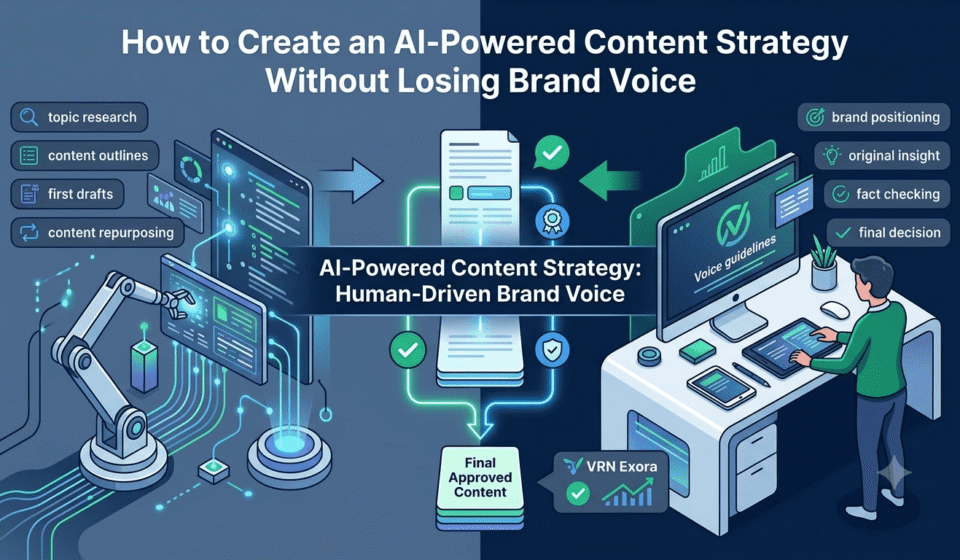
The simplest way to build an AI-powered content strategy without losing brand voice is to separate production from judgment. Let AI handle repetitive work such as research, outlining, drafting, and repurposing, while your team controls brand positioning, expertise, factual accuracy, tone, and final approval. This approach gives you the speed of AI without turning every piece of content into the same generic voice.
What Is an AI-Powered Content Strategy?
An AI-powered content strategy is simply a plan for using AI tools to support content work, while people keep ownership of the parts that actually build trust with readers.
Think of AI as a very fast, very well-read research assistant. It can pull together background information, draft an outline in seconds, and produce a rough first pass at an article. What it doesn’t automatically know is why your company takes a certain stance, what your customers actually struggle with day-to-day, or which claims your legal team already flagged last quarter. That context lives with your people, not your prompt.
So AI takes on:
- Topic research and competitor scans
- Outline creation
- First draft generation
- Repurposing one piece of content into several formats
- Drafting meta descriptions and FAQ answers
And your team keeps:
- Brand positioning and point of view
- Original insight and real experience
- Fact checking
- The final decision on what publishes
Once you set up that split clearly, AI stops being a risk to your brand and starts being genuinely useful. The strategy part isn’t complicated. The discipline to stick to it is where most teams slip.
Why Does Brand Voice Matter When You Use AI for Content?
Brand voice is the combination of tone, word choice, sentence rhythm, and personality that makes your content recognizable even without a logo attached. Readers pick up on this faster than most marketers assume. They may not be able to explain why a blog post feels off, but they notice, and that feeling shapes whether they trust what they’re reading.
Here’s where it gets tricky. Telling an AI content tool to “write in our brand voice” almost never works on its own. Unless you give it that context, the model doesn’t know your last ten years of customer conversations, your founder’s actual speaking style, or the three phrases your competitors overuse that you’ve deliberately avoided. Without that context spelled out, AI defaults to safe, generic marketing language, and safe generic language is exactly what makes content forgettable.
There’s real data behind this too. According to Transparency Without Trust, a study from the Nuremberg Institute for Market Decisions, only 20 percent of respondents said they trust AI itself, while just 25 percent believed they could recognize AI-generated content. The representative study surveyed 1,000 people each in the US, UK, and Germany.
Put those two numbers together, and you get an uncomfortable picture. The findings point to an uncomfortable gap. People may not feel confident identifying AI-generated content, but that doesn’t mean they automatically trust it. A brand that lets its voice slip doesn’t get caught for using AI. It just quietly starts sounding less like itself, and that erosion adds up over months, not overnight.
How Do You Build an AI-Powered Content Strategy in Your Business?
Building this out takes seven steps. None of them require exotic tools. What they require is sequence. Skip step one and jump straight to prompting, and you’ll spend more time fixing tone in edits than you would have spent setting things up properly.
Step 1: Document Your Brand Voice Before You Touch Any AI Tool
Write the voice guide first. Not after you’ve published ten AI-assisted posts and noticed they all sound slightly off. Before.
Your guide should cover tone, preferred sentence length, words your brand uses often, words it avoids entirely, a clear picture of your audience, and a handful of real examples showing what good looks like next to what doesn’t. This document becomes the thing every future prompt gets built around, so it’s worth spending a real afternoon on it rather than dashing off a paragraph.
Step 2: Set Clear Content Goals Tied to Business Outcomes
Every piece of content should connect to something concrete, whether that’s organic search growth, lead generation, customer education, or building authority in your niche. A content calendar without a goal attached just produces volume, and volume without direction wastes everyone’s time, AI-assisted or not.
Step 3: Build Topic and Keyword Clusters With Human Validation
AI is genuinely good at spotting related topics and grouping keywords into clusters quickly. Just don’t treat that output as the final answer. Validate search intent, business relevance, source quality, and factual claims before you turn an AI-generated cluster into a content brief. Let it do that part. But have someone on your team check search intent and business relevance before committing writing hours to any cluster, because AI can group keywords that look related on paper and mean completely different things to a searcher.
Step 4: Write One Reusable Prompt Built Around Your Brand Voice
Instead of writing a fresh generic prompt every time someone needs content, build one detailed template that bakes in your voice guide, audience details, search intent, formatting requirements, and the key information the piece needs to cover. Keep the content brief separate from the prompt itself, so your team can change the topic and evidence without rebuilding the whole instruction set. A strong reusable prompt saves your team from reinventing brand context every single time, and it keeps output far more consistent across different writers using the same tool.
Step 5: Use AI for Research and First Draft Production
This is the step where AI earns its keep. Let it handle topic ideation, outline building, source gathering, background research, first drafts, and repurposing a long article into shorter formats. Give it authoritative sources when accuracy matters, and treat anything it produces from memory as a draft that still needs checking. Efficiency shows up the most here, and it doesn’t threaten brand consistency as long as a human still edits every draft before it moves forward.
Step 6: Add Human Review and Subject Matter Expertise Before Publishing
Have a real editor or subject matter expert check facts, verify claims, add original insight or first-hand experience, confirm the piece matches your positioning, and adjust tone where needed. This step is what separates content that builds real authority from content that just fills a calendar slot. Don’t treat it as optional, and don’t rush it just because the draft came together quickly.
Step 7: Measure Content Performance and Brand Consistency Together
Track the usual numbers such as organic traffic, rankings, engagement, and conversions. But also check brand consistency, content quality, and whether the piece is adding something genuinely useful that readers couldn’t get from ten other pages covering the same topic. A piece can rank well on Google and still miss the mark on voice, so measure both sides rather than assuming good rankings mean the content did its full job.
What Should AI Handle and What Should Humans Own in Content Production?
|
AI Can Help With |
Humans Should Own |
|
Topic research |
Brand positioning |
|
Content outlines |
Final messaging |
|
First drafts |
Original expertise |
|
Content repurposing |
Strategic decisions |
|
Keyword organization |
Brand voice |
|
Content formatting |
Final approval |
|
FAQ generation |
Subject matter judgment |
This split isn’t about limiting AI. It’s about putting judgment calls in the hands of people who actually understand your customers, your market, and the risk of getting a claim wrong. AI can’t carry that responsibility, and pretending otherwise is how brands end up with content that technically ranks but doesn’t convert or build trust.
How Does an AI Content Strategy Support GEO?
GEO works best when your content gives AI search systems clear answers, reliable information, and something useful to reference. That doesn’t mean writing for machines instead of people. It means making the information easy to understand while giving readers a reason to trust it.
In practice, that means answering the main question directly, supporting important claims with reliable sources, showing first-hand expertise where you have it, and adding information that isn’t just a rewrite of what everyone else already published. AI can help organize and produce that content, but your experience, examples, data, and point of view are what make it worth referencing.
What Makes Content More Useful to AI Search Systems?
There’s no magic GEO checklist that guarantees a citation. The practical goal is simpler: make the page easy to understand, easy to verify, and genuinely useful.
Start with these basics:
- Answer the main question clearly instead of making readers hunt for it.
- Use descriptive headings that match the questions your audience actually asks.
- Support important factual claims with reliable sources.
- Add first-hand experience, examples, data, or opinions your competitors don’t have.
- Explain who created the content and why they’re qualified to write it.
- Keep related information together instead of scattering the answer across multiple sections.
- Update claims and statistics when the underlying information changes.
- Don’t create separate pages just to capture slightly different versions of the same question.
How Do You Keep AI-Generated Content Consistent With Your Brand Voice?
You keep AI-generated content consistent with your brand voice by feeding the tool a documented voice guide, real approved examples, clear audience details, and specific language rules, then reviewing every single draft before it goes live. There’s no shortcut around the review step, no matter how good your prompt gets.
Run every project through this checklist:
- Define your target audience in specific, concrete terms
- Put your brand personality and tone in writing
- Build a list of preferred vocabulary and phrases
- Feed the AI tool real, approved brand examples
- Note words and phrases your brand avoids
- Decide on sentence length and formality preferences
- Review every AI-generated draft before it publishes
- Update the guide as your messaging evolves
A checklist like this gives your team something they can actually act on, instead of a vague note in a Slack message saying “make it sound more human.”
What Mistakes Make AI Content Sound Off-Brand?
Most brand voice problems come down to a short list of repeated mistakes, not a mysterious flaw in the AI itself.
Using generic prompts
A prompt with no brand context produces generic output every time. This isn’t a limitation you can prompt your way around later. It has to get fixed at the prompt stage.
Publishing drafts without review
Skipping the review step lets factual errors and mismatched tone slip straight through to readers. Once that happens a few times, readers start questioning everything else you publish too.
Prioritizing keywords over readers
Stuffing content with exact match keywords makes it read awkwardly, and awkward reading loses trust fast. More importantly, Google doesn’t require you to repeat the exact query everywhere; its systems are designed to understand relevance even when the wording doesn’t exactly match the search.
Applying the same tone to every brand
A voice guide built for one client or one product line should never get copied straight onto another. Voices differ for a reason, and treating them as interchangeable defeats the purpose of having a guide at all.
Removing human opinion and experience
Readers want a point of view, not just accurate information restated in different words. Content with no opinion in it rarely gets shared or remembered.
Relying on AI for unsupported claims
That check should cover numbers, dates, product capabilities, quotations, named studies, and anything presented as a fact rather than an opinion.
Publishing content only to hit a volume target
Extra content doesn’t help if it dilutes overall quality. Readers notice when a site trades depth for output, and publishing large amounts of unoriginal content doesn’t give you an advantage just because there’s more of it.
None of these mistakes require new software to fix. They require a team that treats the review process as non-negotiable, even when deadlines get tight.
How Can an Audit Tool Like VRN Exora Support an AI-Powered Content Strategy?
AI helps teams produce content faster, but faster production doesn’t automatically mean better content. That gap between speed and quality is exactly where an audit tool earns its place.
VRN Exora reviews existing content and site structure, then flags optimization gaps, quality issues, and SEO opportunities a busy team might miss when producing content at a faster pace. It sits at the review stage of the workflow, not the writing stage. A practical sequence looks like this: research, strategy, AI-assisted production, an SEO and quality audit through VRN Exora, human review, optimization, and measurement.
VRN Exora doesn’t replace your strategist or your editor, and it was never built to. It gives your team visibility into what needs attention, whether that’s a page you just published or one that’s been live for a year and has quietly started underperforming.
Teams that already have a documented brand voice and clear content goals tend to get the most value out of an audit tool like this, because VRN Exora checks content against a standard your team already set, rather than guessing at one. If you’re managing a large content library with multiple contributors or juggling a mix of AI-assisted and fully human-written pages, VRN Exora helps you catch quality drift before it starts costing you rankings or reader trust.
Frequently Asked Questions
What is an AI-powered content strategy?
An AI-powered content strategy is a content plan where AI tools support research, outlines, and first drafts, while humans control brand voice, accuracy, and final publishing decisions.
How do you create an AI content strategy without losing brand voice?
Document your brand voice guide first, build a reusable prompt around it, and require human review of every AI-generated draft before it publishes.
Can AI-generated content actually sound like a specific brand?
AI-generated content can approximate a brand’s tone when you give it a detailed voice guide and real examples, but it still needs human editing to sound authentic and accurate.
Should a business review every piece of AI-generated content before publishing?
Yes. Human review catches factual errors, tone mismatches, and unsupported claims that AI tools can introduce even when the prompt is strong.
What does VRN Exora check when it audits a website’s content?
VRN Exora checks pages for SEO gaps, content quality issues, keyword coverage, and structural weaknesses, then presents the findings so your team can prioritize fixes.
Who should use VRN Exora for content optimization?
Marketing teams managing large content libraries, multiple contributors, or a mix of AI-assisted and human-written content get the most value from VRN Exora.
How does VRN Exora fit into an AI-powered content workflow?
VRN Exora sits at the review stage, after content production and before final publishing, so your team catches quality and optimization issues before readers or search engines do.
Does VRN Exora replace human editors or content strategists?
No. VRN Exora identifies where content needs attention, and your editors and strategists still decide how to act on those findings.
Does AI-generated content hurt SEO?
AI-generated content isn’t automatically a problem for Google Search. The bigger issue is whether the content is useful, original, accurate, and created for people rather than primarily to manipulate search rankings. Using AI to assist with research or drafting is different from using it to mass-produce pages with little added value.
What makes content more likely to be useful in AI search?
Start with the same thing that makes content useful to people: answer the question clearly, support important claims, show real expertise, and add something original. For AI search specifically, unique viewpoints, first-hand experience, reliable information, and non-commodity content give systems more useful material to understand and reference.