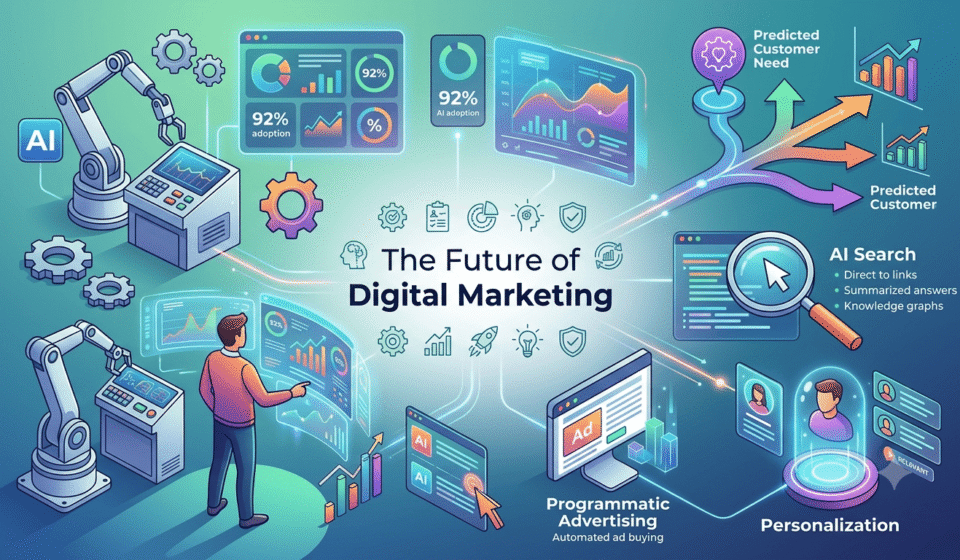

Digital marketing is entering a period of change unlike anything seen before. Machines now plan campaigns, write ad copy, buy advertising space, and predict what customers want, often before a marketer even opens their laptop. This is not a distant future. It is already happening quietly inside businesses of every size, all around the world.
A Quick Look at Where Things Stand Today
Marketing used to run on human effort. A person would write the email, pick the audience, schedule the send, and check the results by hand. That world is fading fast. A few numbers show just how far the shift has already gone:
- 92% of marketers now use AI in some form within their marketing automation workflows.
- 60% of marketers use AI daily as part of their regular work.
- The global marketing automation software market, valued at roughly $47 billion in 2025, is projected to reach around $81 billion by 2030.
This is not a small group of early adopters anymore. It is quickly becoming the normal way marketing gets done. This article looks at three connected forces shaping where digital marketing is heading next: smarter automation that runs itself, AI-powered search that changes how people find brands, and predictive systems that know what a customer wants before they ask for it.
Automation Is Moving From Assisting to Deciding
For years, marketing automation simply followed rules a human had already set. Send this email if someone opens the last one. Show this ad if someone visits a certain page. The system followed instructions, but a person still made every real decision.
That balance is shifting. AI-driven automation tools can now make many of those decisions on their own, adjusting campaigns in real time rather than waiting for a human to notice a pattern. A few clear examples show how far this has gone:
- Systems that automatically shift ad budget toward whichever version of a campaign is performing best
- Tools that write and test dozens of subject lines or ad headlines without a person drafting each one
- Chatbots and AI assistants that now handle a large share of customer conversations without any human stepping in
Industry researchers estimate that by 2027, around 80% of marketing processes are expected to be automated in some meaningful way. That does not mean marketers disappear from the picture. It means their daily work looks very different, shifting away from repetitive manual tasks and toward reviewing, guiding, and fine-tuning what the automation produces.
Old Marketing Work vs. Automated Marketing Work
|
Traditional Approach |
Automated Approach |
|
Human writes and sends every email manually |
AI drafts, tests, and sends based on real-time behavior |
|
Human checks results once a week |
System adjusts campaigns continuously, in real time |
|
Human answers every customer question |
Chatbots handle most routine conversations instantly |
|
Budget shifts happen manually, after review |
Budget shifts automatically toward top performers |
A future built on heavy automation still needs skilled humans, just in a different role than before. The most valuable skills going forward include knowing which goals to give the AI system, spotting when an automated decision looks wrong, and bringing the kind of creative thinking that software still cannot fully replace on its own.
Predictive Analytics: Marketing That Sees Ahead
One of the biggest shifts happening right now is the move from reactive marketing to predictive marketing. Reactive marketing waits for something to happen and then responds, such as sending a reminder email after a customer abandons their cart. Predictive marketing tries to act before that moment even arrives.
Predictive analytics tools study a mix of information, such as past purchases, browsing habits, and real-time behavior, to estimate what a specific customer is likely to do next. Research shows that AI-powered predictive analytics can improve lead conversion rates by up to 20%, a meaningful jump for businesses working with tight marketing budgets.
This technology already shapes ordinary decisions such as:
- Deciding which leads a sales team should call first, based on how likely they are to actually buy
- Adjusting email send times automatically for each individual person, based on when they usually open messages
- Flagging customers who show early warning signs of leaving before they actually cancel a subscription
As this technology becomes more affordable, even small businesses are beginning to use simplified versions of these tools, not just huge global brands with massive data teams.
AI Search Is Rewriting the Rules of Discovery
Search has always been one of the biggest doors through which customers discover a brand. That door is changing shape. People increasingly ask AI tools direct questions instead of typing a search term and scrolling through a list of links. This shift touches how content gets written, how products get described, and how trust gets built online.
AI-powered search tools tend to read through several trusted sources, pull out the clearest facts, and combine them into one direct answer. A business that once relied only on ranking near the top of a search results page now also needs its content to be clear and factual enough that an AI tool feels confident quoting or mentioning it directly. Content stuffed with vague marketing language, without real facts or details, tends to get skipped over entirely in this new environment. This change is pushing marketers to write with more honesty and precision, since clear pricing and direct answers now matter just as much as clever slogans, sometimes even more.
Programmatic Advertising Runs Almost Entirely on Automation Now
Buying advertising space used to involve real people negotiating deals directly with publishers. That process has almost completely disappeared for digital advertising. Programmatic advertising, the automated buying and selling of ad space in real time, now dominates the industry. Recent figures show programmatic buying accounts for more than 91% of all digital display advertising spending worldwide, a level of automation that would have seemed extreme just a few years ago.
Behind the scenes, AI systems now decide, often within a fraction of a second, whether to bid on a specific ad space, how much to offer, and which audience it best fits, studying huge amounts of browsing behavior and past performance data far faster than any human team could manage manually.
The Rise of AI-Generated Ad Creative
Automation has also spread into the actual creative side of advertising, not just the buying process. Instead of a designer manually building dozens of separate ad versions, AI tools can now generate large batches of ad variations automatically, testing different images, headlines, and calls to action to see which combination performs best. Industry data shows nearly 90% of advertisers are already using, or planning to use, generative AI to help build video ad creative.
This shift raises a real challenge too. As more AI-generated content spreads across the internet, distinguishing genuinely helpful content from low-quality, mass-produced filler is becoming harder for both machines and humans alike. Businesses that stay committed to real accuracy, rather than churning out AI content purely for volume, are likely to stand out precisely because so much of the competition will not.
Personalization Without Feeling Creepy
Customers today expect a personal touch, but they are also more aware than ever of how much data companies collect about them. This creates a balancing act for the future of digital marketing: personalizing enough to feel relevant, without crossing into territory that feels invasive.
Hyper-personalization, powered by AI, now goes far beyond simply using a customer’s first name in an email. It can mean showing completely different homepage content to two different visitors based on their past behavior, or adjusting product recommendations in real time as someone browses. The businesses succeeding at this balance tend to follow a few simple principles:
- Be transparent about what data is collected and why
- Give customers real control over their own preferences, rather than guessing silently in the background
- Use personalization to genuinely help customers find what they need faster, not simply to push more products
Privacy Rules Are Shaping How Automation Gets Built
As automation and AI take on a bigger role in marketing, privacy regulation is tightening right alongside it. Laws in various regions now give customers stronger rights over how their personal data gets collected, stored, and used for automated decision-making and profiling. Businesses building AI-driven marketing tools now need to think about privacy and fairness from the very beginning of the process, not as an afterthought bolted on at the end.
This has pushed many companies to rebuild their data strategies around first-party information, meaning data collected directly and transparently from their own customers, rather than relying on outside tracking data that is becoming harder to access and less trusted by regulators. Building marketing automation on a foundation of honestly collected, transparently used data is quickly becoming both a legal necessity and a genuine competitive advantage.
What This Means for Small and Medium Businesses
It is easy to assume all of this only applies to huge global corporations with massive marketing departments. That is no longer true. Many of these AI and automation tools have become far more affordable and easier to use over the past couple of years, putting real capability into the hands of much smaller teams.
A small business today can realistically use AI-powered email automation, basic predictive analytics, and simple chatbot tools without hiring a large specialized team or spending a huge budget. The businesses that will struggle most are not necessarily the smallest ones. They are the ones that ignore these shifts entirely and try to keep operating exactly as they did five years ago, while competitors quietly become faster, smarter, and more responsive around them.
Preparing for What Comes Next
With so much changing at once, it helps to focus on a few practical steps rather than trying to adopt everything simultaneously:
- Identify which repetitive, time-consuming tasks could realistically be automated first, such as basic email sequences or simple customer segmentation
- Test new AI tools in small, low-risk ways before committing a large budget to any single platform
- Watch closely how customers actually respond to more automated and personalized experiences
- Keep real human review in the loop for anything customer-facing, rather than letting automation run fully unchecked
Technology should always serve the relationship with real people, not replace genuine care and attention entirely. The businesses that combine smart automation with real human judgment, honesty, and creativity will be the ones that build lasting trust as this next chapter of digital marketing unfolds.
Conclusion
The future of digital marketing is being shaped by three forces working together at the same time: automation that increasingly makes its own decisions, AI-powered search that rewards clear and factual content, and predictive systems that anticipate what customers want before they even ask. None of these trends are optional extras anymore. They are quickly becoming the normal operating environment for businesses of every size, from small local shops to massive global brands.
The path forward is not about chasing every new tool the moment it appears. It is about understanding these shifts clearly, testing them carefully, and always keeping real human judgment and genuine customer trust at the center of every decision. Businesses that strike this balance well will not just keep up with the future of digital marketing. They will help shape what it becomes.
Frequently Asked Questions
- Is AI replacing marketers completely in the near future?
No, AI is automating repetitive tasks like data analysis and campaign testing, but human judgment, creativity, and strategy remain essential. Marketers are shifting toward supervising and guiding AI systems rather than being replaced by them entirely.
- What is the difference between predictive analytics and regular marketing data?
Regular marketing data shows what already happened, such as past clicks or sales. Predictive analytics uses that historical data to estimate what is likely to happen next, helping businesses act ahead of time rather than only reacting afterward.
- Can small businesses afford AI marketing automation tools?
Yes, many AI and automation tools have become significantly more affordable and easier to use in recent years. Small businesses can now access basic predictive analytics, email automation, and chatbot tools without needing a large specialized marketing team.
- How is AI-powered search different from traditional search engines?
Traditional search shows a list of links for a person to click through. AI-powered search tools read multiple trusted sources and combine facts into one direct answer, making clear, factual content more important than ever for visibility.
- Does more automation mean less privacy for customers?
Not necessarily, though it raises real concerns businesses must address carefully. Growing privacy regulations require companies to be transparent about data use, pushing many toward honestly collected first-party data instead of relying on hidden tracking methods.