
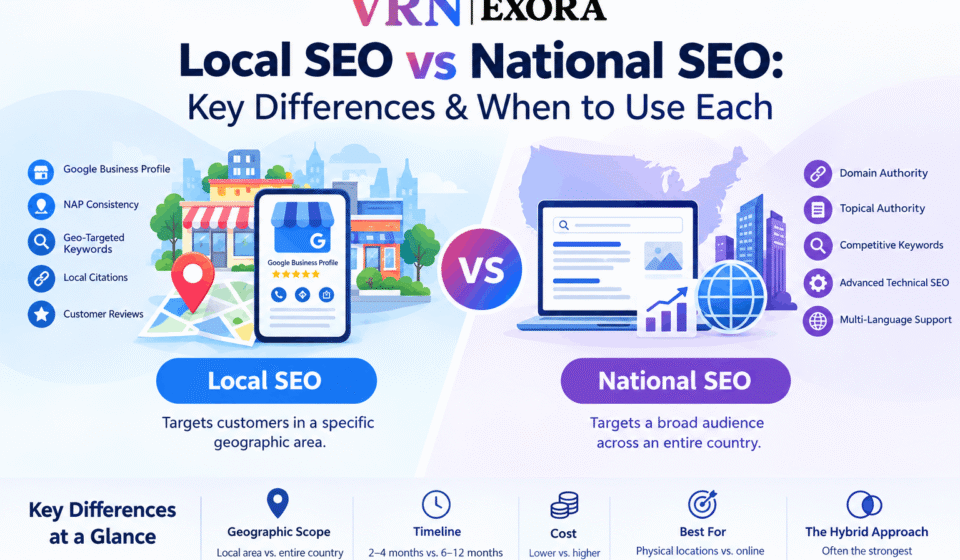

Local SEO targets customers in a specific geographic area using signals like Google Business Profile, NAP consistency, and geo-modified keywords. National SEO targets a broad audience across an entire country using domain authority, topical authority, and competitive keyword strategies. This guide is for business owners and marketers trying to decide where to focus budget and effort, since choosing the wrong scope wastes months targeting the wrong audience with the wrong keywords. You will learn what each strategy actually involves, how Google evaluates them differently, realistic timelines for each, and how to decide which one, or which combination, actually fits your business.
The Core Difference: Geographic Scope
The fundamental split between these two approaches is geography and the ranking signals each one relies on. Local SEO is always tied to a specific location or set of locations, optimizing visibility for searches like “plumber near me” or “best dentist in Austin.” National SEO targets broader, location-independent keywords aimed at an audience across an entire country, competing for terms like “best project management software” or “online business courses,” where physical proximity to the searcher plays no role at all in relevance.
What Local SEO Actually Involves
Local SEO centers on optimizing an online presence specifically to attract customers within a defined geographic area. Its core components include a fully optimized Google Business Profile, consistent name, address, and phone data across directories, geo-targeted content and location-specific pages, local citations, and a steady flow of customer reviews. Google Business Profile carries a disproportionate share of the overall local ranking weight compared to any other single factor, according to recent local ranking factor research, which means a fully optimized profile does more than help a business appear in the Map Pack, it directly multiplies results across the rest of a local strategy as well. Local SEO fits businesses whose customers must physically visit a premises or whose service area is genuinely bounded by geography: restaurants, clinics, salons, real estate agents, and home service providers.
What National SEO Actually Involves
National SEO targets broad, high-volume keywords across an entire country, or in some cases multiple countries, and suits businesses that sell online or serve customers regardless of physical location. It demands considerably deeper content, stronger backlink profiles, higher overall domain authority, and more advanced technical optimization than a typical local campaign, since national campaigns compete against a much larger, more resourced pool of competitors for the same broad terms. National SEO also tends to require more complex site architecture, comprehensive structured data, and in some cases multi-language support to handle traffic from across an entire country, which pushes technical SEO into a higher relative priority than it usually occupies in a purely local campaign. This approach suits ecommerce brands, SaaS companies, online education platforms, and any business without a physical storefront tying it to one specific region.
Ranking Signals: How Google Evaluates Each Differently
Google’s local ranking algorithm continues to rest on three core pillars: relevance, distance, and prominence, with a growing influence from AI-generated local answers that now synthesize Google Business Profile and review data directly into a response. This is a meaningfully different evaluation system than national rankings depend on, where domain authority, topical authority across an entire subject, and a broader, less location-anchored backlink profile carry considerably more weight. A business essentially competes in two different arenas depending on which strategy it pursues, one where proximity to the searcher is a first-class ranking factor, and one where it is entirely irrelevant.
Timeline and Cost: What to Actually Expect
Local SEO consistently produces measurable results faster than national SEO. In most campaigns, meaningful ranking movement on local and city-specific keywords shows up within roughly two to four months when the technical foundation is clean and Google Business Profile is properly optimized, while national campaigns more realistically require six to twelve months before comparable progress becomes visible, given the considerably larger competitive field. Local SEO also typically costs less overall, since it targets less competitive keywords and requires fewer resources than the deeper content investment, stronger backlink building, and more advanced technical work national campaigns generally demand.
When to Choose Local SEO
Local SEO is the right starting point when customers need to physically visit a location, when a service is genuinely bounded by a defined geographic area, or when a business wants faster, lower-cost results by competing within a smaller, more relevant pool of competitors rather than an entire country’s worth of them. A short sales cycle with high, immediate purchase intent, someone actively searching for a service they need right now, favors local SEO specifically, since that intent maps directly onto the kind of proximity-driven, high-conversion searches local optimization is built to capture.
When to Choose National SEO
National SEO is the right starting point for a business that serves customers regardless of physical location, sells products or services entirely online, or is building broad brand authority across an entire industry rather than a single region. A longer, more research-driven sales cycle, where buyers compare options extensively before committing, favors national content authority over local proximity signals, since the deciding factor for that kind of purchase has little to do with where the business is physically located.
The Hybrid Model for Multi-Location and Growing Businesses
These two strategies are not mutually exclusive, and for many growing businesses, particularly those with multiple locations or an ambition to expand regionally, blending both delivers the strongest outcome. A common, effective sequence is starting with local SEO to capture nearby, high-intent customers quickly, building individual location-specific pages for each city or area served rather than one generic regional page, then gradually layering in national content targeting broader industry keywords as domain authority builds. A regional law firm illustrates this well: it might focus on local keywords to attract clients in each specific city it serves, while simultaneously publishing authoritative, broadly relevant content that builds its reputation across the legal industry nationwide, capturing nearby leads and establishing broader credibility at the same time.
How AI Search Is Changing Both
Search behavior is fragmenting across Google, AI Overviews, ChatGPT, and Perplexity, and this affects local and national strategies differently but meaningfully in both cases. For local businesses, Google’s AI features increasingly pull information directly from a business’s Google Business Profile, reviews, and website to generate synthesized answers inside the local pack, which means the same fundamentals, complete profile data, consistent citations, and detailed reviews, now double as AI visibility signals, not just traditional local pack inputs. For national campaigns, businesses that build strong entity signals, maintain genuine E-E-A-T compliance, and close competitive authority gaps are positioned to hold visibility across all of these fragmented search surfaces at once, while businesses that ignore this shift risk becoming increasingly invisible regardless of which geographic strategy they originally chose.
Frequently Asked Questions
Which is faster, local SEO or national SEO?
Local SEO, consistently. Most local campaigns show meaningful ranking movement within two to four months, while national campaigns typically require six to twelve months given the much larger, more competitive field they are up against.
Which is cheaper, local SEO or national SEO?
Local SEO generally costs less, since it targets less competitive keywords and requires fewer resources overall than the deeper content, stronger backlinks, and more advanced technical work a national campaign typically demands.
Can a small business eventually expand from local to national SEO?
Yes, and this is a common, effective growth path. Many small businesses start with local SEO to build a foundation and generate quicker results, then gradually expand into national content as domain authority and overall site strength grow.
Do multi-location businesses need both local and national SEO?
Usually, yes. Most multi-location businesses benefit from a hybrid approach: location-specific pages and local optimization for each individual branch, combined with national content authority that builds overall brand credibility across every market at once.
Does national SEO require more technical work than local SEO?
Generally, yes. National campaigns often require more complex site architecture, more comprehensive structured data, and in some cases multi-language support to handle broad, countrywide traffic, pushing technical SEO into a higher relative priority than it typically occupies in a local-only campaign.
How has AI search changed the local versus national decision?
It has not changed which strategy fits a given business model, but it has raised the stakes for both. Local businesses now need complete, accurate profile and review data specifically because AI systems pull directly from it, while national businesses need strong entity and E-E-A-T signals to maintain visibility across AI Overviews, ChatGPT, and Perplexity, not just traditional Google rankings.
Get a Free Expert Review of Your SEO Strategy
Knowing whether your business is better served by a local, national, or hybrid strategy takes a clear look at your current visibility. If you want a faster starting point, get a free SEO audit from VRN Exora and see exactly where your priorities should be.
Local SEO vs National SEO: Key Differences & When to Use Each
Local SEO targets customers in a specific geographic area using signals like Google Business Profile, NAP consistency, and geo-modified keywords. National SEO targets a broad audience across an entire country using domain authority, topical authority, and competitive keyword strategies. This guide is for business owners and marketers trying to decide where to focus budget and effort, since choosing the wrong scope wastes months targeting the wrong audience with the wrong keywords. You will learn what each strategy actually involves, how Google evaluates them differently, realistic timelines for each, and how to decide which one, or which combination, actually fits your business.
The Core Difference: Geographic Scope
The fundamental split between these two approaches is geography and the ranking signals each one relies on. Local SEO is always tied to a specific location or set of locations, optimizing visibility for searches like “plumber near me” or “best dentist in Austin.” National SEO targets broader, location-independent keywords aimed at an audience across an entire country, competing for terms like “best project management software” or “online business courses,” where physical proximity to the searcher plays no role at all in relevance.
What Local SEO Actually Involves
Local SEO centers on optimizing an online presence specifically to attract customers within a defined geographic area. Its core components include a fully optimized Google Business Profile, consistent name, address, and phone data across directories, geo-targeted content and location-specific pages, local citations, and a steady flow of customer reviews. Google Business Profile carries a disproportionate share of the overall local ranking weight compared to any other single factor, according to recent local ranking factor research, which means a fully optimized profile does more than help a business appear in the Map Pack, it directly multiplies results across the rest of a local strategy as well. Local SEO fits businesses whose customers must physically visit a premises or whose service area is genuinely bounded by geography: restaurants, clinics, salons, real estate agents, and home service providers.
What National SEO Actually Involves
National SEO targets broad, high-volume keywords across an entire country, or in some cases multiple countries, and suits businesses that sell online or serve customers regardless of physical location. It demands considerably deeper content, stronger backlink profiles, higher overall domain authority, and more advanced technical optimization than a typical local campaign, since national campaigns compete against a much larger, more resourced pool of competitors for the same broad terms. National SEO also tends to require more complex site architecture, comprehensive structured data, and in some cases multi-language support to handle traffic from across an entire country, which pushes technical SEO into a higher relative priority than it usually occupies in a purely local campaign. This approach suits ecommerce brands, SaaS companies, online education platforms, and any business without a physical storefront tying it to one specific region.
Ranking Signals: How Google Evaluates Each Differently
Google’s local ranking algorithm continues to rest on three core pillars: relevance, distance, and prominence, with a growing influence from AI-generated local answers that now synthesize Google Business Profile and review data directly into a response. This is a meaningfully different evaluation system than national rankings depend on, where domain authority, topical authority across an entire subject, and a broader, less location-anchored backlink profile carry considerably more weight. A business essentially competes in two different arenas depending on which strategy it pursues, one where proximity to the searcher is a first-class ranking factor, and one where it is entirely irrelevant.
Timeline and Cost: What to Actually Expect
Local SEO consistently produces measurable results faster than national SEO. In most campaigns, meaningful ranking movement on local and city-specific keywords shows up within roughly two to four months when the technical foundation is clean and Google Business Profile is properly optimized, while national campaigns more realistically require six to twelve months before comparable progress becomes visible, given the considerably larger competitive field. Local SEO also typically costs less overall, since it targets less competitive keywords and requires fewer resources than the deeper content investment, stronger backlink building, and more advanced technical work national campaigns generally demand.
When to Choose Local SEO
Local SEO is the right starting point when customers need to physically visit a location, when a service is genuinely bounded by a defined geographic area, or when a business wants faster, lower-cost results by competing within a smaller, more relevant pool of competitors rather than an entire country’s worth of them. A short sales cycle with high, immediate purchase intent, someone actively searching for a service they need right now, favors local SEO specifically, since that intent maps directly onto the kind of proximity-driven, high-conversion searches local optimization is built to capture.
When to Choose National SEO
National SEO is the right starting point for a business that serves customers regardless of physical location, sells products or services entirely online, or is building broad brand authority across an entire industry rather than a single region. A longer, more research-driven sales cycle, where buyers compare options extensively before committing, favors national content authority over local proximity signals, since the deciding factor for that kind of purchase has little to do with where the business is physically located.
The Hybrid Model for Multi-Location and Growing Businesses
These two strategies are not mutually exclusive, and for many growing businesses, particularly those with multiple locations or an ambition to expand regionally, blending both delivers the strongest outcome. A common, effective sequence is starting with local SEO to capture nearby, high-intent customers quickly, building individual location-specific pages for each city or area served rather than one generic regional page, then gradually layering in national content targeting broader industry keywords as domain authority builds. A regional law firm illustrates this well: it might focus on local keywords to attract clients in each specific city it serves, while simultaneously publishing authoritative, broadly relevant content that builds its reputation across the legal industry nationwide, capturing nearby leads and establishing broader credibility at the same time.
How AI Search Is Changing Both
Search behavior is fragmenting across Google, AI Overviews, ChatGPT, and Perplexity, and this affects local and national strategies differently but meaningfully in both cases. For local businesses, Google’s AI features increasingly pull information directly from a business’s Google Business Profile, reviews, and website to generate synthesized answers inside the local pack, which means the same fundamentals, complete profile data, consistent citations, and detailed reviews, now double as AI visibility signals, not just traditional local pack inputs. For national campaigns, businesses that build strong entity signals, maintain genuine E-E-A-T compliance, and close competitive authority gaps are positioned to hold visibility across all of these fragmented search surfaces at once, while businesses that ignore this shift risk becoming increasingly invisible regardless of which geographic strategy they originally chose.
Frequently Asked Questions
Which is faster, local SEO or national SEO?
Local SEO, consistently. Most local campaigns show meaningful ranking movement within two to four months, while national campaigns typically require six to twelve months given the much larger, more competitive field they are up against.
Which is cheaper, local SEO or national SEO?
Local SEO generally costs less, since it targets less competitive keywords and requires fewer resources overall than the deeper content, stronger backlinks, and more advanced technical work a national campaign typically demands.
Can a small business eventually expand from local to national SEO?
Yes, and this is a common, effective growth path. Many small businesses start with local SEO to build a foundation and generate quicker results, then gradually expand into national content as domain authority and overall site strength grow.
Do multi-location businesses need both local and national SEO?
Usually, yes. Most multi-location businesses benefit from a hybrid approach: location-specific pages and local optimization for each individual branch, combined with national content authority that builds overall brand credibility across every market at once.
Does national SEO require more technical work than local SEO?
Generally, yes. National campaigns often require more complex site architecture, more comprehensive structured data, and in some cases multi-language support to handle broad, countrywide traffic, pushing technical SEO into a higher relative priority than it typically occupies in a local-only campaign.
How has AI search changed the local versus national decision?
It has not changed which strategy fits a given business model, but it has raised the stakes for both. Local businesses now need complete, accurate profile and review data specifically because AI systems pull directly from it, while national businesses need strong entity and E-E-A-T signals to maintain visibility across AI Overviews, ChatGPT, and Perplexity, not just traditional Google rankings.
Get a Free Expert Review of Your SEO Strategy
Knowing whether your business is better served by a local, national, or hybrid strategy takes a clear look at your current visibility. If you want a faster starting point, get a free SEO audit from VRN Exora and see exactly where your priorities should be.