
The main difference between ecommerce SEO and SaaS SEO comes down to what they sell and how customers actually buy it. Ecommerce SEO prioritizes transactional keywords and optimized product pages to convert shoppers quickly, while SaaS SEO nurtures leads over months with educational content built for a much longer, more considered sales cycle. This guide is for marketers and business owners moving between these two models, or building an SEO strategy for one of them for the first time, who want a clear answer on what actually needs to change. You will learn how keyword strategy, content depth, conversion goals, technical priorities, and link building all diverge between the two, and what stays genuinely the same regardless of which model you’re working in.
The Core Difference: What They’re Actually Selling
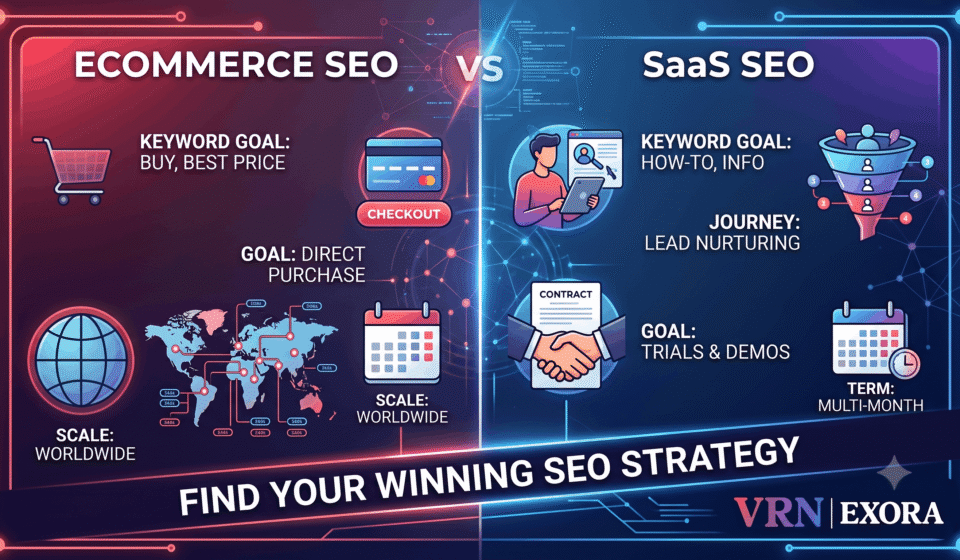
Ecommerce sells a physical or digital product through a comparatively short, often single-session purchase decision. SaaS sells a subscription to software through a considerably longer, more deliberated buying process that typically involves multiple stakeholders and a genuine evaluation period. This single distinction cascades into nearly every other difference between the two strategies, since a search engine optimization approach built to drive an immediate transaction looks fundamentally different from one built to nurture a buyer through a multi-month research and evaluation process before they ever sign up for a trial.
Keyword Strategy: Transactional vs Educational
Ecommerce SEO leans heavily on transactional keywords, terms like “buy,” “best price,” or a specific product name, aimed directly at shoppers who are ready or nearly ready to purchase. SaaS SEO targets a broader, more educational keyword set, including terms like “how to” or “best way to,” along with keywords less directly tied to the product itself but still relevant to the audience’s broader interests and pain points, since the goal is attracting and building trust with a prospect long before they are ready to buy anything. This means SaaS keyword research typically needs to expand further beyond the product itself than ecommerce keyword research does, capturing demand generation and category-education queries that a purely transactional ecommerce strategy would have little reason to target.
Content Depth and the Buyer’s Journey
In ecommerce, category and product pages do most of the actual conversion work, since the buyer’s journey is comparatively short and the content’s job is largely to remove friction between discovery and purchase. In SaaS, the buyer’s journey is fundamentally longer and less linear, commonly averaging three to six months from first visit to conversion, which means content needs to support an extended consideration process covering what the software does, how it fits into a buyer’s existing workflow, how it compares to alternatives, and what ongoing value it delivers beyond the initial purchase. SaaS content strategy therefore needs to be considerably more flexible and full-funnel than ecommerce content, meeting prospects at multiple distinct stages of a much longer decision rather than converting them in one or two page visits.
What Counts as a Conversion
This is one of the clearest practical differences between the two models. Ecommerce SEO optimizes for direct transactions, a completed purchase is the conversion event the entire strategy is built around. SaaS SEO optimizes for a different set of outcomes entirely: demo requests, free trial signups, and newsletter subscriptions, each representing a step toward an eventual sale rather than the sale itself. This changes how success gets measured and reported, since a SaaS SEO program judged purely on direct revenue attribution, the way an ecommerce program reasonably could be, would badly undercount its actual contribution to a sales pipeline that closes weeks or months after the original organic visit.
Technical SEO: Where the Real Complexity Actually Lives
Technical SEO complexity diverges sharply between the two models, largely driven by site size and structure. Ecommerce sites, particularly those with tens of thousands of product pages, face genuine, recurring technical challenges: crawl budget management, duplicate content from filtered and faceted navigation, canonical tag governance, and structured data at a scale that can meaningfully tank organic visibility if handled poorly. Most SaaS sites, by contrast, run on only a few hundred pages total, which means the same category of technical problems, crawl budget exhaustion, large-scale duplicate content, complex pagination, simply does not occur with anything like the same frequency or severity. This is not a claim that technical SEO is unimportant for SaaS, only that it occupies a meaningfully smaller share of the overall strategy compared to ecommerce, where it is frequently one of the highest-leverage areas of investment.
Competition: Local and Niche vs Global and Well-Funded
Ecommerce competition often has a meaningful local or niche dimension, competing brands selling similar products within a specific category or region, though this varies considerably by product category and market size. SaaS competition is consistently described as global and well-funded regardless of niche, since a SaaS company is typically competing directly against other companies with large content teams and high existing domain authority, all targeting the same relatively narrow set of high-value category keywords. This makes keyword and content differentiation a genuinely higher priority in SaaS SEO, since ranking for a category-defining term against a handful of well-resourced, entrenched competitors requires a more deliberate, differentiated angle than simply publishing competent content on the same topic everyone else already covers.
Link Building: Different Assets, Different Angles
Both models benefit from genuine digital PR and earned link building rather than low-quality, high-volume tactics, but the assets that earn those links differ. Ecommerce link building often centers on product-adjacent content, buying guides, comparison content, and press coverage tied to a specific product line or brand story. SaaS link building more often centers on original research, industry data, and genuine thought leadership content that positions the company as a category authority, since SaaS buyers are evaluating long-term trust and expertise as much as the product’s features themselves, and that trust signal extends into which sites are willing to reference and link to the company’s content.
What Stays the Same Across Both
Despite these real differences, the underlying SEO fundamentals apply equally to both models. Genuine topical authority, clean crawlability and indexation, strong E-E-A-T signals, and content that actually satisfies the search intent behind a query all matter regardless of whether the business sells a physical product or a software subscription. Both models also increasingly need to account for generative engine optimization alongside traditional SEO, since AI-driven search affects product discovery for ecommerce shoppers and category research for SaaS buyers alike, just through different types of queries and different points in each respective buyer’s journey.
Frequently Asked Questions
Which is more technically demanding, ecommerce SEO or SaaS SEO?
Ecommerce, in most cases. Large product catalogs commonly introduce crawl budget issues, duplicate content from faceted navigation, and complex canonical management that most SaaS sites, with their comparatively small page count, simply do not encounter with the same frequency or severity.
Why does SaaS SEO need more educational content than ecommerce SEO?
Because the SaaS buyer’s journey is considerably longer and less linear, commonly taking three to six months to convert, which means content needs to support an extended research and evaluation process rather than driving an immediate, single-visit purchase decision the way ecommerce content typically does.
What should ecommerce SEO measure as a conversion versus SaaS SEO?
Ecommerce SEO should measure direct transactions, since that is the actual revenue event the strategy drives toward. SaaS SEO should measure demo requests, trial signups, and other pipeline-stage actions, since the actual sale typically closes weeks or months after the original organic visit through a separate sales process.
Is SaaS SEO competition really harder than ecommerce SEO competition?
It depends on the specific niche, but SaaS competition is consistently described as global and well-funded almost by default, since SaaS companies typically compete directly against a relatively small number of well-resourced players for the same category-defining terms, requiring more differentiated content to break through.
Do ecommerce and SaaS SEO both need to think about AI search now?
Yes. Both models are affected by the shift toward AI-driven search and discovery, ecommerce through AI-assisted product research and recommendations, SaaS through AI-assisted category and vendor comparison research, just showing up through different query types at different points in each respective buyer’s journey.
Can the same person or team run both ecommerce and SaaS SEO effectively?
Yes, but they need to consciously apply different playbooks rather than treating the two as interchangeable, since the keyword strategy, content depth, conversion goals, and technical priorities all diverge meaningfully between the two business models despite sharing the same underlying SEO fundamentals.
Get a Free Expert Review of Your Strategy
Knowing exactly which SEO priorities fit your specific business model takes a strategy built around how your customers actually buy. If you want a faster starting point, get a free SEO audit from VRN Exora and see where your ecommerce or SaaS SEO strategy stands today.