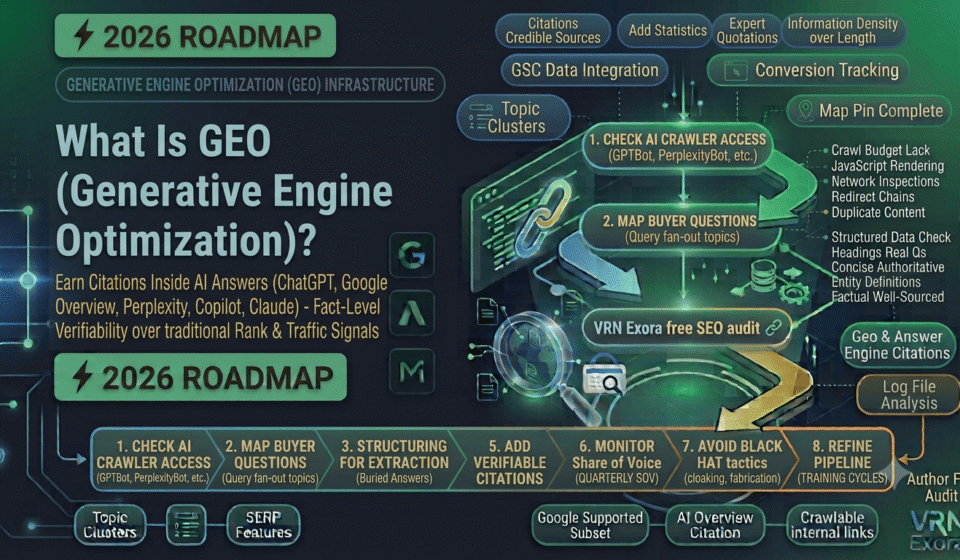

Generative Engine Optimization, or GEO, is the practice of structuring content and a brand’s digital presence so AI-powered platforms like ChatGPT, Google AI Overviews, Perplexity, Claude, and Copilot can find, understand, and cite that content when answering a user’s question. This guide is for marketers, SEO managers, and business owners who keep hearing the term and want a clear, practical answer to what it actually means, how it works, and how it differs from the SEO practices they already know. You will learn the core mechanics of how generative engines answer a question, exactly where GEO overlaps with and departs from traditional SEO, and the specific techniques that research has shown actually improve AI citation.
GEO Definition: The Short Answer
GEO is the discipline of earning a citation inside an AI-generated answer, rather than earning a ranked position in a list of blue links. The term was introduced by Princeton researchers in 2023, and by 2026 it has become a standard part of how serious marketing teams think about search visibility, since a growing share of informational queries now get resolved directly inside an AI-generated summary before a user ever sees a traditional search results page.
If traditional SEO is about earning a spot among ten organic results, GEO is about earning a place among the small handful, typically somewhere between two and seven sources, that a large language model actually cites when generating a single response. That is a considerably narrower target, and it is judged by a different set of signals than classic ranking factors.
How Generative Engines Actually Answer a Question
When someone asks an AI system a question, the system generally does not simply search the web the way a person typing into Google would. Many generative engines use a process called query fan-out, breaking a single question into several smaller sub-queries and researching each one separately before synthesizing the results into one coherent answer. A question like “what is the best VPN for streaming in Europe” might get broken into separate searches for general VPN rankings, streaming-specific performance, and regional server availability, with the final answer drawing from whichever sources performed best across each of those individual sub-queries.
It also helps to understand that not all generative engines work identically. Training-based systems draw primarily from what was learned during model training and update on a slower cycle. Search-based systems, like Perplexity or Google’s AI Overviews, actively retrieve and cite live web content in something closer to real time. Hybrid systems combine both approaches. This distinction matters practically, since a page can be added to a search-based engine’s citations within weeks of a fix, while a purely training-based system may not reflect a change until its next training cycle.
GEO vs Traditional SEO: What Actually Changes
GEO builds on SEO fundamentals rather than replacing them, but it optimizes at a genuinely different level of granularity. Traditional SEO largely optimizes at the page level: a strong title tag, clear headings, and thorough topical coverage across the whole page. GEO optimizes closer to the fact level, since each individual statistic, definition, or concept on a page needs to stand on its own with enough clarity that an AI system can lift it cleanly without needing the surrounding paragraphs for context.
The two disciplines also measure success differently. SEO ultimately drives clicks, so a page ranking third with a weak title tag still loses real traffic even while technically ranking well. GEO is closer to building authority: if ChatGPT cites a specific page as the source for a claim, the user may never actually click through to the site at all, but the brand still gains a real association with expertise on that topic in the mind of whoever read the answer. Research tracking the overlap between what ranks highly in traditional Google results and what actually gets cited by AI systems has found that overlap is meaningfully smaller than most marketers assume, and appears to be shrinking further as AI systems develop their own distinct preferences for which sources to trust.
GEO vs AEO vs LLM SEO: Are They Different?
In practice, no, not in any way that changes what you actually need to do. Generative Engine Optimization, Answer Engine Optimization, and LLM SEO are three terms circling the same underlying goal: getting content cited by an AI system when it generates an answer. The industry has not settled on a single preferred term, and different platforms, publications, and vendors use each one somewhat interchangeably. If you see content discussing AEO or LLM SEO, treat it as covering the same core discipline as GEO rather than assuming it is describing a genuinely separate practice.
Why GEO Matters Now
The shift is not theoretical anymore. AI-referred sessions to websites grew dramatically through 2025, and industry forecasts point to continued, meaningful declines in traditional search engine volume as more of that activity moves into AI-powered agents and chatbots instead. This affects categories differently: informational-heavy industries like technology, SaaS, healthcare, finance, legal, and professional services tend to see the strongest AI citation activity, since their audiences frequently ask AI systems direct definitional, comparative, and how-to questions. Transactional categories like ecommerce and local services benefit more indirectly, primarily through educational content that builds broader category authority rather than driving product citations directly.
A brand absent from these AI-generated answers is not simply losing a small slice of traffic, it is becoming genuinely invisible at exactly the moment a growing number of buyers are forming their first impression of what options exist in a category. Analytics complicate this further, since a business can see AI referral traffic look modest in GA4 while sales quietly grow, because a user often gets a recommendation from an AI system and then searches the brand name directly or navigates straight to a checkout page, a pattern standard last-click attribution tends to undercount.
What Actually Improves AI Citation
Princeton’s original GEO research identified specific, measurable techniques that improve how often AI systems cite a page, and the findings remain the foundation of most current GEO practice. Citing credible sources, adding specific statistics, and including expert quotations each independently improved AI visibility by a meaningful margin, roughly in the thirty to forty percent range compared to unoptimized content, when tested against a baseline. This is a genuinely different priority than classic SEO copywriting, which historically optimized more for keyword placement and overall page length than for fact-level verifiability.
Beyond sourcing and statistics, a few structural fundamentals matter as much as the content itself. AI systems need to actually be able to crawl a page in the first place, and one of the most common, purely accidental GEO failures is a robots.txt configuration that blocks AI crawlers without anyone realizing it, sometimes introduced by a CDN or security provider’s default settings rather than a deliberate choice. Beyond crawlability, information density tends to outperform length, since AI engines generally favor concise, fact-heavy sections over long, loosely structured prose that buries the actual answer several paragraphs into the page.
Common GEO Mistakes to Avoid
The most damaging and most common mistake is an accidental AI crawler block, since no amount of content quality matters if the system cannot reach the page at all. A second common mistake is treating GEO purely as a keyword exercise, stuffing the phrase “generative engine optimization” repeatedly into a page without actually explaining the concept clearly, since a page with genuine conceptual clarity and supporting examples consistently outperforms one relying on repetition alone. A third mistake is expecting immediate results across every AI platform uniformly, when in reality search-based engines can reflect a fix within weeks while training-based systems may take considerably longer to catch up.
How to Measure GEO Success
Traditional rank tracking does not capture GEO performance, since there is usually no ranked list to measure, only a single generated response that either includes a brand or does not. Measuring GEO instead means tracking share of voice, or how often a brand is cited relative to named competitors across a defined set of realistic buyer questions, run repeatedly across the AI platforms that matter most to a given audience. Most practitioners recommend planning for three to six months of consistent effort before expecting meaningful, measurable movement in citation rates, since this is a compounding process rather than a single campaign with a defined end point.
Frequently Asked Questions
Is GEO replacing traditional SEO?
No. GEO builds on SEO fundamentals and adds a new layer of technique specifically for AI citation. Traditional search still drives meaningful traffic, and the two disciplines increasingly need to be practiced together rather than treated as competing priorities.
What is the difference between GEO and AEO?
Functionally, very little. GEO and Answer Engine Optimization describe the same underlying goal, earning citations inside AI-generated answers, and the industry has not settled on one preferred term over the other.
How long does it take to see results from GEO efforts?
Results vary by platform. Search-based engines like Perplexity can reflect a change within weeks, while training-based systems update on a slower cycle. Most practitioners plan for three to six months of consistent effort before expecting meaningful, measurable improvement.
What is the single most common GEO mistake?
Accidentally blocking AI crawlers in robots.txt, often through a default security or CDN configuration nobody deliberately chose. If an AI crawler cannot access a page, no amount of content quality matters, since the platform cannot reach the content to cite it.
Does GEO matter for every type of business?
It matters more for some categories than others. Informational-heavy industries like SaaS, healthcare, finance, and professional services tend to see the strongest direct citation activity, while transactional categories like ecommerce benefit more indirectly through educational content that builds broader category authority.
Can I measure GEO success the same way I measure SEO rankings?
Not directly. There is usually no ranked list to track in AI-generated answers, only a single response that either includes a brand or does not. GEO is more commonly measured through citation frequency and share of voice against named competitors across a defined set of buyer questions.
Get a Free Expert Review of Your AI Search Visibility
Understanding GEO is the first step, seeing where your own brand currently stands is the next one. If you want a faster starting point, get a free SEO audit from VRN Exora and see how your content currently performs for both traditional and AI-powered search.