
A GEO tool tracks how often, and how favorably, your brand gets cited when someone asks ChatGPT, Perplexity, Gemini, or Google’s AI Overviews a question relevant to your business. This guide is for marketers, SEO managers, and brand teams who know traditional rank trackers no longer show the full picture and want to know which platforms are actually worth evaluating in 2026. You can also explore practical GEO strategies for improving your brand’s visibility across AI search platforms. You will learn what these tools measure, how the main options compare, and how to pick the right one for your team’s size and budget, since the space has grown quickly and pricing and positioning shift often enough that it pays to know what to look for rather than which single tool to default to.
What GEO Tools Actually Measure
Generative engine optimization tools run a defined set of prompts, the kinds of questions your actual customers ask, across the AI platforms you care about, on a repeating schedule, then report back on whether and how your brand appeared. Most platforms track some combination of citation frequency, share of voice against named competitors, sentiment in how your brand is described, and which specific sources the AI system pulled from to build its answer.
The category has grown fast. What began as a niche idea two years ago is now a crowded field with genuine venture investment behind several of the leading platforms, and the practical difference between a tool marketed as “GEO,” “AEO,” or “AI visibility” is mostly branding, since they all describe the same underlying goal of earning a citation inside a generated answer rather than a ranked position in a list of links.
Profound: Best for Enterprise AI Visibility Intelligence
Profound has established itself as the category leader at the enterprise end, with significant venture funding behind it and a client base that includes large, well-known brands. It offers the deepest coverage across multiple AI engines and increasingly includes an action layer that moves beyond passive monitoring into helping teams actually respond to what the data shows. Entry-level plans exist, but Profound’s real strength and pricing scale toward larger organizations that need coverage across many engines, single sign-on, and dedicated account support rather than a lightweight monitoring setup.
Choose Profound if your organization already has a dedicated AI search function or is prepared to invest at an enterprise level for the most comprehensive intelligence available in the category.
Peec AI: Best Mid-Market Analytics and Share of Voice Tracking
Peec AI has grown quickly as a strong self-serve option for fast-scaling marketing teams that want detailed share of voice reporting without an enterprise sales process. It focuses specifically on helping teams understand how their brand performs relative to named competitors across the AI platforms buyers actually use, with pricing and plan structures aimed at mid-market budgets rather than Fortune 500 procurement cycles.
Choose Peec AI if you want strong competitive analytics and straightforward reporting without committing to an enterprise-tier contract.
Otterly.AI: Best Affordable Entry Point
Otterly.AI is consistently recommended as the most accessible way to start tracking AI visibility, with an entry-level monthly price low enough that a solo marketer or small agency can justify testing it without a lengthy budget approval process. It covers the core function most teams need first, confirming whether and how often a brand appears in AI-generated answers, without the deeper enterprise features that come at a higher price elsewhere in the category.
Choose Otterly.AI if you are testing the waters of GEO tracking for the first time and want to see what the underlying data actually looks like before committing to a larger platform.
Scrunch AI: Best for Broad Model Coverage and Content Delivery
Scrunch AI is positioned for larger organizations that need advanced AI search intelligence alongside broader coverage across engines, including some less commonly tracked models. It stands out specifically for teams thinking about how content gets delivered to AI agents and crawlers, not just how visibility is measured after the fact, which makes it a reasonable fit for organizations planning a more technical, infrastructure-aware approach to GEO.
Choose Scrunch AI if broad model coverage and a technical content-delivery angle matter more to your team than a simple monitoring dashboard.
Ahrefs Brand Radar and Semrush AI Toolkit: Best for Existing SEO Suite Users
Both Ahrefs and Semrush have added AI visibility modules to their existing SEO platforms, which makes them a natural extension for teams already paying for and working inside one of those tools daily. The tradeoff most reviewers point to is depth: these bolted-on modules tend to be more shallow than dedicated GEO platforms, but the convenience of one login and one existing contract is a real advantage for teams that do not want to manage a separate tool and separate relationship just for AI visibility tracking.
Choose one of these if your team already lives inside Ahrefs or Semrush and wants a reasonable starting view of AI visibility without adding a new vendor.
AthenaHQ and Other Enterprise-Focused Platforms
Beyond the names above, a second tier of well-funded, enterprise-focused platforms, including AthenaHQ, Bluefish, and Evertune, each carve out a specific angle within the category. AthenaHQ focuses on tracking brand presence and performance specifically across AI-generated answers, Bluefish emphasizes brand protection and monitoring, and Evertune is often chosen by teams that prioritize statistical rigor in how visibility is measured and reported. These are worth evaluating specifically when a generalist platform does not fully address a particular priority your team has, such as protecting brand reputation or needing methodologically rigorous measurement for internal reporting.
Free and Low-Cost Ways to Start Without a Dedicated Tool
Before committing budget to any platform, several free or near-free options exist for getting an initial read on AI visibility. One-shot AI visibility graders, offered by several vendors including HubSpot and Semrush, give a free, single snapshot of how a brand currently appears across major AI engines. A simpler, fully manual approach costs nothing at all: set up a referral filter in GA4 to catch traffic clicking through specifically from chatgpt.com or perplexity.ai, which gives a real, if incomplete, signal of AI-driven traffic without any new tool at all. Open-source, self-hosted options have also emerged in the category for technically capable teams that want full control without a subscription cost.
How to Choose the Right GEO Tool for Your Team
Match the tool to your team’s actual budget and the depth of action you are prepared to take on the data, not to whichever platform has raised the most funding or published the loudest case studies. A solo operator or small team is generally better served starting with an affordable entry-level tool and learning what the underlying data looks like before investing in a deeper platform. A mid-market team wanting strong competitive analytics without an enterprise sales process fits naturally with a self-serve analytics platform. A large organization with a dedicated AI search function and the resources to act on detailed, engine-by-engine intelligence is the right buyer for an enterprise-tier platform.
Before demoing any platform, map your own top customer questions across the AI engines your buyers actually use, since this list is what any tool will actually run against, and a platform’s value depends entirely on how well its prompt coverage and reporting match questions relevant to your specific business rather than a generic template.
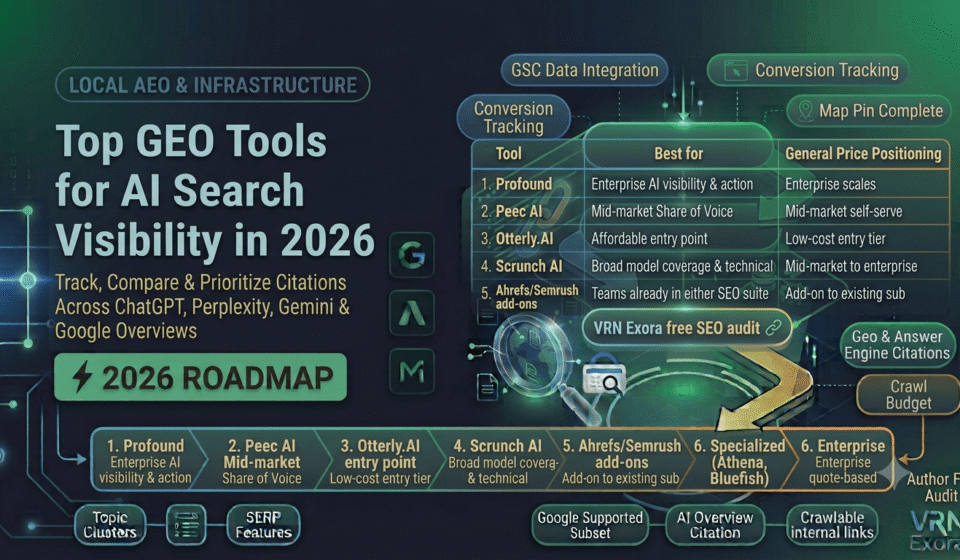
| Tool | Best for | General price positioning |
|---|---|---|
| Profound | Enterprise AI visibility intelligence and action layer | Enterprise, scales with engine coverage and seats |
| Peec AI | Mid-market share of voice and competitor analytics | Mid-market, self-serve |
| Otterly.AI | Affordable entry point for first-time tracking | Low-cost entry tier |
| Scrunch AI | Broad model coverage and content delivery to AI agents | Mid-market to enterprise |
| Ahrefs Brand Radar / Semrush AI Toolkit | Teams already using either SEO suite | Add-on to existing subscription |
| AthenaHQ, Bluefish, Evertune | Specialized enterprise needs like brand protection or measurement rigor | Enterprise, quote-based |
Pricing and feature sets in this category are changing quickly as the market matures, so treat any specific figure as directional and confirm current pricing directly with each vendor before making a final decision.
Frequently Asked Questions
What is the difference between a GEO tool and a traditional rank tracker?
A traditional rank tracker measures your position in Google’s list of blue links for a given keyword. A GEO tool measures whether and how your brand is cited inside a generated answer from an AI system, which is a fundamentally different, often binary outcome rather than a ranked position.
Do I need a dedicated GEO tool, or can I use my existing SEO platform?
It depends on your depth needs. AI visibility add-ons inside Ahrefs and Semrush offer a reasonable starting view for teams already using those platforms, but dedicated GEO tools generally provide deeper prompt coverage and more detailed competitive analytics.
What is the cheapest way to start tracking AI visibility?
Otterly.AI is commonly recommended as the most affordable dedicated option, and a completely free alternative is setting up a GA4 referral filter to catch traffic arriving from AI platforms like ChatGPT or Perplexity, though this only captures traffic that actually clicks through rather than all citation activity.
Which GEO tool is best for a large enterprise?
Profound is generally considered the category leader for enterprise use, with the broadest engine coverage and the most developed feature set for organizations with a dedicated AI search function and budget to match.
Are GEO, AEO, and AI visibility the same thing?
Functionally, yes. Generative engine optimization and answer engine optimization describe the same underlying practice of earning citations inside AI-generated answers, and “AI visibility” has become a common umbrella term covering both.
How often do these tools actually check AI platforms?
Most run your defined prompt set on a repeating schedule, commonly daily or weekly depending on the plan. Because AI-generated answers can vary between runs of the same prompt, repeated, regular checks of a focused prompt set tend to give a more reliable picture than a single one-time check across a larger list of prompts.
Get a Free Expert Review of Your AI Search Visibility
Choosing the right GEO tool is easier once you know where your brand actually stands today. If you want a faster starting point, get a free SEO audit from VRN Exora and see how your current visibility looks before investing in a dedicated tracking platform.