
Topical authority is the search engine’s confidence that your site is a genuinely reliable, comprehensive source on a specific subject, built by covering that subject with real depth rather than publishing isolated articles targeting individual keywords. This guide is for content teams, SEO managers, and site owners who want a repeatable planning process instead of a random list of blog post ideas. You will learn how to identify the right central topic, structure supporting content around it in the correct order, and avoid the planning mistakes that cause most topical authority efforts to stall before they gain any real traction.
What Topical Authority Actually Means
Search engines no longer evaluate pages purely as isolated units competing for a keyword. They increasingly assess how completely a site covers an entire subject, how those pages connect to each other, and whether the coverage reflects genuine, structured expertise rather than scattered content chasing individual search terms. This matters even more in 2026 because AI search engines and Google’s AI Overviews specifically favor sources that demonstrate depth across a whole topic when deciding what to cite, rather than rewarding single strong pages in isolation.
A useful way to think about this: random blog posts are like individual books scattered across a store, while a genuine topical authority plan builds an entire, organized section that a customer can browse with confidence. The planning process below builds that section deliberately, before a single page gets written.
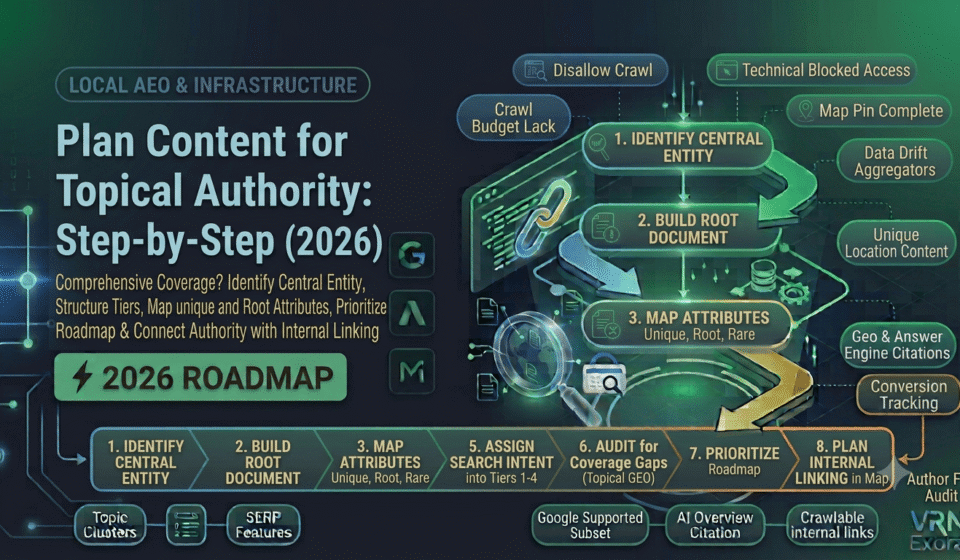
Step 1: Identify Your Central Entity
Every topical authority plan starts with one specific, clearly definable subject the site wants to own, not a broad category like “fitness” or “marketing,” but something narrow enough to actually dominate. This central entity should genuinely match your business, your services, and your audience, since a topical map built around a subject unrelated to what you actually do will not translate into business results even if it ranks well.
The most common failure at this stage is choosing a pillar topic that is too broad or too loosely defined. A niche site trying to cover an entire industry from day one spreads effort so thin that no single area ever reaches genuine depth, and research on topical authority consistently shows that sites achieving full coverage within one focused cluster rank faster than sites spreading thin across several clusters at once.
Step 2: Build Your Root Document
The root document is the anchor page for your entire content cluster, the broad, comprehensive guide that every supporting page will eventually connect back to. Its H1 should be built around the central search intent behind the topic, not just the bare keyword. A page titled simply “Germany” tells a reader and a search engine very little, while a title like “Living and Working in Germany: Complete Guide for Expats” immediately signals both the entity and the specific angle the content serves.
The root document needs to cover the essential, macro-level aspects of the topic broadly, while explicitly identifying the micro-contexts, the specific subtopics, that will each spawn their own dedicated supporting page later in the plan. Think of it as the table of contents for the entire cluster, written as genuinely useful content in its own right rather than just a list of links.
Step 3: Map Attributes Into Unique, Root, and Rare
Once the central entity and root document are defined, list every attribute, subtopic, question, and angle connected to it, and sort each one into one of three categories. Unique attributes define this specific entity exclusively and should appear first in your plan, since they build the fastest, most distinctive topical signal. Root attributes are the universal subtopics that any entity of this type needs coverage on, such as cost, process, or comparison content that a reader would expect regardless of which specific entity they were researching. Rare attributes are the niche, differentiating subtopics that are not strictly required but help the site stand out once the foundational coverage is in place.
Draw on People Also Ask results, real customer questions, and competitor content as raw material during this brainstorming phase, aiming for genuine breadth rather than filtering too early, since gaps identified now are far cheaper to fix than gaps discovered after publishing has already started.
Step 4: Structure Your Content Into Tiers
Organize the full list of mapped attributes into a clear tiered structure rather than one flat list. The root document sits at the top as Tier 1. Tier 2 holds your primary attribute pages, the unique and root attributes that carry the most search demand and the highest intent. Tier 3 holds secondary pages covering rare attributes, groupings, and comparison content. Tier 4 is reserved for trending, opportunistic, or seasonal content that captures momentum but is not foundational to the cluster’s core authority.
There is no fixed number of pages required, but a fully built cluster typically needs somewhere between eight and fifteen articles in total, one root document plus roughly seven to fourteen supporting pieces, before Google begins to recognize a genuine topical pattern rather than a handful of disconnected posts.
Step 5: Assign Search Intent to Every Planned Page
Every page in the map needs a clearly assigned purpose before it gets written. Tag each planned page by intent, whether it primarily informs, compares, or drives a purchase decision, and by the specific context terms, related risks, benefits, types, or alternatives, it needs to cover to fully serve that intent. Two topics that sound similar on the surface, such as batch cooking and weekly meal planning, can actually represent distinct search behaviors and deserve separate pillar treatment rather than being collapsed into a single page that tries to serve both imperfectly.
This step is also where information gain deserves attention. Content that only repeats what already ranks for a query adds little value regardless of how well it is written, while a page planned specifically to add a fresh angle, an original example, or genuinely new data earns real differentiation within the cluster rather than just filling a slot in the map.
Step 6: Audit for Coverage Gaps
Before finalizing the plan, validate the topical map against real search demand rather than relying purely on intellectual completeness. A subtopic that belongs logically within the niche but generates no measurable search interest is a low priority, even if it feels important to cover on principle. Cross-check your planned Tier 2 and Tier 3 pages against actual keyword volume data and competitor coverage to confirm the map reflects genuine demand, not just a theoretically complete outline. A content gap analysis can help identify important topics your competitors cover that your site is currently missing.
This is also the step most content plans skip entirely, publishing individual articles around high-volume keywords without ever stepping back to check whether the overall collection actually adds up to comprehensive coverage of the subject. A connected coverage framework consistently outperforms a pile of disconnected, keyword-targeted posts, even when each individual post is well optimized on its own.
Step 7: Prioritize Your Publishing Roadmap
Publishing everything in the map at once is rarely realistic, so sequence the roadmap deliberately rather than working through it in a random order. Publish the root document and core Tier 2 pages first, since supporting pages depend on the pillar already existing to link back to. Beyond that dependency, prioritize by business value, meaning which planned pages are most likely to drive conversions, by realistic ranking potential given current site authority, and by search volume where the topic genuinely has demand.
Consistency matters more than speed at this stage. A sustainable publishing pace that steadily completes Tier 2 coverage before expanding into Tier 3 builds a stronger, faster-recognized cluster than a rushed initial burst of content followed by months of inactivity.
Step 8: Plan Internal Linking as Part of the Map, Not After It
Internal linking is what actually turns a list of related pages into a recognizable topical cluster in the eyes of a search engine, and it needs to be planned alongside the content map itself rather than added as an afterthought once everything is already published. Every supporting page should link back to the root document using consistent, descriptive anchor text that reflects the pillar’s core subject, and the root document should link out to every completed supporting page in the cluster. Where relevant, supporting pages should also link to each other when a genuine, logical connection exists between them, rather than linking only up and down the hierarchy.
Use descriptive, topic-relevant anchor text throughout rather than generic phrases, since anchor text is one of the clearest signals a search engine uses to understand what a linked page is actually about and how it relates to the page linking to it.
How Topical Authority Affects AI Search Visibility
AI-generated answers increasingly favor sources that demonstrate depth and consistency across an entire subject rather than a single standout page, since these systems are specifically built to identify sources that qualify as reliable across a whole topic area, not just for one isolated query. A site built around a genuine topical map, with a clear pillar, complete supporting coverage, and consistent internal linking, is considerably more likely to be treated as a trustworthy reference by an AI system than a scattered site with disconnected posts covering the same subject unevenly.
This gives topical authority planning a second, growing purpose beyond traditional rankings. The same structured coverage that earns trust from Google’s ranking systems also builds the kind of demonstrated expertise that AI search engines look for when deciding which sources to cite in a generated answer.
Common Mistakes That Undermine a Topical Map
The most frequent mistake is treating content strategy as a volume game, publishing a large batch of loosely related articles and expecting authority to accumulate simply from having more pages live. The real issue is almost always structural rather than a volume problem: content published without a topical map first tends to plateau regardless of how much of it exists. Other recurring mistakes include starting Tier 3 content before Tier 2 coverage is genuinely complete, choosing a weak root document title that does not match the primary search intent, skipping unique attributes that would have built the fastest topical distinctiveness, and building the content map without planning internal linking alongside it from the start.
Frequently Asked Questions
How many articles does a topical authority cluster need?
There is no fixed number, but a fully built cluster typically requires somewhere between eight and fifteen articles, one root document plus roughly seven to fourteen supporting pieces, before a search engine begins to recognize a genuine topical pattern.
Should I cover multiple pillar topics at once or focus on one first?
Focus on one pillar first. Data on topical authority consistently shows that sites achieving full coverage within a single cluster rank faster than sites spreading effort thin across several clusters simultaneously.
What is the difference between a root attribute and a rare attribute?
Root attributes are universal subtopics expected for any entity of that type, such as cost or process information. Rare attributes are niche, differentiating subtopics that are not strictly required but help a page stand out once foundational coverage already exists.
Do I need to plan internal linking before writing the content?
Yes, ideally. Planning internal links alongside the content map, rather than adding them afterward, ensures every supporting page reinforces the pillar and every page in the cluster genuinely connects, rather than existing as disconnected posts that happen to share a topic.
How is a topical map different from a regular content calendar?
A content calendar schedules individual pieces of content, often built around isolated keywords. A topical map defines the full structure of a subject first, including the pillar, supporting clusters, attribute hierarchy, and internal linking plan, and the publishing schedule is built on top of that structure rather than replacing it.
Does topical authority planning matter for AI search, not just Google rankings?
Yes. AI-generated answers increasingly favor sources that demonstrate consistent depth across an entire topic, which makes a genuinely structured topical map relevant to both traditional search rankings and AI search citation at the same time.
Get a Free Expert Review of Your Content Strategy
Building a topical map that search engines and AI systems both recognize takes the right structure from the first page. If you want a faster starting point, get a free SEO audit from VRN Exora and see exactly where your current content coverage stands.