
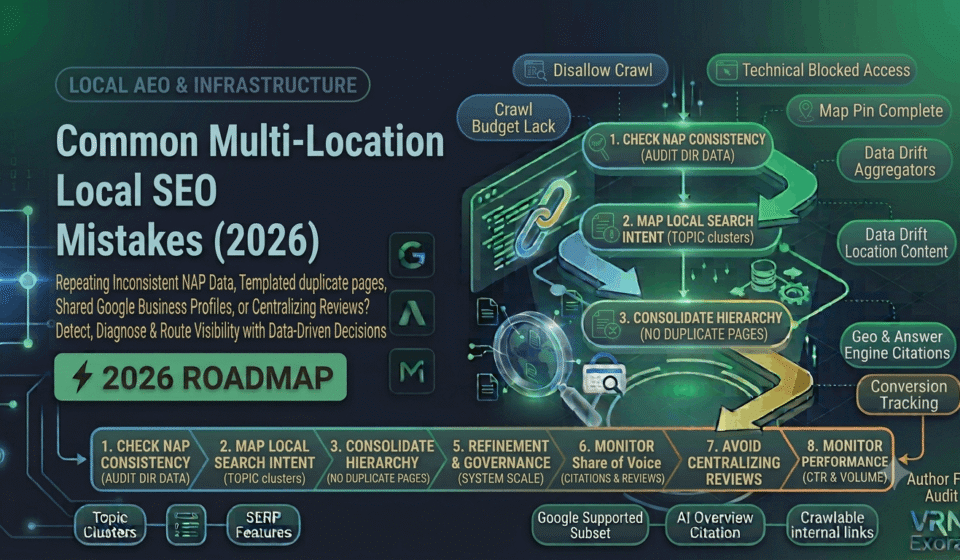

Local SEO for a multi-location brand fails in different, more expensive ways than local SEO for a single storefront, because the same small mistake gets repeated across every location instead of staying contained to one. This guide is for marketers, franchise owners, and SEO managers overseeing local visibility across several branches who want to know exactly which recurring mistakes are costing calls and visits. You will learn the most common multi-location local SEO mistakes, why each one specifically hurts a brand with many locations, and how to fix each one without rebuilding your entire local presence from scratch.
Why Multi-Location Local SEO Fails Differently
A single-location business manages one Google Business Profile, one set of citations, and one page targeting local keywords. A multi-location brand needs both centralized governance and localized execution at the same time, and most of the mistakes below happen because a brand leans too far in one direction, either letting every location manage itself inconsistently, or applying one generic strategy uniformly across markets that genuinely behave differently from each other.
Mistake 1: Inconsistent NAP Data Across Locations and Directories
Name, address, and phone data that does not match exactly between your website, Google Business Profile, and third-party directories confuses both customers and search engines about which listing is actually authoritative. A location listed as “123 Main St, Suite 4” on one directory and “123 Main Street #4” on another is a mismatch, even though a human reader would recognize them as identical. This problem compounds specifically at multi-location scale, since franchisees or local managers often use different abbreviations, alternate phone lines, or outdated suite numbers independently, and these inconsistencies accumulate across dozens or hundreds of directories over time.
The impact is measurable. Citation consistency carries an estimated significant weight in local map pack ranking factors, and businesses with consistent information across the large majority of major directories see a substantial increase in website clicks from Google compared to those with scattered, mismatched data.
The fix: Run a full NAP audit across your top ten to fifteen directories for every location, standardize the format in one central source of truth down to details like suite number abbreviations, and push corrections everywhere at once rather than fixing directories one at a time. A ninety-eight percent or higher consistency rate across top directories is a realistic bar before inconsistency stops meaningfully dragging down rankings.
Mistake 2: Templated Location Pages With Only the City Name Changed
Many multi-location brands copy the same page template across every location and swap only the city name, creating near-duplicate content across the site. Google’s quality systems specifically identify and suppress this pattern. A business with fifteen locations, each using an identically worded page except for the city name, is not publishing fifteen ranking opportunities, it is publishing fifteen thin, competing pages that collectively underperform a single well-optimized page would on its own.
The fix: Every location page needs genuinely unique content: local service context, area-specific details, neighborhood references, and location-specific FAQs that do not appear word for word on any other location’s page. This does not require a full custom rewrite for every location, but it does require real local inputs beyond the address and phone number changing.
Mistake 3: Treating Google Business Profile as a One-Time Setup
Most multi-location businesses set up their Google Business Profiles once and stop actively managing them, leaving stock imagery in place, generic descriptions unchanged, and useful local attributes, like parking availability, wheelchair access, or seasonal offerings, unfilled even though they genuinely matter to nearby customers deciding where to go.
The fix: Build a recurring review cadence for every profile, not just the flagship location, that checks photos, descriptions, categories, and attributes on a defined schedule. Google increasingly weighs engagement signals like review activity and recency, click-through rate, and profile interaction, all of which decline naturally when a profile is left untouched for months at a time.
Mistake 4: Using One Shared or “Service Area” GBP for Multiple Locations
Every physical location needs its own individually verified, individually managed Google Business Profile. A single shared profile or a broad “service area” listing covering multiple physical addresses typically gets suppressed or merged by Google, since this pattern conflicts directly with how Google’s local systems expect a genuine multi-location business to be represented.
The fix: Confirm every physical address has its own distinct, verified profile rather than a shared or consolidated listing standing in for several locations. This is a foundational structural requirement, not an optional best practice, and getting it wrong undermines every other local SEO effort layered on top of it.
Mistake 5: Running One Generic Strategy Across Every Location
One of the more overlooked local SEO mistakes is applying an identical local SEO strategy uniformly across every location, regardless of how differently those markets actually behave. A coastal branch has genuinely different seasonal search patterns from a city-center location, and a suburban site may compete against an entirely different set of local businesses than a downtown counterpart even within the same brand.
The fix: Build shared brand standards and templates centrally, but allow real local customization within them, adjusting seasonal content, locally relevant offers, and competitive positioning per market rather than assuming what works in one location automatically works everywhere.
Mistake 6: Mixing Up or Centralizing Reviews Across Locations
Each Google Business Profile operates as an isolated asset, and mixing reviews between locations, whether by accident through a shared review widget or intentionally to make a newer location appear more established, confuses both search engines and the customers trying to evaluate a specific branch.
The fix: Keep review generation, display, and response processes strictly per-location. If you want to showcase brand-wide trust signals, do so separately from each individual location’s actual review count and rating, rather than blending them into one combined figure that misrepresents any single location.
Mistake 7: No Governance or Repeatable System as You Scale
Multi-location local SEO fails specifically when a brand treats it as a one-time checklist rather than a repeatable system. If launching or optimizing each new location depends entirely on manual, ad hoc effort from a single person, growth plateaus, since the process cannot scale faster than that person’s available time.
The fix: Document a repeatable process covering site architecture, GBP setup, review generation, and citation management, so a new location plugs into an existing structure rather than requiring the entire local SEO setup to be reinvented from scratch each time. A hybrid workflow, centralized templates and tooling combined with local sign-off for things like GBP verification and review responses, tends to scale more reliably than either full centralization or full local autonomy alone.
Mistake 8: Ignoring Data Drift From Aggregators
Data drift, where a directory listing quietly reverts to old, outdated information pulled from a data aggregator, is a common and underappreciated problem that erodes local rankings gradually with no obvious, single warning sign. A location that fixed its NAP data six months ago can find an old address or phone number has silently resurfaced on a major directory without anyone actively changing anything.
The fix: Treat citation management as a recurring quarterly audit at minimum, checking that every location’s data on top directories still matches your authoritative source, and audit immediately, not at the next scheduled cycle, following any location move, phone number change, rebrand, or new service area addition.
How to Fix These Mistakes Without Overhauling Everything
Start with your highest-traffic or currently underperforming locations rather than attempting to fix every location simultaneously. A local SEO audit can help identify NAP inconsistencies, GBP issues, citation gaps, and location-page problems so you can prioritize the fixes with the greatest potential impact. Expect meaningful ranking movement within roughly sixty to one hundred twenty days once fixes are live, and expect newer or recently relaunched locations to lag behind more established ones, since crawl frequency and authority build up over time rather than resetting instantly across dozens of pages at once.
Frequently Asked Questions
What is the single biggest local SEO mistake multi-location brands make?
Inconsistent NAP data across locations and directories is generally considered the most damaging, since it directly confuses both search engines and customers about which listing is authoritative, and citation consistency carries meaningful weight in local map pack rankings.
Can two locations share the same Google Business Profile?
No. Every physical location needs its own individually verified profile. A shared or broad service-area listing covering multiple addresses typically gets suppressed or merged by Google rather than functioning as intended.
How much unique content does each location page actually need?
Enough that no two location pages read identically except for the city name. Genuinely unique local service context, neighborhood references, and location-specific FAQs are what separate a real ranking opportunity from a thin, near-duplicate page.
How often should a multi-location brand audit its citations?
Quarterly at minimum, and immediately following any location move, phone number change, rebrand, or new service area addition, since data drift from aggregators can quietly revert corrected listings back to outdated information over time.
How long does it take to see results after fixing multi-location SEO issues?
Roughly sixty to one hundred twenty days for meaningful movement once fixes are live, though newer or recently relaunched locations typically take longer than established ones to catch up, since crawl frequency and authority accumulate gradually rather than resetting all at once.
Should reviews from one location ever be shown on another location’s page?
No. Reviews should stay strictly tied to the specific location that earned them. Mixing reviews across locations confuses search engines about which profile the reviews belong to and misleads customers evaluating a specific branch.
Get a Free Expert Review of Your Locations
Catching NAP drift and templated page issues across many locations takes a systematic audit. If you want a faster starting point, get a free SEO audit from VRN Exora and see exactly which locations need attention first.