
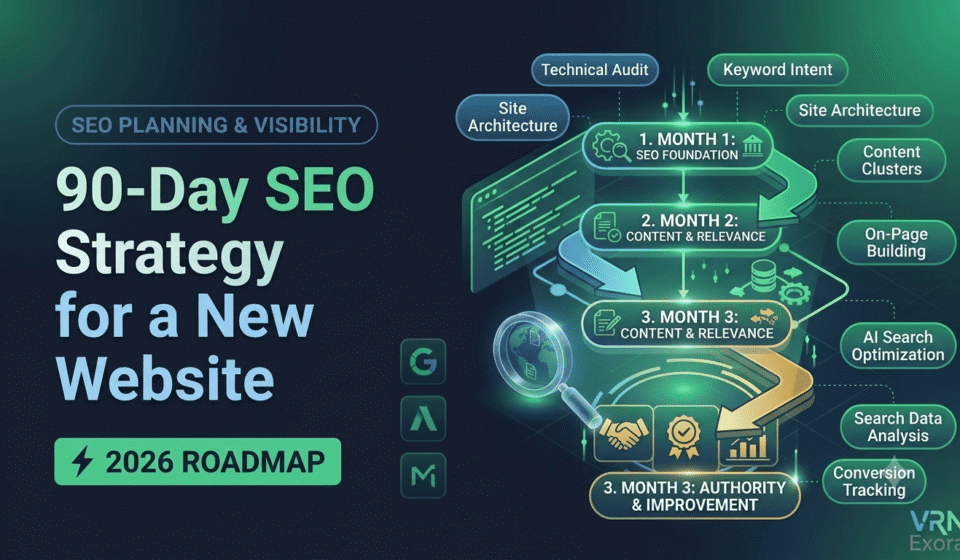

Launching a new website is only the first step. Without a clear SEO plan, even a well-designed website can struggle to attract organic traffic, reach the right audience, or appear in Google Search and AI-powered search platforms.
A 90-day SEO strategy provides a practical roadmap for turning a new website into a stronger search presence. Instead of trying to rank for hundreds of keywords immediately, you can use the first three months to establish technical foundations, understand search intent, publish valuable content, build authority, and measure early results.
Whether you are launching a business website, online store, SaaS platform, personal brand, or content website, this guide explains how to create a 90-day SEO strategy for a new website and what to prioritize at each stage.
What Is a 90-Day SEO Strategy?
A 90-day SEO strategy is a structured three-month plan that organizes search engine optimization activities into clear stages.
It generally includes:
- Technical SEO
- Keyword research
- Search intent analysis
- Website architecture
- On-page optimization
- Content creation
- Internal linking
- Link building
- Performance tracking
- Content updates
The purpose is not to guarantee first-page rankings within 90 days. No legitimate SEO strategy can promise that.
Instead, the objective is to establish a strong foundation, generate early search visibility, identify opportunities, and create assets that can continue producing results over time.
What Should a 90-Day SEO Plan Achieve?
By the end of the first three months, a new website should ideally have:
- A technically healthy website
- Clearly defined target audiences
- A prioritized keyword list
- Optimized core pages
- A logical website structure
- Several useful content assets
- A strong internal linking system
- Initial authority-building activity
- Search performance data
- A process for ongoing SEO improvements
Why New Websites Need a Different SEO Strategy
A new website starts with a major disadvantage: it has little or no established search authority.
An established website may already have backlinks, indexed pages, branded searches, historical rankings, and returning visitors. A new domain generally has to build these signals from scratch.
That means trying to compete immediately for extremely difficult keywords is rarely the best approach.
For example, a new fitness website may struggle to rank quickly for a broad term such as “fitness.” It may have a more realistic opportunity with specific searches such as “home strength training plan for beginners.”
The principle is simple:
Start with relevance and realistic opportunities, then gradually compete for more difficult searches.
Month 1 – Build the SEO Foundation
The first 30 days should focus on research, technical SEO, website structure, and strategic planning.
Do not rush into publishing dozens of articles before understanding how the website should be organized.
Step 1: Define Your SEO Goals
Before choosing keywords, decide what SEO needs to accomplish for your website.
Traffic is useful, but it should not always be the main objective.
Depending on your business, SEO may be intended to generate:
- Leads
- Product sales
- Bookings
- Phone calls
- Free trials
- Newsletter subscriptions
- Brand awareness
- Qualified organic traffic
For example, an online store might prioritize product sales, while a B2B service company may care more about qualified leads.
Set Measurable SEO Objectives
Instead of saying:
“We want more organic traffic.”
Set a more useful objective such as:
“Increase non-branded organic impressions and generate qualified leads from three priority service pages during the next 90 days.”
Specific goals make it easier to evaluate whether your SEO strategy is working.
Step 2: Understand Your Audience
Good SEO starts with understanding the people behind the searches.
Think about:
- What problems do they have?
- What questions do they ask?
- What products or services are they comparing?
- What prevents them from making a purchase?
- What information do they need before contacting a business?
- What alternatives might they consider?
Customer conversations, sales questions, support requests, reviews, forums, competitor websites, and search results can all reveal useful content ideas.
This approach often uncovers better opportunities than relying solely on keyword volume.
Step 3: Conduct Keyword Research
Keyword research helps you understand how your audience searches for information, products, and services.
Start by creating keyword groups around:
- Products
- Services
- Problems
- Questions
- Comparisons
- Pricing
- Locations
- Alternatives
- Features
- Use cases
Then evaluate each keyword based on:
- Relevance
- Search intent
- Competition
- Search demand
- Business value
Do Not Choose Keywords Based Only on Search Volume
High search volume can be attractive, but it does not necessarily mean high business value.
Consider two keywords:
Keyword A: 10,000 monthly searches but broad intent
Keyword B: 500 monthly searches with strong buying intent
Keyword B could potentially produce more valuable visitors.
For a new website, highly relevant long-tail keywords can often provide a more realistic starting point.
Step 4: Analyze Search Intent
Before creating a page for a keyword, search for the keyword yourself.
Look at the current results and ask:
- What type of pages are ranking?
- Are they articles, product pages, service pages, or category pages?
- How detailed are the results?
- What questions do they answer?
- What information appears in featured snippets?
- Are videos, maps, shopping results, or other SERP features present?
The goal is to understand what Google believes satisfies the search.
Match Content Format to Search Intent
For informational searches, a detailed guide may work best.
For transactional searches, users may expect a product or service page.
For comparison searches, a comparison article may be more appropriate.
Matching intent is often more important than simply inserting the target keyword several times.
Step 5: Complete a Technical SEO Audit
Before scaling content, check whether search engines can properly access, crawl, index, and understand the website.
Review:
- HTTPS
- XML sitemap
- txt
- Indexability
- Canonical tags
- Redirects
- Broken links
- 404 errors
- Mobile usability
- Page speed
- Core Web Vitals
- URL structure
- Duplicate pages
- Metadata
- Structured data
- Internal links
An SEO audit tool such as VRN Exora can help identify technical and on-page areas that deserve attention.
The objective should not be achieving a perfect audit score. The priority is fixing issues that could affect crawling, indexing, usability, or the performance of important pages.
Step 6: Create a Logical Website Structure
Website architecture affects both user navigation and search engine understanding.
A simple structure might look like:
Homepage → Category → Subcategory → Product
For a service business:
Homepage → Services → Individual Service → Supporting Content
For a content website:
Homepage → Topic Hub → Supporting Articles
This structure also makes internal linking easier.
Avoid creating important pages that are buried several clicks deep or have no meaningful links pointing toward them.
Month 2 – Create Content and Strengthen Relevance
Once the technical foundation is in place, the second month should focus heavily on content and on-page optimization.
The objective is not simply to publish more pages. It is to publish the right pages for the right searches.
Step 7: Build Topic Clusters
Instead of creating one article for every small keyword variation, organize related searches into topic groups.
For example, a website about home security could create a central topic around home security systems and supporting content covering:
- Types of home security systems
- Wireless vs. wired security
- Security cameras for apartments
- Smart locks
- Home alarm costs
- Security system installation
- Home security mistakes
These pages can then link to each other where appropriate.
Why Topic Clusters Matter
A collection of related, useful resources can provide greater topical depth than a group of disconnected articles.
It also helps users move naturally from general information to more specific solutions.
Step 8: Prioritize Commercial Pages
Do not focus exclusively on blog content.
If the website exists to sell products or services, your most important commercial pages deserve significant attention.
These could include:
- Product pages
- Service pages
- Category pages
- Location pages
- Pricing pages
- Comparison pages
- Consultation pages
Each page should make it easy for users to understand:
- What is being offered
- Who it is for
- What problem it solves
- Why it is different
- What it costs, when appropriate
- What evidence supports the claims
- What the visitor should do next
SEO should support the buying journey rather than interfere with it.
Step 9: Create People-First Content
People-first content answers a real question or solves a real problem.
Before publishing an article, ask:
Would this content still be useful if search engines did not exist?
If the answer is yes, you are more likely to be creating something valuable.
Strong content can include:
- Original examples
- Practical instructions
- Expert insights
- Relevant comparisons
- First-hand observations
- Data and research
- Common mistakes
- Limitations
- Decision-making advice
- Actionable checklists
Avoid adding paragraphs simply to reach a particular word count.
A 1,000-word article that completely answers a user’s question can be more useful than a 3,000-word article padded with repetition.
Step 10: Optimize On-Page SEO
Every important page should have a clear primary topic.
Review the following elements.
Title Tag
Write a concise title that accurately describes the page and gives users a reason to click.
H1 Heading
Use one clear H1 that communicates the main topic.
H2 and H3 Headings
Use H2s for major sections and H3s for supporting points.
Do not force keywords into every heading. Headings should primarily help users scan and understand the content.
Meta Description
Write a useful description that summarizes the page and encourages relevant clicks.
Images
Use relevant images and descriptive alt text where appropriate.
Internal Links
Connect related pages naturally to help users discover additional information.
Step 11: Build a Strong Internal Linking System
Internal links are particularly valuable for new websites because you control them.
Whenever you publish a new page, consider:
- Which existing pages should link to it?
- Which pages should this page link to?
- Is there a relevant product or service page?
- Are important pages receiving enough internal links?
- Does the anchor text describe the destination accurately?
For example, an article about choosing running shoes could link to a running shoe category page, shoe-sizing guide, and relevant product pages.
Internal links should always make sense from the reader’s perspective.
Step 12: Optimize for Featured Snippets and AI Search
Search behavior is changing.
Users increasingly obtain answers through Google AI Overviews, ChatGPT, Gemini, Perplexity, and other AI-powered search experiences.
The most practical way to prepare your content is to make useful information easy to understand and extract.
Use:
- Direct answers
- Numbered steps
- Bullet lists
- Tables
- Definitions
- Question-based headings
- Concise explanations
- Examples
- Clear terminology
For example, if your article targets “How long does SEO take for a new website?”, answer that question directly before discussing the factors that influence the timeline.
This makes the information easier for both people and search systems to interpret.
Month 3 – Build Authority and Improve Performance
By month three, your website should have a technical foundation, optimized core pages, and an expanding content library.
Now the focus shifts toward authority, measurement, and refinement.
Step 13: Develop a Sustainable Link-Building Strategy
Backlinks can help search engines understand the authority and relevance of a website.
However, link building should focus on quality rather than volume.
Potential opportunities include:
- Relevant industry publications
- Professional associations
- Digital PR
- Expert interviews
- Original research
- Business directories
- Partnerships
- Supplier websites
- Relevant guest contributions
- Useful resources and tools
Avoid buying large quantities of low-quality links simply to increase backlink numbers.
A relevant link from a trusted industry website can be considerably more meaningful than dozens of unrelated links.
Step 14: Create Content Worth Linking To
One effective way to attract links is to create resources other websites genuinely want to reference.
Examples include:
- Original research
- Industry reports
- Statistics pages
- Calculators
- Templates
- Comprehensive guides
- Checklists
- Interactive tools
- Data studies
For example, a financial website could create a useful calculator, while a marketing website could publish original research about search behavior.
These resources have a stronger reason to earn references than generic articles.
Step 15: Track SEO Performance
Do not evaluate your 90-day SEO plan based only on whether a page reached position one.
Monitor several indicators.
Important SEO Metrics
Track:
- Organic impressions
- Organic clicks
- Keyword rankings
- Indexed pages
- Click-through rate
- Organic conversions
- Leads
- Sales
- Referring domains
- Backlinks
- Page-level performance
For a new website, impressions can provide particularly useful early signals.
A page may begin appearing for relevant searches long before it receives significant clicks.
Step 16: Use Search Data to Improve Existing Pages
SEO should not follow a “publish and forget” model.
Once your pages begin collecting data, look for opportunities.
If a Page Ranks in Positions 8-20
Consider improving:
- Search intent alignment
- Content depth
- Internal links
- Title and headings
- Examples
- Supporting information
If a Page Gets Impressions but Few Clicks
Review:
- Title tag
- Meta description
- Search intent
- SERP competition
- Whether the page provides what users expect
If a Page Gets Traffic but Few Conversions
Review:
- Calls to action
- Offer clarity
- Trust signals
- Pricing information
- Page usability
- Relevance of the traffic
The data should influence what you do next.
A Practical 90-Day SEO Roadmap
The following schedule provides a simple framework for implementation.
|
Time period |
Primary focus |
Key tasks |
|
Days 1–15 |
Research |
Audience, competitors, keywords, search intent |
|
Days 16–30 |
Technical SEO |
Crawling, indexing, speed, structure, metadata |
|
Days 31–45 |
Content |
Core pages, topic clusters, priority articles |
|
Days 46–60 |
On-page SEO |
Internal linking, content optimization, FAQs |
|
Days 61–75 |
Authority |
Digital PR, relevant backlinks, useful resources |
|
Days 76–90 |
Measurement |
Rankings, impressions, CTR, conversions, updates |
This schedule should be adjusted according to the website’s size, industry, competition, and available resources.
Common SEO Mistakes to Avoid in the First 90 Days
A strong SEO plan also requires knowing what not to prioritize.
Chasing Extremely Competitive Keywords
A new website does not need to compete for the most difficult keywords immediately.
Start with relevant opportunities where the website has a realistic chance of gaining visibility.
Publishing Too Much Low-Quality Content
Publishing 100 weak articles will not necessarily outperform publishing 10 excellent ones.
Focus on usefulness, originality, relevance, and search intent.
Buying Cheap Backlinks
Large quantities of questionable backlinks can create quality and trust concerns.
Prioritize relevant, legitimate opportunities.
Obsessing Over SEO Audit Scores
An SEO score is a diagnostic tool, not a business objective.
A website can have an excellent technical score and still have poor content, weak authority, or low conversion rates.
Ignoring Existing Search Data
Keyword research tools are useful, but actual search results and website performance data provide additional context.
Use both when making decisions.
How Much Can a New Website Achieve in 90 Days?
There is no universal amount of traffic or rankings a new website should expect after three months.
Results depend on:
- Industry competition
- Search demand
- Website quality
- Technical health
- Content quality
- Domain history
- Backlinks
- Geographic targeting
- Brand recognition
- Publishing consistency
- Search intent
A website targeting low-competition searches may see rankings relatively quickly. A website operating in a highly competitive market may require substantially more time.
What Should You Measure Instead?
During the first 90 days, look for evidence of progress such as:
- More pages being indexed
- Increasing search impressions
- New keyword rankings
- Improved positions
- More non-branded visibility
- Growing organic clicks
- Relevant backlinks
- Better engagement
- Organic leads or sales
These signals provide a more realistic picture of SEO progress than an arbitrary ranking deadline.
How to Prioritize SEO When You Have Limited Resources
Not every website has a dedicated SEO team.
If you have limited time or budget, prioritize activities based on expected impact.
High Impact + Low Effort
Do these first:
- Fix indexing problems
- Repair broken links
- Improve important title tags
- Add internal links
- Improve weak commercial pages
High Impact + High Effort
Schedule these carefully:
- Major content hubs
- Website restructuring
- Original research
- Digital PR
- Link-worthy resources
Low Impact + High Effort
These should generally receive lower priority unless there is a specific reason to address them.
The objective is to spend limited resources on changes that can meaningfully improve visibility, usability, or business results.
What Should You Do After the First 90 Days?
The end of the first three months should not be treated as the end of SEO.
It should be the point where you have enough information to make better decisions.
Review:
- Which pages gained visibility?
- Which keywords showed potential?
- Which topics attracted relevant traffic?
- Which pages are close to page-one rankings?
- Which articles need updating?
- Which commercial pages need improvement?
- Which content attracted links?
- Which organic visitors converted?
Then use those findings to create the next SEO roadmap.
For example, if several related articles begin ranking on page two, you could expand the topic, improve those pages, strengthen internal links, and build relevant authority rather than starting an entirely unrelated content campaign.
Conclusion
A successful 90-day SEO strategy for a new website is not about finding a shortcut to Google’s first page.
It is about creating a website that deserves to be discovered and trusted.
Start with technical SEO and audience research. Identify realistic keywords based on search intent. Optimize important commercial pages, publish genuinely useful content, create strong internal links, and develop credible authority through relevant external opportunities.
Then measure what happens.
The first 90 days will reveal which pages attract impressions, which topics have ranking potential, which searches bring qualified visitors, and where users still need better answers. Those insights should guide the next stage of your SEO roadmap.
When you treat SEO as an ongoing process of research, implementation, measurement, and improvement, the work completed during the first 90 days becomes more than an initial checklist. It becomes the foundation for long-term visibility across Google Search and the growing ecosystem of AI search experiences.
Frequently Asked Questions
How long does SEO take for a new website?
SEO results vary by industry, competition, website quality, and authority. A new website may begin receiving impressions and ranking for less competitive searches within a few months, while competitive terms can take much longer. The first 90 days should focus on building foundations and identifying opportunities for sustainable growth.
How many keywords should a new website target?
There is no fixed number of keywords a new website should target. Focus on relevant keyword groups based on search intent, business value, competition, and content opportunities. A smaller set of well-selected keywords is generally more useful than hundreds of loosely related terms.
Should technical SEO come before content?
Serious technical problems should generally be addressed before scaling content. If search engines cannot crawl or index important pages, additional content may not achieve its potential. Once the technical foundation is healthy, content creation, internal linking, and authority building can become larger priorities.
Does a new website need backlinks to rank?
Backlinks can contribute to authority, but they are only one part of SEO. A new website should first create useful content, strong site architecture, and technically accessible pages. Relevant links from credible websites can then strengthen authority. Quality and relevance are more important than acquiring large quantities of links.
Can a 90-day SEO strategy guarantee first-page rankings?
No. Rankings depend on competition, relevance, authority, search demand, website quality, and many other factors. A responsible 90-day SEO strategy should focus on measurable improvements in technical health, indexing, content quality, search visibility, rankings, organic traffic, and conversions rather than promising a specific position.