
Would you buy something an AI couldn’t even describe properly? That’s the question brands are quietly panicking about right now.
Search has changed shape. People aren’t just typing keywords into a box anymore; they’re asking full questions to AI tools and expecting a straight answer, sometimes even a direct recommendation. If your product page can’t feed that answer clearly, you’re invisible in a conversation that’s happening whether you’re part of it or not.
This guide walks through exactly what it takes to make your product pages readable, trustworthy, and quotable for AI systems, plus a couple of related pieces you genuinely need to understand alongside it. Stick with it till the end, because the small structural fixes we cover here tend to matter more than any trendy tactic you’ll read elsewhere.
Why Product Pages Need a Different Approach for AI Search
Traditional SEO was built around ranking on a results page. AI search is built around being selected as the answer. That’s a completely different game, and product pages are usually the least prepared part of a website for it.
The Shift From Ranking to Being Referenced
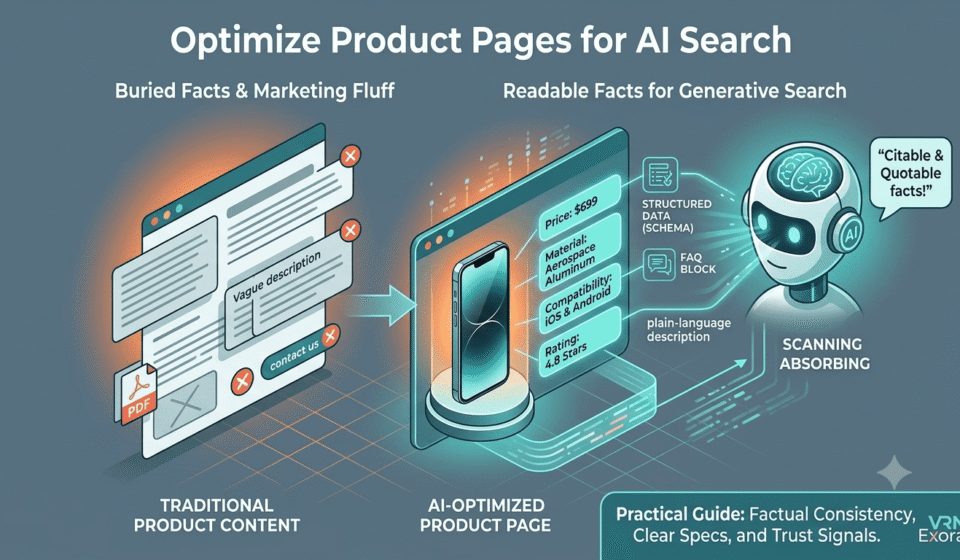
AI tools scan content, pull out facts, and repackage them into a response. If your product page buries specs in a PDF, hides pricing behind a “contact us” click, or wraps everything in vague marketing language, there’s simply nothing for the AI to extract. It moves on to a competitor’s page that made its job easier.
What AI Models Actually Look For
Think of AI crawlers as impatient readers. They want facts, not flourishes. A page optimized for AI search usually has:
- Clear, specific product attributes (size, material, compatibility, price)
- Plain-language descriptions instead of jargon-heavy copy
- Structured data that labels what each piece of information actually is
- Consistent facts that match across your site, marketplaces, and reviews
If any of these are missing, you’re asking the AI to guess, and it usually won’t bother.
Core Steps to Optimize Product Pages for AI Search
This is the part that actually moves the needle. Let’s break it down piece by piece.
Write Product Descriptions Like You’re Answering a Question
Ask yourself: what would someone actually type or say when looking for this product? Then answer that directly in your first paragraph. Skip the poetic intro about your brand’s “journey” and get to what the product does, who it’s for, and why it’s different, right at the top.
Use Structured Data So Machines Aren’t Guessing
Schema markup (Product, Offer, Review, and FAQ schema) tells search engines and AI tools exactly what each element on your page means. Without it, an AI has to interpret raw text, which is slower and far less reliable. With it, your price, availability, and rating become instantly readable data points.
Keep Specifications Complete and Scannable
Half-filled spec tables are one of the biggest reasons AI tools skip a product entirely. If a competitor lists dimensions, warranty terms, and material composition, and you don’t, guess whose page gets cited?
A quick checklist worth running on every product page:
- Are all key specs listed in text, not just in an image?
- Is pricing visible without requiring a login or popup?
- Does the page answer common pre-purchase questions directly?
- Are reviews and ratings marked up with schema?
- Is the page free of duplicate or conflicting details elsewhere on your site?
Match Language to How People Actually Ask Questions
People don’t search the way they typed keywords in 2015. They ask, “which running shoes are good for flat feet” instead of “running shoes flat feet.” Your product copy should mirror that natural phrasing somewhere on the page, ideally in an FAQ block or a short Q&A section near the description.
Build Trust Signals Into the Page Itself
AI tools weigh credibility heavily. Verified reviews, clear return policies, and transparent shipping details all act as trust markers. A page stacked with vague claims and no proof reads as low-confidence content, and AI systems are cautious about repeating low-confidence content to users.
Related Piece: Understanding Entity SEO for Product Pages
You can’t fully optimize a product page for AI search without understanding entities, so let’s cover this briefly before moving on.
What an Entity Actually Means in SEO Terms
An entity is simply a distinct, identifiable thing: your brand, your product line, a specific model number. AI search systems build knowledge around entities rather than isolated keywords. When your product is clearly defined as its own entity, connected consistently to your brand across the web, it becomes easier for AI to recognize and recommend confidently.
How to Strengthen Entity Signals Without Overcomplicating It
Keep your product naming consistent everywhere: your site, marketplaces, social profiles, press mentions. Link internally between related products and category pages. Use the same terminology in your descriptions that you use in your metadata. These small consistency habits add up to stronger entity recognition over time.
If you’re not sure where your product pages currently stand on any of this, running a quick check helps more than guessing. VRN Exora, a free SEO audit tool, scans your pages and flags exactly where structured data, entity signals, or basic optimization gaps are holding you back.
Common Mistakes That Quietly Sabotage AI Visibility
Let’s talk about what actually breaks things, because most brands aren’t failing due to lack of effort; they’re failing due to small oversights.
Overloading Pages With Marketing Fluff
“Revolutionary,” “game-changing,” “industry-leading,” none of these mean anything to an AI trying to extract facts. Every sentence that doesn’t add a concrete detail is a sentence that dilutes the page’s usefulness.
Inconsistent Information Across Platforms
If your website says a product weighs 2kg, but your marketplace listing says 2.3kg, that inconsistency erodes trust for both shoppers and AI systems trying to verify facts. Pick your source of truth and keep every channel aligned to it.
Ignoring Mobile and Load Speed
A slow page doesn’t just annoy shoppers; it can prevent crawlers from indexing content properly, which means the AI never even gets to read your carefully written specs in the first place.
Here’s a quick rundown of fixes worth prioritizing this week:
- Audit product pages for missing or outdated schema markup
- Rewrite the top three paragraphs of your bestselling product pages in plain, direct language
- Cross-check specs and pricing across every platform you sell on
- Add a short FAQ block answering three to five real customer questions
- Run your pages through VRN Exora to catch technical gaps you might have missed
Frequently Asked Questions
Does optimizing for AI search replace traditional SEO entirely? No, it builds on it. Traditional SEO fundamentals like site speed, mobile usability, and clean structure still matter. AI search optimization adds another layer focused on clarity, structured data, and factual consistency.
How long does it take to see results from these changes? It varies by industry and how AI tools index your site, but most brands notice improved visibility within a few weeks of adding structured data and rewriting key product content clearly.
Do I need developer help to add schema markup? Not always. Many platforms like Shopify or WordPress offer plugins that handle basic schema automatically, though custom product attributes sometimes need manual tagging for accuracy.
Should every product page have an FAQ section? Yes, ideally. FAQs mirror natural language questions shoppers actually ask, giving AI tools an easy, direct source to pull answers from when someone searches conversationally.
Can small businesses compete with larger brands in AI search results? Absolutely. AI tools prioritize clarity and completeness over brand size. A well-structured, honest product page from a small business can easily outperform a vague page from a bigger competitor.
Before You Go
Optimizing product pages for AI search isn’t about chasing another algorithm update; it’s about making your content genuinely easier to understand, for machines and humans alike. Clear specs, honest language, and consistent facts will always win, no matter how search technology evolves next.
Start small. Pick your top five product pages, run them through a structured audit, and fix the gaps you find. That alone puts you ahead of most competitors still writing copy for search engines that no longer work the way they used to.