
AI has changed how marketers approach content. Tasks that once took hours- brainstorming topics, creating outlines, rewriting introductions, analyzing search intent, and editing long-form articles- can now be completed much faster with the right AI assistant.
But speed is only one part of the equation.
For SEO professionals, content writers, business owners, and marketing teams, the more important question is whether AI can help produce content that is useful, accurate, original, relevant to search intent, and genuinely valuable to readers.
That is why the debate around ChatGPT vs Claude for SEO content has become increasingly relevant. Both tools can assist with research, writing, editing, ideation, and content analysis, but they can feel quite different when used as part of a real SEO workflow.
So, which one should marketers choose?
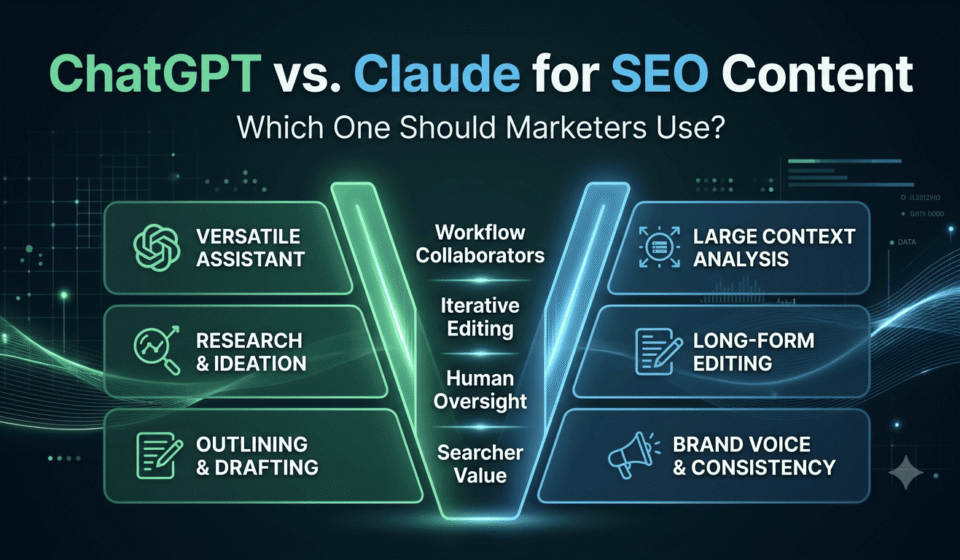
ChatGPT is generally the stronger all-purpose option for marketers who want flexibility across the SEO workflow, while Claude can be particularly valuable for long-form analysis, contextual editing, and working with large amounts of reference material. However, neither tool should replace keyword research, subject expertise, fact-checking, or human editorial judgment.
ChatGPT vs Claude for SEO Content: Quick Comparison
|
SEO task |
ChatGPT |
Claude |
|
Keyword brainstorming |
Excellent |
Excellent |
|
Search-intent analysis |
Excellent |
Strong |
|
Blog topic ideation |
Excellent |
Strong |
|
Content outlines |
Excellent |
Excellent |
|
First drafts |
Excellent |
Excellent |
|
Long-form editing |
Strong |
Excellent |
|
Maintaining context |
Strong |
Excellent |
|
Tone adjustment |
Excellent |
Excellent |
|
Content gap analysis |
Excellent |
Excellent |
|
FAQ generation |
Excellent |
Excellent |
|
Content repurposing |
Excellent |
Strong |
|
Final fact-checking |
Human review required |
Human review required |
|
SEO strategy |
Assistant, not replacement |
Assistant, not replacement |
The important point is that there is no universal winner.
The better platform depends on what you are trying to accomplish, how much source material you have, how your team works, and how much editorial control you want.
What Do Marketers Actually Need From an AI SEO Tool?
Before comparing ChatGPT and Claude, it helps to define what “good SEO content” actually requires.
An SEO content workflow usually involves much more than generating 1,500 words around a keyword.
A marketer may need to:
- Understand the primary search intent.
- Identify related questions and subtopics.
- Analyze competing content.
- Build a logical information hierarchy.
- Create a useful outline.
- Draft the article.
- Add examples and supporting information.
- Optimize headings and terminology naturally.
- Improve readability.
- Review factual claims.
- Add internal-link opportunities.
- Create metadata.
- Adapt the article for different audiences.
- Refresh the content as information changes.
This is where AI tools become useful.
The best use of AI is not simply:
“Write me an SEO article.”
A stronger workflow is:
Research → Analyze → Plan → Draft → Challenge → Edit → Verify → Publish
That distinction matters because search engines are not looking for content that merely contains the right keywords. Marketers need to satisfy the person behind the search.
Google’s guidance continues to emphasize helpful, reliable, people-first content, while its spam policies apply to generative AI content as well.
ChatGPT for SEO Content: Where It Performs Well
ChatGPT is particularly useful when the content process involves several different tasks.
OpenAI’s current writing guidance describes ChatGPT as a tool for drafting, rewriting, tightening, adjusting tone, organizing ideas, and refining written work. It also recommends providing context and constraints and treating the output as something to review rather than a final authority.
That approach fits SEO particularly well.
1. Content Ideation
Suppose a company wants to create content around “home security systems.”
A basic AI prompt might produce generic titles such as:
- Benefits of Home Security Systems
- How Home Security Systems Work
- Why You Need a Home Security System
Those aren’t necessarily bad, but they may not provide much differentiation.
A stronger approach is to ask ChatGPT to identify different search intents around the topic:
- Informational searches
- Comparison searches
- Problem-solving searches
- Commercial investigation searches
- Beginner questions
- Product-specific questions
This can turn one broad keyword into an entire content cluster.
2. Building Content Structures
ChatGPT can also be useful for turning a keyword into a structured article.
For example, instead of immediately asking for a finished article, a marketer can ask for:
- The likely search intent
- The reader’s primary problem
- Important subtopics
- Potential H2s
- Supporting H3s
- FAQs
- Missing information competitors often overlook
- Suggestions for examples
This planning stage can make the eventual article much stronger.
3. Rewriting and Content Refinement
One of the most useful applications is editing existing content.
A marketer can provide a draft and ask ChatGPT to identify:
- Repetitive sentences
- Weak introductions
- Overly complicated language
- Unsupported claims
- Missing transitions
- Sections that don’t answer the reader’s question
- Opportunities to make the copy more concise
This is often more valuable than asking AI to create an article from nothing.
4. Adapting Content for Different Audiences
The same information may need different versions.
For example, a cybersecurity company might need:
- A beginner-friendly blog
- A technical article for IT managers
- A short LinkedIn post
- A landing-page section
- An FAQ
- A sales email
ChatGPT can help transform the same core information into different formats while maintaining the central message.
Claude for SEO Content: Where It Can Be Particularly Useful
Claude is also capable of handling a wide range of writing and analysis tasks, but one area has historically been a major part of its positioning: working with large amounts of context.
Anthropic has published extensive material around Claude’s long-context capabilities and its ability to process large documents and retrieve information from them.
For SEO teams, that can be useful in several situations.
1. Reviewing Long Articles
Imagine an editor has a 5,000-word article containing:
- Product specifications
- Research notes
- Customer questions
- Competitor observations
- Brand guidelines
- Existing copy
Instead of reviewing each part separately, a long-context workflow can allow the model to consider a larger body of material together.
This can be particularly useful for consistency checks.
2. Working With Brand Guidelines
Large organizations often have extensive style requirements.
A brand may specify:
- Words that should never be used
- Preferred terminology
- Tone guidelines
- Product positioning
- Formatting rules
- Audience characteristics
- Compliance requirements
Claude can be useful when the task requires keeping a large amount of reference information in context while editing or producing content.
3. Content Auditing
Imagine you have 20 existing articles about the same subject.
Instead of looking at one article in isolation, you could use an AI model to help identify:
- Repeated ideas
- Overlapping topics
- Missing subtopics
- Inconsistent terminology
- Contradictory claims
- Content that could be consolidated
- Potential content gaps
This is closer to content strategy than simple AI writing.
4. Long-Form Editing
Some writers prefer Claude’s output when working on lengthy prose because it can be useful for preserving broader context while revising sections.
That does not mean Claude automatically produces better writing. Output quality depends heavily on the prompt, source material, model version, and editing process.
The important advantage is the ability to give the model substantial context when the task calls for it.
ChatGPT vs Claude for Keyword Research
Neither ChatGPT nor Claude should be treated as a replacement for dedicated keyword research platforms.
AI can help marketers think about keywords, but search volume, competition, ranking and SERP data should come from appropriate SEO tools and actual search results.
AI is particularly useful after you have gathered the data.
For example, you can provide a keyword list and ask the model to group terms into:
- Primary topics
- Secondary topics
- Supporting questions
- Comparison searches
- Commercial terms
- Informational terms
- Long-tail variations
This can turn a messy keyword export into a usable content strategy.
The practical winner
ChatGPT: excellent for transforming keyword research into content ideas and structures.
Claude: excellent for analyzing large keyword lists when substantial context needs to be considered together.
The difference is relatively small. The quality of the original keyword data matters much more.
ChatGPT vs Claude for Search Intent Analysis
Search intent is one area where marketers should be careful.
AI can make reasonable assumptions about what a searcher wants, but it should not be the only source of truth.
For example, the keyword:
“best CRM software for small business”
could indicate that users want:
- A comparison
- A shortlist of products
- Pricing information
- Feature comparisons
- Recommendations
- Alternatives
- Buying guidance
An AI model can help map these possibilities.
However, marketers should also examine the actual search results.
Look at:
- The types of pages ranking
- Common headings
- Featured results
- Product pages versus informational pages
- Search-related questions
- Recurring topics
- Content formats
AI should help interpret the SERP, not replace it.
Which AI Produces Better SEO Blog Posts?
This is one of the most difficult questions to answer because “better” depends on the workflow.
If you ask either model:
“Write a 2,000-word SEO blog about digital marketing.”
you may receive competent but relatively generic content.
The problem isn’t necessarily the model.
The prompt itself doesn’t provide enough information.
A better brief might include:
- Target audience
- Search intent
- Primary keyword
- Secondary topics
- Brand positioning
- Required examples
- Desired reading level
- Existing content
- Facts that must be included
- Claims that require verification
- Competitor weaknesses
- Desired CTA
The more meaningful context you provide, the more useful the output tends to become.
OpenAI similarly recommends giving ChatGPT context, constraints and source material, then iterating with specific feedback rather than repeatedly asking for a completely new draft.
Where Both Tools Can Fail for SEO
This is perhaps more important than the comparison itself.
AI-generated content can sound polished while still being strategically weak.
Problem 1: Generic Information
An AI may explain a topic accurately but say little that distinguishes the page from hundreds of competing articles.
For competitive keywords, that is a serious problem.
Problem 2: Repetition
AI content can repeat the same point using slightly different wording.
For example:
- “AI saves time.”
- “AI helps marketers work faster.”
- “AI increases productivity.”
- “AI makes content creation more efficient.”
Four sentences may communicate essentially one idea.
A human editor should remove this padding.
Problem 3: Unsupported Claims
AI can produce confident statements that require verification.
This is particularly risky for:
- Statistics
- Prices
- Product specifications
- Regulations
- Medical information
- Financial information
- Legal information
- Current events
Important claims should be checked against reliable sources.
Problem 4: Keyword Obsession
A marketer may instruct AI to insert a keyword 20 times.
The result may technically contain the keyword but read terribly.
Modern SEO is not about making a page sound like it was written for a crawler.
Use the primary keyword where it helps clarify the topic, then write naturally around the subject.
Problem 5: No First-Hand Experience
This is perhaps the biggest weakness of generic AI content.
If an article claims to explain the “best” software, service or product, what actual experience supports that conclusion?
A strong human-led article can add:
- Practical examples
- Observations from using a product
- Customer questions
- Industry-specific problems
- Testing results
- Screenshots
- Original comparisons
- Lessons learned
AI can help organize those insights, but it cannot manufacture genuine first-hand experience.
A Better SEO Workflow: Use AI as a Collaborator
Instead of asking ChatGPT or Claude to do everything, divide the process into stages.
Step 1: Start With the Searcher
Ask:
Who is searching for this?
Then determine:
- What problem are they experiencing?
- What decision are they trying to make?
- What information do they need?
- What would make them trust the answer?
Step 2: Research the SERP
Identify what currently ranks.
Do not simply copy the structure.
Look for opportunities to improve it.
For example:
Competitors explain what property snagging is, but few explain what homeowners should photograph before an inspection.
That observation can become an original section.
Step 3: Use AI for Content Architecture
Ask ChatGPT or Claude to create an outline based on your research.
Then modify the outline yourself.
AI should suggest the structure, not dictate it.
Step 4: Add Your Own Material
Insert:
- Original examples
- Expert comments
- Customer concerns
- Data
- Case studies
- Product information
- First-hand observations
This is where generic AI content can become genuinely useful content.
Step 5: Draft in Sections
Rather than generating an enormous article in one prompt, develop the content section by section.
This makes it easier to control:
- Accuracy
- Tone
- Depth
- Repetition
- Keyword usage
Step 6: Run a Critical Edit
Ask the AI to act as a critic.
Useful questions include:
- What claims need evidence?
- Which sections are repetitive?
- What would an expert challenge?
- What important question remains unanswered?
- Which paragraphs provide no new information?
- Where does the article sound generic?
This is much more productive than simply asking:
“Make this better.”
Step 7: Perform Human Quality Control
Before publication, a person should check:
- Facts
- Sources
- Product information
- Internal links
- Search intent
- Brand accuracy
- Grammar
- Originality
- User experience
Can AI Content Rank on Google?
Yes, but the important distinction is why the content was created and whether it provides value.
Google’s guidance does not frame AI involvement itself as the deciding factor. Its focus is on helpfulness, reliability, originality and compliance with spam policies. Google has also clarified that its spam policies apply to generative AI responses in Search.
Therefore, marketers should avoid thinking:
“How do I hide that AI wrote this?”
A better question is:
“How do I make this content genuinely useful?”
That shift changes the entire workflow.
If AI helps a subject-matter expert organize research, improve clarity and produce a better article, that can be a productive use of the technology.
If someone generates thousands of pages with little original value simply to capture search traffic, the strategy is much weaker.
What About AI Search Engines and AEO?
SEO is no longer limited to traditional blue-link results.
Users increasingly interact with AI-powered search experiences and answer engines. That makes Answer Engine Optimization (AEO) and broader generative search visibility increasingly important considerations.
Content should therefore make important answers easy to understand.
For example, instead of burying the answer to:
“Is ChatGPT or Claude better for SEO?”
inside a 2,000-word article, provide a concise answer near the beginning.
Then explain the reasoning.
This structure helps both readers and systems identify the central answer.
Useful AEO practices include:
- Answer important questions directly.
- Use descriptive headings.
- Break complex concepts into logical sections.
- Include concise definitions.
- Use lists where they improve clarity.
- Support important claims with credible sources.
- Avoid unnecessary introductory filler.
- Provide original information beyond obvious summaries.
The goal is not to “write for AI.”
The goal is to make information clear enough for humans and machines to understand.
Should Marketers Use Both ChatGPT and Claude?
For larger content teams, potentially yes.
Different tools can be assigned different roles.
For example:
ChatGPT workflow
Research questions → content ideas → outline → first draft → metadata → repurposing
Claude workflow
Source review → long-form analysis → consistency check → detailed editing → content critique
A marketer could then have a human editor perform the final review.
This approach treats AI tools as specialized collaborators rather than competing replacements for writers.
For smaller teams, however, using both may introduce unnecessary complexity.
If one platform already handles most of your workflow well, the productivity benefit of switching between multiple tools may be limited.
ChatGPT vs Claude: Which One Should Different Marketers Choose?
For freelance content writers
ChatGPT may be the better starting point.
Its flexibility makes it useful for moving between research, outlines, drafts, revisions, and different content formats.
For SEO agencies
Either can work well.
The better choice depends on the agency’s workflow, client requirements, preferred models, and need for long-context analysis.
For enterprise content teams
A combination may be useful.
Large teams often have extensive brand documentation, editorial standards, and existing content libraries. Tools capable of handling substantial context can be valuable in these workflows.
For bloggers and small businesses
Choose the tool that reduces friction.
You don’t need the theoretically “best” AI model if your workflow is complicated and slow.
The best tool is the one that helps you consistently produce useful content.
For technical content teams
Claude may be worth testing for large reference-heavy assignments, while ChatGPT can be useful for broader ideation, explanation, and content transformation.
The important word is testing.
Don’t choose based solely on online rankings or model hype.
A Simple Decision Framework
If you’re still unsure which tool to choose, ask these five questions:
Do I need broad content versatility?
If yes, start with ChatGPT.
Do I frequently work with very long documents?
If yes, Claude may be particularly attractive.
Do I need extensive content repurposing?
ChatGPT can be a strong option for this type of workflow.
Do I spend most of my time editing long-form material?
Claude is worth testing.
Do I want the highest possible SEO rankings?
Don’t expect either AI tool to provide that automatically.
Your research, expertise, originality, technical SEO, authority, internal linking, user experience, and overall content quality matter far more than choosing one model over another.
The Real Winner Is the Better Workflow
The ChatGPT vs Claude for SEO content debate can make it sound as though choosing an AI model is the most important marketing decision.
It isn’t.
The biggest advantage comes from understanding how to use AI without outsourcing your editorial judgment to it.
Use AI to generate possibilities.
Use research to establish facts.
Use SEO data to understand demand.
Use human expertise to add something competitors don’t have.
Then use AI again to challenge, edit, and improve the result.
That creates a much stronger workflow than simply generating an article and publishing it.
Final Verdict: ChatGPT vs Claude for SEO Content
So, ChatGPT vs Claude for SEO content: which should marketers use?
For most marketers looking for a versatile, general-purpose content assistant, ChatGPT is an excellent starting point. It can support brainstorming, outlining, drafting, rewriting, editing, content repurposing, and many other parts of the marketing workflow. OpenAI’s own writing guidance emphasizes using the tool iteratively, with clear context and constraints, rather than treating its first output as the final answer.
Claude is also a strong option, particularly when the workflow involves substantial source material, detailed analysis, or long-form editing. Anthropic has specifically developed and documented Claude’s ability to work with large contexts, making that capability relevant to document-heavy workflows.
But neither platform is a shortcut to SEO success.
The strongest marketers will use ChatGPT or Claude to think faster, research more effectively, challenge assumptions, and improve drafts, not to eliminate human thinking.
If you have to choose one, start with the tool that fits your existing workflow. If you’re managing a larger content operation, test both against the same real-world tasks and measure the results.
Ultimately, the best AI for SEO content is not the one that produces the most words.
It is the one that helps you produce content your audience actually wants to read, trust, and use.
Frequently Asked Questions
1. Is ChatGPT or Claude better for SEO content writing?
ChatGPT is generally a strong all-purpose choice for SEO content because it supports ideation, outlining, drafting, editing, and content repurposing. Claude can be particularly useful for long-form analysis and editing. The best option depends on the type of content workflow a marketer uses most frequently.
2. Can ChatGPT and Claude replace SEO content writers?
No. They can automate or accelerate parts of content production, but they do not replace subject expertise, editorial judgment, original research or first-hand experience. Human oversight is especially important for factual claims, competitive topics, regulated industries and content intended to influence purchasing decisions.
3. Which is better for long-form SEO articles, ChatGPT or Claude?
Claude can be particularly useful when a long article requires substantial context, source material, or detailed editing. ChatGPT is also capable of handling long-form writing and can be valuable for planning, drafting, and iterative revisions. The quality of the workflow and source material often matters more than the platform alone.
4. Does using AI-generated content hurt SEO rankings?
AI involvement does not automatically make content unsuitable for search. The important consideration is whether the resulting content is useful, reliable, original, and created in accordance with search-engine policies. Marketers should avoid mass-producing low-value pages simply to manipulate rankings.
5. Should SEO marketers use both ChatGPT and Claude?
They can, especially when different stages of a workflow benefit from different capabilities. One tool can assist with ideation and drafting while another reviews long-form material or challenges the content. However, smaller teams may be better served by mastering one platform rather than adding unnecessary complexity.