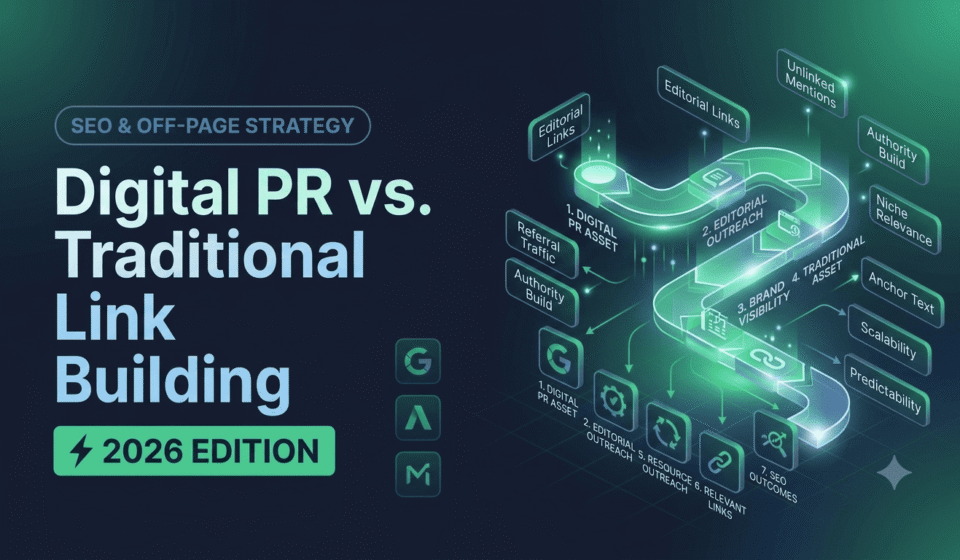

Backlinks remain an important part of SEO, but earning them is no longer simply a numbers game. A website with hundreds of links is not automatically more authoritative than one with fewer, highly relevant references from trusted sources.
That is why the debate around digital PR vs traditional link building has become increasingly important for businesses, marketers, publishers, and SEO professionals.
The short answer is this: digital PR can be the stronger long-term approach when the goal is to build authority, earn editorial coverage, increase brand visibility, and attract high-quality links. Traditional link building still has value, particularly when it focuses on relevant, useful, and legitimate opportunities.
The right choice depends on your website, industry, resources, content assets, and objectives. In many cases, the strongest SEO strategy uses both.
Digital PR vs Traditional Link Building: What Is the Difference?
The simplest distinction is based on what you are trying to earn.
Traditional link building focuses primarily on acquiring backlinks. Digital PR focuses on creating something worth talking about, with backlinks often becoming a result of that attention.
Digital PR may involve original research, proprietary data, expert commentary, surveys, reports, trend analysis, or newsworthy campaigns. A journalist or publisher may then reference the information in an article and link to the original source.
Traditional link building can involve activities such as resource-page outreach, broken-link reclamation, relevant editorial contributions, relationship building, and promoting useful content to publishers.
Neither approach is automatically superior. The real question is whether the resulting links and mentions are relevant, credible, useful, and earned for a legitimate reason.
Google’s current guidance continues to emphasize spam policies and warns against manipulative practices designed to influence search rankings.
What Is Digital PR for SEO?
Digital PR combines public relations, content marketing, and SEO to generate online attention for a brand or its expertise.
Rather than approaching a publisher with only a request for a backlink, a digital PR campaign gives that publisher a reason to cover the subject.
For example, suppose a financial website conducts a survey about how consumers are changing their saving habits. The company publishes the methodology, findings, charts, and analysis. A journalist writing about household finances could use those findings as a source.
The resulting article may mention the company and link to the original research.
That is fundamentally different from asking a website to insert a link simply because you want another backlink.
Common digital PR assets include:
- Original research
- Industry surveys
- Proprietary statistics
- Expert commentary
- Trend reports
- Data journalism
- Interactive tools
- Original studies
- Expert-led analysis
- Newsworthy campaigns
The strongest campaigns provide information that publishers can use to make their own articles more useful.
What Is Traditional Link Building?
Traditional link building is the broader practice of identifying legitimate opportunities to earn backlinks from external websites.
There are many ways to approach it.
A business might create a detailed guide and reach out to relevant websites that already reference similar resources. An SEO team might find broken links on industry pages and suggest a suitable replacement. A company may contribute genuinely useful expertise to a relevant publication.
These approaches can be valuable because the link has a logical relationship with the content.
However, there is a major difference between strategic link acquisition and link manipulation.
Buying large quantities of links, using irrelevant websites solely because they offer backlinks, participating in manipulative link schemes, or publishing low-value content at scale can create unnecessary SEO risk.
A better question is:
Would this link still make sense if search engines did not exist?
If the answer is yes because it helps readers discover a useful resource, the opportunity is much more defensible.
Digital PR vs Traditional Link Building: Key Differences
|
Factor |
Digital PR |
Traditional Link Building |
|
Main goal |
Earn attention, authority, and coverage |
Acquire relevant backlinks |
|
Typical assets |
Research, data, surveys, expert insights |
Guides, resources, contributions |
|
Link acquisition |
Often a result of coverage |
Usually a direct objective |
|
Brand exposure |
High potential |
Depends on placement |
|
Referral traffic |
Can be substantial |
Varies by link |
|
Predictability |
Less predictable |
Usually easier to plan |
|
Scalability |
Depends on campaign quality |
Can be more systematic |
|
Best suited for |
Authority and visibility |
Targeted link opportunities |
This comparison highlights an important point: backlinks are only one possible outcome of digital PR.
A successful campaign may produce links, unlinked brand mentions, referral visits, media exposure, expert recognition, and new opportunities for future coverage.
Recent industry analysis also suggests that SEO teams are increasingly evaluating link acquisition beyond backlink counts and considering brand visibility, referral traffic, and AI-search visibility.
Why Digital PR Can Be More Valuable for SEO
1. Digital PR Can Earn Editorial Links
One of the biggest advantages of digital PR is the potential to earn links within genuine editorial coverage.
Imagine a journalist writing about the rising cost of home renovations. Your company has published original research showing which renovation categories have experienced the biggest changes in consumer spending.
If the journalist uses your findings, the link exists because the information supports the article.
That context is valuable.
The objective is not simply to persuade someone to place a link. It is to become a useful source worth referencing.
2. It Builds Brand Visibility Beyond Search
Traditional link building often concentrates on the backlink itself.
Digital PR can expose a company to an entirely new audience.
A story published by a respected industry publication may reach thousands of relevant readers, even if only a fraction visit the company’s website.
This creates opportunities for:
- Brand recognition
- Referral traffic
- New customers
- Industry credibility
- Expert positioning
- Future media opportunities
That broader impact is one reason digital PR can be particularly attractive to established brands.
3. It Creates Assets That Can Keep Working
A strong research report or industry study does not necessarily stop producing value after the initial campaign.
It can later become:
- A statistic cited in another article
- A source for future journalists
- A sales presentation
- A social media asset
- A supporting resource for another blog
- A foundation for a new PR campaign
This makes digital PR more than a one-time backlink exercise.
The content itself becomes an asset that can continue generating attention.
4. It Can Support Visibility in AI Search
Search is becoming increasingly conversational.
People now use Google AI features and systems such as ChatGPT, Gemini, and Perplexity to research brands, compare products, and find explanations.
That does not mean digital PR automatically makes a brand appear in AI-generated answers. There is no guaranteed formula for that.
However, building a credible presence across relevant third-party sources can help create a stronger information ecosystem around a brand.
Current SEO discussions increasingly focus on brand mentions, citations, authority, and broader online presence alongside traditional backlinks. This broader approach is also relevant to LLM optimization, which focuses on helping AI systems understand, trust, and cite your content.
For businesses targeting both conventional search and AI-powered discovery, that broader perspective is worth considering.
When Traditional Link Building Is the Better Choice
Digital PR sounds attractive, but it is not suitable for every situation.
A small business may not have original research. A new website may need foundational links from relevant industry resources. A niche company may operate in a sector where journalists rarely cover its specific products.
In these situations, traditional link building can be more practical.
For example, an accounting firm could create a comprehensive small-business tax guide. It could then identify relevant business associations, educational resources, and industry websites that already link to useful tax information.
If the guide genuinely improves those resources, outreach has a clear purpose.
Traditional link building can therefore work particularly well for:
- Evergreen guides
- Industry resources
- Original tools
- Educational content
- Broken-link opportunities
- Relevant resource pages
- Legitimate industry directories
- Expert contributions
The key is selectivity rather than scale for its own sake.
Is Digital PR More Expensive Than Traditional Link Building?
Often, yes.
A digital PR campaign may involve:
- Research
- Data collection
- Survey development
- Content writing
- Graphic design
- Data visualization
- Media research
- Outreach
- Follow-up
- Performance measurement
That can make it more resource-intensive than targeted link outreach.
But comparing the two purely by cost per backlink can produce misleading conclusions.
Consider two hypothetical campaigns.
Campaign A earns 40 links from websites with little topical relevance.
Campaign B earns seven editorial links from highly relevant publications and generates substantial referral traffic and brand exposure.
Campaign A has more links.
Campaign B may create considerably more business value.
This is why organizations should track more than backlink volume.
Useful metrics include:
- Referring-domain quality
- Topical relevance
- Referral traffic
- Organic visibility
- Brand mentions
- Rankings
- Leads
- Conversions
- Assisted conversions
- Media coverage
How to Decide Which Strategy Your Website Needs
Before investing in either approach, ask a few practical questions.
Do You Have Something Newsworthy?
If you have original research, unique data, expert insight, or an interesting industry finding, digital PR could be a strong option.
If your website does not yet have a compelling story, create a valuable asset first.
Are You Trying to Build Brand Authority?
If your objective extends beyond rankings and includes recognition within your industry, digital PR offers a wider range of benefits.
Do You Need Links to Specific Pages?
If you have a particular evergreen resource that genuinely deserves references from relevant websites, targeted link building may be more efficient.
Are You a New Website?
A new site may benefit from foundational SEO work before investing heavily in PR.
Make sure important pages are technically accessible, useful, internally linked, and aligned with search intent.
An SEO audit tool such as VRN Exora can also be used as part of a basic review process to identify potential website issues before you invest heavily in off-page promotion.
Are You Competing in a Crowded Industry?
Digital PR can be especially useful when competitors already have strong backlink profiles.
Instead of trying to replicate every competitor’s link, develop something competitors cannot easily copy: proprietary research, original data, expert analysis, or a genuinely useful resource.
How to Create a Digital PR Campaign That Earns Links
Step 1: Identify an Interesting Insight
Start with a question people actually care about.
Look for:
- Unexpected trends
- Changes in consumer behavior
- Industry statistics
- New developments
- Contrasting data
- Seasonal patterns
- Expert opinions
A strong idea should be interesting even before you think about SEO.
Step 2: Build Evidence Around It
If you are making a claim, support it.
Use reliable data sources, transparent methodology, surveys, internal data where appropriate, or expert analysis.
Do not manufacture statistics simply because they make a better headline.
Step 3: Turn the Data Into a Story
Journalists do not necessarily want a spreadsheet.
They want to know what the information means.
Explain the finding in a way that gives the audience context.
Step 4: Create a Useful Asset
Depending on the campaign, this might be a:
- Research report
- Interactive calculator
- Survey
- Data visualization
- Industry study
- Expert guide
- Original dataset
The asset should be easy to understand and easy for publishers to reference.
Step 5: Build a Targeted Media List
Do not send the campaign to every publication you can find.
Identify journalists and publishers who already cover the topic.
A highly relevant contact is generally more valuable than a massive generic media list.
Step 6: Pitch the Story, Not the Link
This is one of the biggest differences between effective digital PR and conventional backlink outreach.
Instead of:
“Can you link to our website?”
The pitch should explain:
- What was discovered
- Why it matters
- Why their audience may care
- What makes the information original
If the story is strong enough, the link can become a natural part of the coverage.
How to Improve Traditional Link Building
Traditional link building does not need to disappear.
It simply needs to become more strategic.
Focus on Relevance
A link from a website closely related to your industry can make more sense than one from an unrelated high-authority domain.
Create Link-Worthy Resources
Instead of asking publishers to link to ordinary commercial pages, create resources people would actually want to reference.
Examples include:
- Original research
- Detailed tutorials
- Industry statistics
- Calculators
- Templates
- Checklists
- Data-driven guides
Personalize Outreach
Generic emails are easy to ignore.
Explain why the resource is relevant to the specific page or audience you are contacting.
Reclaim Existing Opportunities
Look for brand mentions that do not link to your website, outdated references, broken links, and older resources that could legitimately point to a newer version.
Measure the Result
Do not judge success solely by the number of links acquired.
A backlink that sends qualified visitors can be more valuable than several links that nobody clicks.
Common Mistakes in Digital PR and Link Building
Chasing Quantity
More links do not automatically mean better SEO.
Choosing Sites Only Because They Have High Metrics
Third-party metrics can help with research, but they should not replace judgment.
Ask whether the publication is relevant, credible, active, and useful to your target audience.
Using Manipulative Anchor Text
A natural backlink profile should not rely on forcing the same keyword-rich anchor text repeatedly.
Publishing Content Only for Links
A page created solely because it needs a backlink target is unlikely to become a valuable long-term asset.
Treating PR Like Press Release Distribution
Uploading the same announcement to numerous low-value sites is not the same as earning editorial coverage.
Ignoring Technical SEO
Off-page promotion cannot fix every website problem.
Before scaling link acquisition, review indexing, crawlability, internal links, page experience, content quality, redirects, and other technical fundamentals. A quick audit with VRN Exora can be useful for spotting issues that deserve attention before you scale an outreach campaign.
Digital PR vs Traditional Link Building: Which Is Better?
For most businesses, the answer is not one or the other.
Digital PR is particularly strong for:
- Building brand authority
- Earning editorial coverage
- Promoting original research
- Generating high-quality links
- Increasing brand visibility
- Reaching new audiences
- Supporting broader search visibility
Traditional link building is useful for:
- Earning relevant resource links
- Reclaiming broken links
- Promoting evergreen content
- Building relationships with niche publishers
- Supporting specific content assets
- Finding targeted opportunities
The two approaches can also reinforce each other.
A successful PR campaign can generate coverage from publishers that later become valuable relationships. A strong linkable asset can be promoted through digital PR. Media coverage can reveal new websites that may be interested in related resources.
In other words, the most effective strategy is often an ecosystem rather than a single tactic.
Final Verdict: Digital PR vs Traditional Link Building for SEO
So, digital PR vs traditional link building: which is better for SEO?
Digital PR is often the stronger long-term strategy when a business has genuinely useful stories, original research, proprietary data, or expert knowledge worth sharing. It can generate editorial links while also increasing brand visibility, referral traffic, credibility, and recognition.
But traditional link building remains useful when it is focused on relevant, legitimate opportunities.
The goal should not be to collect the largest possible number of backlinks. It should be to build a web presence that people and search systems have good reasons to trust.
Use digital PR when you have something worth talking about. Use traditional link building when you can identify a legitimate reason for another website to reference your content.
And whenever possible, combine both with strong technical SEO, helpful content, internal linking, and clear measurement.
The best SEO strategy is not the one that builds the most links.
It is the one that builds the most meaningful authority around your brand and the topics you want to be known for.
Frequently Asked Questions
- Is digital PR better than traditional link building for small businesses?
Not necessarily. Small businesses with original data, strong expertise, or interesting stories can benefit greatly from digital PR. Others may find targeted traditional link building more practical initially. The right choice depends on available resources, content assets, industry competitiveness, and whether the business has something genuinely newsworthy to promote.
- Does digital PR guarantee backlinks?
No. Digital PR can generate backlinks, but coverage is never guaranteed. A journalist may mention a company without linking to it, while another publisher may link to the original research. Campaign success should therefore be measured using coverage, relevant links, brand mentions, referral traffic, and business outcomes rather than guaranteed backlink numbers.
- Can traditional link building help with AI search visibility?
Potentially, but backlinks should not be treated as a guaranteed ranking or AI-search signal. AI-powered search considers information from multiple sources and systems. Relevant links can contribute to a website’s broader authority, while useful content, recognizable expertise, credible mentions, and consistent information across the web can also matter.
- Should businesses stop guest posting and focus only on digital PR?
No. Genuine guest contributions can still be useful when they provide substantial value to a relevant audience. The problem arises when guest posting becomes a scaled tactic designed primarily to manipulate rankings through low-value content and optimized links. The focus should remain on expertise, relevance, editorial quality, and usefulness.
- How can I measure whether a link-building strategy is working?
Track more than the number of backlinks. Monitor referring-domain quality, topical relevance, referral traffic, organic rankings, organic conversions, brand mentions, media coverage, and assisted conversions. For digital PR, also evaluate campaign reach and the quality of publications covering the story. This gives a clearer picture of actual SEO and business value.