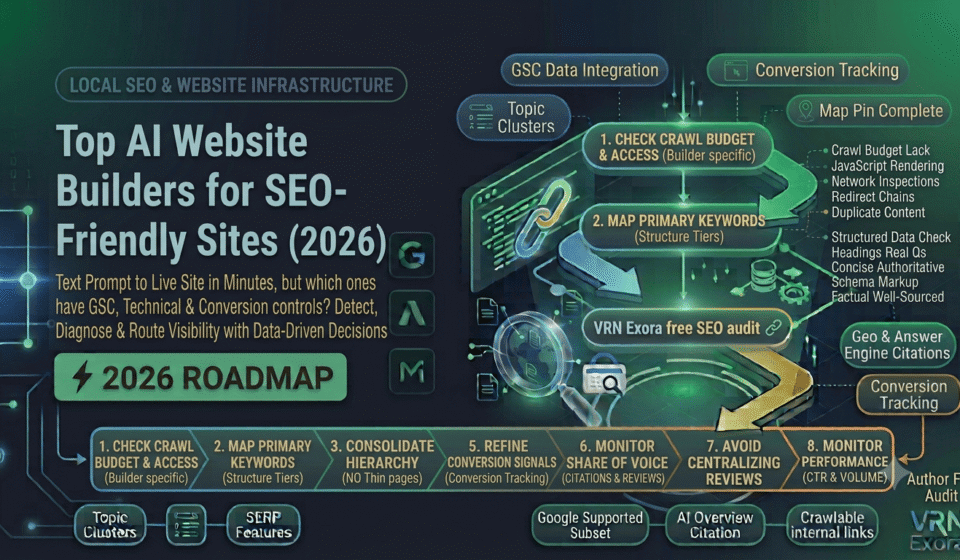

An AI website builder can generate a polished site from a text prompt in minutes, but not every one of them hands you the SEO controls needed to actually rank once that site goes live. This guide is for founders, marketers, and small business owners choosing a website builder in 2026 who want the speed of AI generation without inheriting a technically weak foundation. You will learn which platforms genuinely balance AI-assisted building with real SEO control, and which common pitfalls to watch for regardless of which one you choose.
What “SEO-Friendly” Actually Means for a Builder
A genuinely SEO-friendly website builder needs to give you direct control over title tags, meta descriptions, URL structure, header tags, image alt text, and canonical tags, not just a generated design. It also needs to render content in a way search engines can reliably crawl and index, generate a clean XML sitemap automatically, and support structured data either natively or through a straightforward integration. AI-generated visual polish is a genuine advantage for conversion and brand perception, but it says nothing on its own about whether the underlying site will actually be crawlable and indexable, which is a separate technical question worth checking directly before committing to any platform.
WordPress with AI Tools: Best for Full SEO Control and Data Ownership
WordPress remains the platform of choice specifically for SEO and full data ownership, and it still powers a substantial share of all websites globally. Tools like 10Web layer AI-assisted design and setup directly on top of WordPress, giving you the speed of AI generation without leaving an ecosystem built around SEO plugins, granular technical control, and a massive library of extensions covering nearly any specific need. This combination matters because WordPress’s SEO plugin ecosystem, including tools like Yoast, gives direct, page-level control over nearly every technical SEO variable that matters, a level of granularity most pure AI builders do not match.
Best for: Blogs, content-heavy sites, and any business that wants maximum long-term SEO control and full ownership of its data and hosting.
Webflow: Best for Structured, Scalable Marketing Sites
Webflow’s AI Site Builder generates a complete, consistent design system, colors, typography, spacing, and structure, rather than a series of disconnected AI-generated pages, and hands the result into its visual Designer for further refinement. This matters for SEO because a consistent underlying structure makes it considerably easier to maintain clean heading hierarchy, consistent metadata patterns, and a scalable CMS as the site grows well beyond an initial handful of pages. Webflow is the stronger choice specifically when a site needs more structure, richer CMS handling, or room to scale beyond a lightweight marketing presence, and it offers a documented static-code export path, though a hosted CMS, ecommerce, forms, and accounts remain separate boundaries worth checking before assuming a full site migrates cleanly.
Best for: Design-led marketing sites and growing businesses that need a real CMS and room to scale past a simple landing page.
Framer: Best for Fast, Clean Marketing Sites and Portfolios
Framer consistently comes up as the strongest default pick when the goal is a beautiful, fast marketing site, landing page, or portfolio, offering the cleanest balance of visual quality, speed, and low friction among the design-first builders. Its AI layout generation focuses on producing genuinely good-looking results rather than just functional ones, and its underlying output tends to be clean and fast-loading, which directly supports Core Web Vitals performance, a real ranking and user experience factor.
Best for: Landing pages, portfolios, and smaller marketing sites where visual polish and speed matter more than deep CMS or ecommerce functionality.
Wix: Best for Beginners Who Still Want Reliable Built-In SEO
Wix offers the most comprehensive AI features specifically aimed at marketing sites, with an AI system that generates a full first draft a beginner can then edit without needing design or technical skill. Its built-in SEO tools have matured considerably and are now genuinely reliable for most small sites, though Wix has historically carried a reputation for weaker technical SEO flexibility compared to WordPress or Webflow, a gap that has narrowed but is still worth confirming against your specific technical needs before committing.
Best for: Beginners and small local businesses that want to launch quickly with dependable, if less granular, built-in SEO tools.
Squarespace: Best for Visual Portfolios With Adequate SEO
Squarespace remains a strong pick for creatives and visual portfolios, with award-winning templates and increasingly capable AI tools that draft text and images directly inside those templates. Its SEO capabilities are adequate for most small sites and portfolios, though like Wix, it offers less granular technical control than WordPress or Webflow for teams with more advanced, specific SEO requirements.
Best for: Photographers, designers, and other visually driven businesses where portfolio presentation matters as much as content-driven SEO.
Shopify: Best for Ecommerce SEO Specifically
Shopify remains the standard choice specifically for product-based ecommerce, built for secure, scalable global selling with SEO considerations, like product schema and category structure, built into its core ecommerce templates rather than added as an afterthought. Its AI features increasingly assist with product descriptions and store setup, but its core strength for SEO specifically comes from how deliberately its ecommerce architecture, not just its AI layer, is built around the structural needs of product and category pages.
Best for: Any business selling physical or digital products online that needs ecommerce-specific SEO structure built in from the start.
What to Avoid: Common SEO Pitfalls in AI-Generated Sites
Regardless of which builder you choose, a few recurring pitfalls affect AI-generated sites specifically. Heavy reliance on client-side JavaScript rendering, common on code-first, application-oriented builders, can delay or complicate how quickly search engines discover and index new content, so confirm any code-first or app-oriented tool you consider renders content in a way crawlers handle reliably. AI-generated copy across many pages can also default to repetitive structure and phrasing if not reviewed and varied by a human, echoing the same scaled content risk that affects AI writing tools generally. Finally, always verify a builder’s static export or portability options directly rather than assuming a hosted CMS, forms, or ecommerce functionality will migrate cleanly if you ever need to move the site to a different platform later.
How to Choose the Right Builder for SEO
Match the builder to how much technical SEO control your specific situation actually requires. A simple local service business launching quickly is well served by Wix or Squarespace’s reliable, if less granular, built-in tools. A content-heavy site or blog planning serious long-term SEO investment benefits from WordPress’s deeper plugin ecosystem and full data ownership. A growing marketing site that needs a real CMS and room to scale fits Webflow well, while a smaller, design-focused site prioritizing speed and visual polish fits Framer. An ecommerce business should default to Shopify specifically for its built-in product and category SEO structure rather than trying to replicate that structure manually on a general-purpose builder.
| Builder | Best for | SEO control level |
|---|---|---|
| WordPress (with 10Web AI) | Content-heavy sites, blogs, full data ownership | Highest, via mature plugin ecosystem |
| Webflow | Structured, scalable marketing sites and CMS-driven content | High, strong native controls |
| Framer | Fast, visually polished marketing sites and portfolios | Moderate to high, clean fast output |
| Wix | Beginners and small local businesses | Moderate, reliable built-in tools |
| Squarespace | Visual portfolios and creative businesses | Moderate, adequate for most small sites |
| Shopify | Ecommerce specifically | High for product and category SEO structure |
Frequently Asked Questions
Are AI website builders bad for SEO?
Not inherently. The AI generation layer handles design and initial copy, but SEO friendliness depends on the platform’s underlying technical controls, meta tags, crawlability, structured data support, not on whether AI was involved in building the site.
Which AI website builder gives the most SEO control?
WordPress, especially paired with an AI-assisted setup tool like 10Web, generally offers the deepest technical SEO control through its mature plugin ecosystem, since it gives direct, page-level access to nearly every technical SEO variable that matters.
Is Wix good enough for SEO in 2026?
For most small sites, yes. Wix’s built-in SEO tools have matured considerably, though it still offers less granular technical control than WordPress or Webflow for businesses with more advanced or specific SEO requirements.
Does Framer’s speed advantage actually help SEO?
Yes, indirectly. Framer’s generally clean, fast-loading output supports Core Web Vitals performance, which is a real ranking and user experience factor, even though speed alone does not guarantee strong rankings on its own.
Should an ecommerce business use a general-purpose builder or Shopify specifically?
Shopify is generally the better choice for ecommerce specifically, since its core architecture builds SEO-relevant structure, like product and category schema, directly into its ecommerce templates rather than requiring it to be replicated manually on a general-purpose site builder.
What is the biggest SEO risk with code-first, AI-generated websites?
Heavy reliance on client-side JavaScript rendering can delay or complicate how search engines discover and index new content, so confirming how a code-first or app-oriented builder actually renders content for crawlers is worth checking before committing.
Get a Free Expert Review of Your Website
Choosing the right builder is only the first step, the technical setup after launch matters just as much. If you want a faster starting point, get a free SEO audit from VRN Exora and see how your site’s current SEO foundation actually holds up.


