
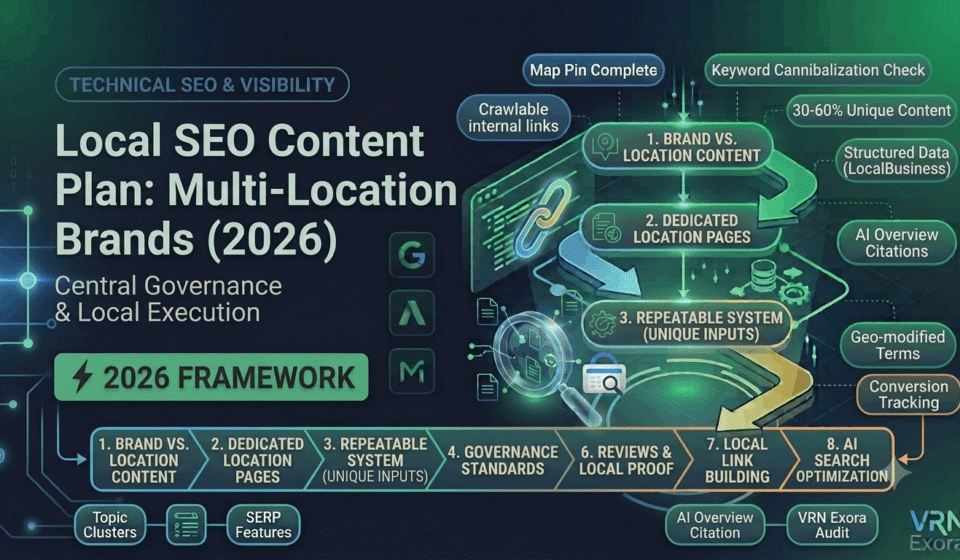

A local SEO content plan for a multi-location brand is a repeatable system for producing genuinely unique, locally relevant content across every physical location without collapsing into duplicate pages that compete against each other. This guide is for marketers, SEO managers, and franchise or multi-location business owners who need a structure that scales past ten or fifty locations without a full-time writer for every city. You will learn how to separate brand-level content from location-level content, avoid the duplicate content trap that quietly suppresses most multi-location sites, and build the governance system that keeps every new location from depending on manual, one-off effort.
What Makes a Multi-Location Content Plan Different?
Multi-location SEO is not single-location SEO repeated many times. Each location competes in its own micro-market with different competitors, different customer behavior, and different search demand, which means a strategy that wins in one city can genuinely underperform in another even when the underlying business is identical. At the same time, a multi-location brand also needs unified governance, since letting every location manage its own content and Google Business Profile independently produces exactly the inconsistency that damages trust with both users and search engines.
The content plan has to hold two things true at once: centralized brand standards and localized execution. Get the balance wrong in either direction and the result is the same failure pattern, either a set of disconnected local pages with no consistent quality, or a set of templated pages so similar that Google treats them as one thin, near-duplicate cluster instead of many distinct ranking opportunities.
Step 1: Separate Brand-Level Content From Location-Level Content
Before writing a single location page, decide which content belongs at the corporate level and which belongs at the local level. Educational resources, industry insights, evergreen guides, and core service or product pages should live in one central place rather than being duplicated across every location, since these define what the brand offers and typically stay consistent regardless of city. Brand history, leadership, mission, and company-wide differentiators belong at the corporate level too, reinforcing credibility in one authoritative place instead of being repeated with minor variations across dozens of pages.
Location pages should then reference this central content rather than recreating it. This single decision prevents the majority of duplicate content problems before they start, since most multi-location sites go wrong by treating every page as if it needs to explain the entire business from scratch.
Step 2: Build a Location Page for Every Physical Address
Every physical location needs its own dedicated page, using a clear, descriptive URL structure such as /locations/state/city/, with embedded Google Maps, direct contact information for that specific location, and a link to the corresponding Google Business Profile. Never include contact information for other locations on a single location’s page, since this dilutes the local relevance signal that page is trying to send.
The content threshold that most current guidance converges on is roughly 30 to 60 percent genuinely unique content per location page. That uniqueness needs to come from real local specifics: the neighborhoods or service area actually covered, industries or customer types common to that market, location-specific FAQs, and, where available, reviews or testimonials collected from customers at that specific location rather than reused from elsewhere in the brand.
Step 3: Solve the Duplicate Content Problem With a System
The single most common failure in multi-location SEO is the templated location page where only the city name and phone number change between one page and the next. Search engines have filtered this pattern for years, and AI systems are filtering it even more aggressively now, since their retrieval pipelines are specifically built to identify and downrank clusters of near-identical content. A brand with fifteen locations publishing fifteen pages that read identically except for the city name is not creating fifteen ranking opportunities, it is creating fifteen thin pages that compete with each other and collectively underperform a single well-built page.
The fix is a system, not a one-time rewrite. Build a content brief template for location pages that requires specific local inputs before a page can be published: the actual service area boundaries, two or three locally relevant FAQs unique to that market, a short paragraph on what makes that specific location’s customer base or competitive landscape distinct, and where possible a local landmark, neighborhood, or community reference that would not make sense on any other location’s page. Certain elements are genuinely fine to standardize across every page, including brand boilerplate, core service lists, standard calls to action, legal disclaimers, and navigation, since forcing uniqueness into these elements adds no real value for the user.
Step 4: Set Content and Governance Standards Before You Scale
Multi-location SEO breaks down specifically when content production has no clear governance and each new location depends on ad hoc manual effort. Before adding your next ten locations, document a repeatable process: who writes and approves location page content, what the minimum required local inputs are, how often GBP profiles get reviewed, and who owns fixing an underperforming location once it is identified.
Run a keyword cannibalization check before publishing any new location page, using Search Console to confirm your corporate pages are not already ranking for the geo-modified terms you plan to target locally. Without this check, brands routinely end up with a corporate service page and a new city page competing against each other for the same query, splitting ranking signals that should have reinforced a single page instead.
Step 5: Manage Google Business Profile as a Per-Location Asset
Each Google Business Profile needs to be treated and maintained as its own individual asset rather than an extension of one central corporate listing. That means consistent name, address, and phone data, accurate primary and secondary categories specific to that location’s actual services, city-specific descriptions, ongoing review responses, and regular local posts rather than a profile that gets set up once at launch and never touched again.
For franchise and multi-location brands specifically, profile quality tends to vary widely by location depending on who is responsible for it locally. Build a simple recurring checklist, such as a monthly photo upload requirement and a defined review response time, and assign clear ownership so profile quality does not depend entirely on how engaged an individual location manager happens to be.
Step 6: Build a Review Generation and Local Proof System
Reviews function as both a ranking signal and a consumer trust signal, and for a multi-location brand they also reveal which locations are actually performing well operationally. Set up a standardized, automated review request process that triggers after a completed purchase or service visit at every location, rather than leaving review generation to inconsistent, manual follow-up.
Monitor review trends across locations centrally so you can identify what a high-performing location is doing differently and replicate it elsewhere, while also catching a negative trend early at an underperforming location before it damages the broader brand. Where possible, collect first-party reviews and testimonials directly from customers and publish them on the relevant location page, since this both diversifies your content and gives the brand ownership of that proof rather than relying entirely on third-party platforms.
Step 7: Plan Local Link Building Market by Market
Local backlinks need to be earned market by market rather than pursued as one generic national campaign. Build relationships with local business associations, chambers of commerce, and community organizations relevant to each specific market, and look for unlinked mentions of individual locations in local news coverage that can be converted into links.
This step is slower and more resource-intensive than centralized content work, so most multi-location brands prioritize it for their highest-value or most competitive markets first, then expand the same playbook to additional locations once it is proven to work.
Step 8: Optimize for AI Overviews on Local Queries
AI Overviews now appear prominently for many local search queries, and the businesses appearing inside those AI-generated answers are not always the same ones ranking first in traditional blue-link results. AI systems draw heavily on structured data, authoritative local content, and strong Google Business Profile signals to generate these answers, which means a location page with incomplete schema or thin content will lose ground to a competitor with cleaner, more complete local signals even if the underlying business is comparable.
Ensure LocalBusiness schema is complete for every location, including service area, hours, and accepted payment methods, and confirm the business information on your website and Google Business Profile is genuinely consistent, since studies have found a meaningful share of business contact information appearing in AI assistants like ChatGPT and Perplexity does not actually match the underlying Google Business Profile data. That gap is a direct, fixable cause of missed AI visibility and LLM optimization opportunities for multi-location brands specifically.
How to Audit and Maintain the Plan as You Grow
Run a full audit of your location pages, GBP profiles, and citation consistency quarterly. Check for content that has drifted back toward templated similarity as new locations were added under time pressure, since this pattern tends to creep back in without deliberate governance even after an initial cleanup.
Treat each new location as a test of whether your system actually works without heavy manual intervention. If launching a new location still requires significant one-off effort from a senior team member rather than following the documented process, the system needs refinement before you add the next ten locations on top of it.
Frequently Asked Questions
How much unique content does each location page actually need?
Most current guidance points to roughly 30 to 60 percent unique content per page, built from real local specifics like service area details, locally relevant FAQs, and location-specific proof, rather than a template with only the city name changed.
Should every location have its own Google Business Profile?
Yes. Each physical location needs its own individual Google Business Profile managed as a distinct local asset, rather than one corporate listing or a virtual office standing in for multiple physical addresses.
What is the biggest mistake multi-location brands make with location pages?
Publishing templated pages where only the city name and contact details change between locations. Search engines and AI systems both identify and suppress this near-duplicate pattern, which means the pages compete with each other instead of each ranking independently.
How often should a multi-location content plan be audited?
Quarterly is the standard recommendation, since content quality and profile consistency tend to drift as new locations are added, especially under time pressure that pushes teams back toward shortcuts and templates.
Does content need to be duplicated for franchise locations run by different owners?
No, and this is precisely where governance matters most. A shared framework with required local inputs, paired with clear ownership and training for franchisees, keeps quality consistent without forcing every location to write from a blank page or duplicate a shared template.
Do multi-location brands need to think about AI Overviews separately from traditional local SEO?
Yes, to a meaningful degree. AI Overviews weigh structured data and Google Business Profile completeness heavily, and a location can rank well in traditional local results while still being skipped in AI-generated answers if its schema or listing data is incomplete or inconsistent.
Get a Free Expert Review of Your Multi-Location Strategy
Building a system that scales across many locations without collapsing into duplicate content takes the right structure from the start. If you want a faster starting point, get a free SEO audit from VRN Exora and see exactly where your location pages and local signals stand today.