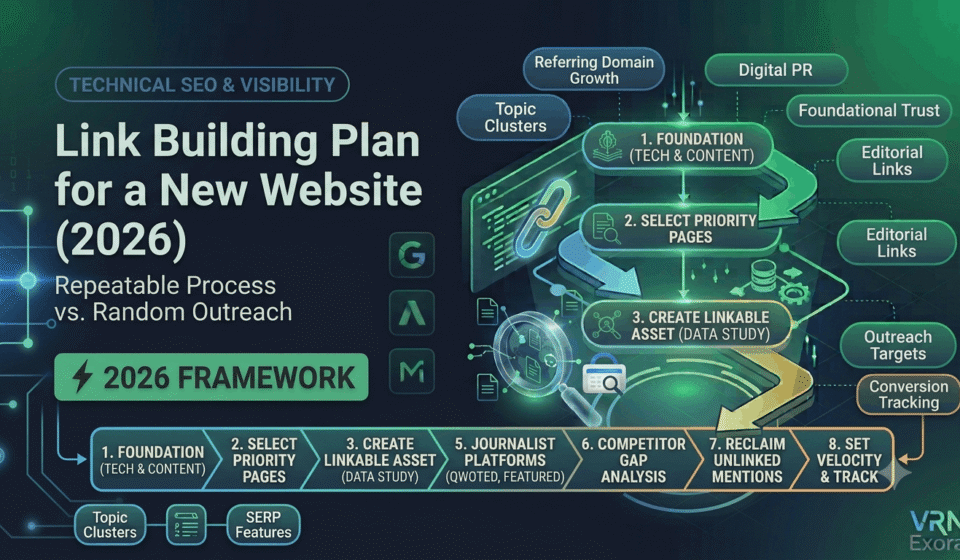

A link building plan for a new website is a documented, repeatable process for earning backlinks in a deliberate order, rather than a scramble of guest post pitches and directory submissions with no strategy behind them. This guide is for founders, marketers, and SEO managers launching a new site who want to understand exactly where to start and in what sequence. You will learn how to lay the groundwork before outreach even begins, which pages deserve link-building attention first, how to create something worth linking to, and what a realistic timeline actually looks like for a brand-new domain.
Why New Websites Need a Plan, Not Random Outreach
Most new sites approach link building backwards, sending outreach emails before there is anything genuinely worth linking to. A recent industry study found that only a minority of link builders follow a documented, repeatable process, which means most sites are building links by improvisation rather than strategy. The businesses that treat link building as a structured plan see the compounding benefits: steadier link velocity, better link quality, and rankings that actually hold instead of fading after the next algorithm update.
This matters even more for new sites specifically. The vast majority of pages on the web have zero backlinks, and links simply do not happen by accident. A new domain starts with no history and no earned trust, so every step in this plan is designed to build that trust in a logical order rather than hoping links arrive on their own.
Step 1: Lay the Foundation Before Chasing Any Links
Before any outreach, confirm the site itself is worth linking to. This means a clear value proposition, functioning technical SEO, and content that is genuinely useful rather than thin placeholder pages. A journalist, blogger, or fellow site owner who clicks through from an outreach email and lands on an unfinished or confusing page will not link, no matter how good the pitch was.
This is also the stage to set up tracking. Record your starting referring domain count, even if it is zero, and note which competitor sites you will benchmark progress against. Without a starting point, it becomes impossible to prove the plan is actually working three or six months in.
Step 2: Pick the 3 to 5 Pages Worth Building Authority For
Do not build links for every page on the site. Choose three to five pages that either convert directly or sit at the center of a topic cluster, where gaining authority on that one page lifts the rankings of several related pages around it. Spreading early link-building effort across dozens of pages dilutes the impact each individual link has, which matters even more for a new site with a small overall link budget.
Once these priority pages are chosen, align your internal linking to support them. This is the step most new sites skip, and it means any authority earned from an external link partially leaks away because nothing on the site is passing that value back to the pages that actually need it.
Step 3: Create One Genuinely Linkable Asset
Digital PR, meaning original research, data-led stories, and expert commentary pitched to journalists and publications, is currently the most effective link building approach, and it works because it gives people an actual reason to link rather than asking for a favor. Google’s spam updates over the past two years have largely stopped rewarding paid links, private blog networks, and mass guest post farms, which means the strategies that still move rankings are the ones built around something genuinely worth citing.
Before creating something from scratch, check whether an existing page on the site is already attracting some organic interest or early backlinks, since improving and re-promoting that page is often faster than starting a brand-new asset. For a new site with no existing content to build on, choose one small, specific, citable format rather than a broad, generic resource: an original survey of your own customers, a simple free calculator or tool relevant to your niche, or a well-sourced data study pulling together public information nobody has organized before. The goal is a piece specific enough that a publisher would realistically cite it as a source.
Step 4: Set Up Foundational and Directory Links
Foundational links will not move rankings dramatically on their own, but they establish the baseline trust signals that make later outreach more credible. Claim listings on the directories genuinely relevant to your industry and location rather than submitting to every generic directory that will accept a listing, since low-quality directory spam is exactly the pattern Google’s spam updates now ignore or discount.
Where relevant, also set up profiles on industry-specific platforms your audience actually uses. These rarely count as strong ranking signals individually, but they create the kind of consistent brand footprint that supports every other link-building effort that follows.
Step 5: Use Journalist-Source Platforms for Early Editorial Links
Journalist-source platforms remain one of the more accessible ways for a new site to earn editorial links from established publications, since they connect experts directly with reporters actively looking for quotes and commentary. HARO itself relaunched under new ownership after its 2024 shutdown, but the more effective options today are typically Qwoted, which uses algorithmic matching to connect experts with a large journalist network, and Featured, which curates opportunities to your specific niche rather than sending a broad daily digest.
Success on these platforms depends less on the platform and more on the response. Reply within the first hour of a request going out, lead with a ready-to-use quote rather than a pitch about yourself, and offer something specific and original rather than a generic answer that reads like it came from an AI tool, since journalists have become noticeably better at spotting and ignoring exactly that pattern. Diversify across two or three platforms rather than relying on just one, since query volume and journalist quality vary considerably between them.
Step 6: Run a Competitor Backlink Gap Analysis
Once the site has a small foundation of links, pull the backlink profiles of two or three established competitors using a tool like Ahrefs or Semrush and look specifically for domains linking to multiple competitors but not yet to you. These sites have already shown a willingness to link to businesses like yours, which makes them a far more efficient outreach target than a cold list built from a generic search.
Use this analysis to inform format decisions too. If a specific type of content, such as a comparison guide or an original industry survey, consistently earns links across your competitors, that is a strong signal for what your next linkable asset should be.
Step 7: Reclaim Unlinked Mentions
As the site starts to build a presence, set up basic brand mention monitoring to catch instances where another site references your business, product, or founder by name without linking to you. Converting an existing mention into a link is typically faster and has a higher success rate than earning a brand-new link from scratch, since the writer or publication has already decided your business was worth mentioning.
A short, polite email pointing out the mention and asking for a link is usually enough. This tactic scales naturally as brand awareness grows, so it becomes a more productive channel the longer the site has been active.
Step 8: Set a Realistic Timeline and Link Velocity
Link building for a new website is a compounding process, not a sprint, and setting the wrong expectations early is one of the most common reasons founders abandon a plan too soon. In the first one to three months, expect mostly foundational and directory links plus early journalist-platform placements, with digital PR and gap-analysis outreach picking up meaningfully from month three onward as the site has more to point to and more history to reference in pitches.
Aim for a steady, natural link velocity rather than a burst of many links in a short window followed by silence, since an unnatural spike is one of the patterns that draws scrutiny. A smaller number of relevant, earned links arriving consistently over time outperforms a large batch acquired all at once, both for how Google evaluates the pattern and for how sustainable the process actually is to maintain.
How to Track and Maintain the Plan
Review referring domain growth, not just total backlink count, every month, and revisit the full plan quarterly. Track which channel, digital PR, journalist platforms, directory links, or mention reclamation, is producing the strongest and most relevant links, and shift more effort toward whichever channel is actually working rather than spreading effort evenly across all of them indefinitely.
As the site matures, layer in guest posting and deeper relationship-based outreach with industry publications, but keep the same standard throughout: every link should come from a page or process that would hold up under scrutiny, since links that used to be bought or traded are the ones Google’s recent updates are actively learning to ignore.
Frequently Asked Questions
How long does it take a new website to build a meaningful backlink profile?
Expect the first three months to focus mostly on foundational links, with digital PR and gap-analysis outreach starting to produce meaningful editorial links from around month three onward as the site builds more credibility and content to reference.
How many backlinks does a new page need to rank?
There is no fixed number, and quality matters far more than volume. Research on top-ranking pages has found the median number of backlinks is considerably lower than most people assume, which means a small number of relevant, earned links can outperform a much larger pile of low-quality ones.
Is guest posting still worth doing in 2026?
Selective, genuinely relevant guest posting on real publications with an active audience still works, but mass guest-post farms built purely to pass links are now the kind of pattern Google’s spam updates largely ignore or discount.
Should a new website use paid link building services?
Paid links, private blog networks, and mass link farms are increasingly ignored by Google’s algorithms rather than penalized outright, which means the money spent on them is largely wasted rather than a risky shortcut worth the gamble.
What is the fastest way for a brand-new site to earn its first real links?
Journalist-source platforms like Qwoted or Featured tend to be the fastest realistic path to an early editorial link, since they do not require an existing reputation, only a specific, well-written answer submitted quickly after a relevant request goes out.
Do backlinks still matter now that AI search is growing?
Yes, and increasingly for a second reason beyond rankings. The same link-earning activities, original research, expert commentary, and citable data, also tend to earn citations in AI-generated answers, so a genuine link-building plan supports both traditional SEO and AI search visibility at once.
Get a Free Expert Review of Your Site’s Link Foundation
Building the right link foundation from day one saves months of wasted outreach later. If you want a faster starting point, get a free SEO audit from VRN Exora and see exactly where your new site stands before you send a single pitch.