
If you’ve spent any time in a marketing meeting this year, you’ve probably heard someone say “just have AI write it” and someone else say “no, Google will bury it.” Both of them are a little bit right and a little bit wrong.
The truth in 2026 is messier than either side wants to admit. AI content isn’t dead. Human content isn’t automatically better. What actually works is understanding what each one is good at and where it falls apart.
Let’s get into it.
Quick Answer: What Wins in 2026?
Search engines and answer engines like Google AI Overviews, ChatGPT, and Perplexity don’t reward content because a human or a machine wrote it. They reward content that is accurate, well-organized, backed by real experience, and easy to extract. AI-written content can rank if it’s edited, fact-checked, and shaped by a human who knows the topic. Purely human content can also fail if it’s poorly structured or thin on substance.
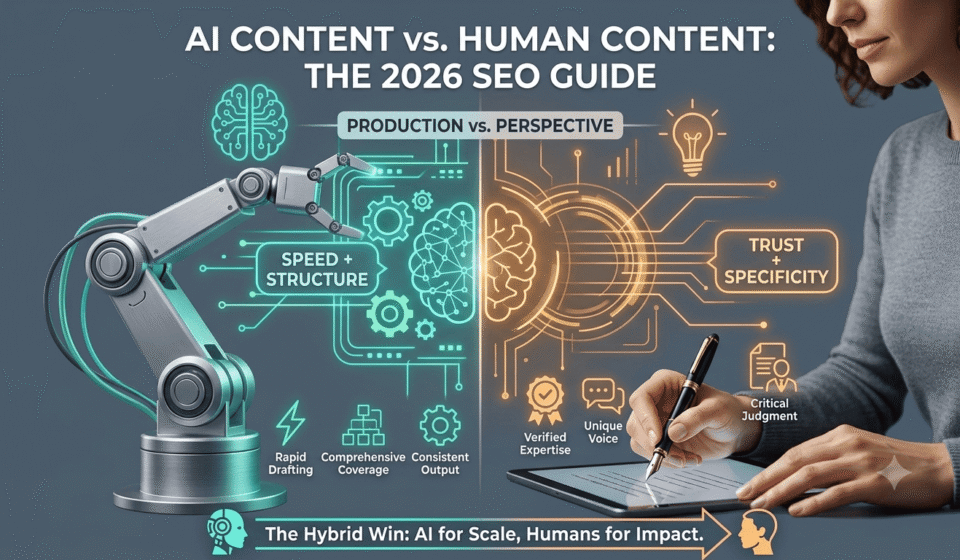
The winning formula is a hybrid one: AI for speed and structure, humans for judgment, experience, and trust. This approach is at the heart of LLM optimization, where the goal is to make content easier for AI systems to understand, trust, and cite.
Why AI vs. Human Content Matters for SEO in 2026
Search itself has changed shape. It used to be one search box and ten blue links. Now you’ve got Google’s AI Overviews sitting right at the top, plus millions of people asking ChatGPT or Perplexity questions instead of typing them into Google at all.
This shift has a name: Generative Engine Optimization, or GEO, alongside Answer Engine Optimization, or AEO. Both are about getting your content picked up, summarized, and cited by AI systems, not just ranked on a results page.
That changes the stakes. If your content is generic AI fluff with no real point of view, an AI summarizer has nothing worth quoting. If your content is packed with genuine experience and clear answers, it becomes the source that gets cited, even if a human never clicks through to your site.
What Are the Benefits of AI-Generated Content?
Let’s give credit where it’s due. AI writing tools in 2026 are genuinely useful, and pretending otherwise doesn’t help anyone.
Speed: A first draft that used to take three hours can now take fifteen minutes. That’s not a small thing when you’re trying to publish consistently.
Structure: AI is good at organizing information logically, breaking down complex topics into digestible sections, and following an outline without wandering off track.
Coverage: AI can quickly cover a topic from multiple angles, which helps when you’re trying to build out a comprehensive resource instead of a thin 500-word post.
Consistency: Tone, formatting, and structure stay consistent across a large content library, which is genuinely hard to maintain with a team of five different writers.
None of this is fake or cheating. It’s just a tool doing what tools do.
What Are the Downsides of AI-Generated Content?
Here’s where things get shaky and where many businesses get burned.
AI content tends to be generic. It says true things, but it says the same true things everyone else’s AI-generated article also says. There’s no fresh insight, no “here’s what actually happened when we tried this,” no strong opinion backed by scars from experience.
It also has a habit of sounding confident while being wrong. AI tools can invent statistics, misattribute quotes, or describe outdated information as current fact. If nobody checks it, that mistake goes live and quietly damages your credibility.
And search engines have gotten better at spotting the pattern. Content that reads like it was assembled from a formula, without any real voice or specificity, tends to sit flat in rankings even if it’s technically well-written.
Why Does Human-Written Content Still Rank Well?
This is the part that actually matters for ranking and trust in 2026.
Google’s quality guidelines lean heavily on something called E-E-A-T: Experience, Expertise, Authoritativeness, and Trust. Notice that the first letter stands for Experience specifically, not just knowledge.
A human who has actually run the SEO audit, actually made the pricing mistake, and actually tested the tool can write a sentence that no AI model can generate from scratch: a specific, first-hand, slightly imperfect detail that proves someone was really there.
That’s the thing AI content is missing. It can describe a process. It can’t tell you what surprised the writer about the process, because it didn’t go through it.
Humans also bring judgment about what to leave out. Good writing isn’t just adding information; it’s deciding what the reader doesn’t need. AI tools, left unsupervised, tend to include everything, which makes content longer without making it more useful.
AI Content vs. Human Content: A Side-by-Side Look
|
Factor |
AI-Generated Content |
Human-Written Content |
|
Speed of production |
Very fast |
Slower, more deliberate |
|
Structure and formatting |
Strong, consistent |
Varies by writer |
|
Original insight or experience |
Weak or absent |
Strong, if the writer knows the topic |
|
Factual accuracy |
Needs verification |
Depends on research quality |
|
Voice and personality |
Generic unless heavily edited |
Distinct and memorable |
|
Trust signals (E-E-A-T) |
Low on its own |
High when written by real experts |
|
Cost to produce at scale |
Low |
Higher |
|
Risk of sounding like everyone else |
High |
Low, if genuinely original |
Looking at this table, the pattern is pretty clear. AI wins on production. Humans win on trust and originality. Neither one wins on everything.
What Is the Best Content Strategy: AI, Human, or Both?
Most businesses that are actually seeing results in 2026 aren’t choosing a side. They’re combining both in a specific order.
Here’s roughly what that looks like in practice.
- Research and outline with AI: Use it to gather angles, competitor gaps, and a logical structure fast.
- Draft with AI, guided by a real brief: Feed it specific facts, data, and direction rather than a vague topic.
- Rewrite the parts that matter with a human: Add first-hand experience, opinions, examples, and anything that proves a real person or real business stands behind this.
- Fact-check everything: Every number, every claim, and every “studies show” needs a real source.
- Edit for voice: Strip out the generic phrasing that makes AI content sound like it was written by nobody in particular.
This isn’t slower than pure AI writing, and it’s not as slow as pure human writing either. It’s the sweet spot.
How to Optimize Content for Both Search Engines and AI Engines
This is where GEO and traditional SEO actually overlap more than people expect. A few things matter for both.
Answer the Question Directly, Near the Top
AI Overviews and chat assistants pull sentences that directly and clearly answer a question. Bury your answer in paragraph six, and it won’t get pulled at all. Say the answer plainly and early, then explain it.
Use Clear, Simple Headings
Headings should read like real questions or clear statements, not clever wordplay. “What Actually Works for SEO in 2026” gets picked up more easily than something vague and abstract. This helps both a skimming human and a crawling AI system understand your structure instantly.
Back Up Claims with Specifics
Vague statements like “many businesses see better results” don’t help you. Specific numbers, named tools, and real examples do. Specificity is one of the strongest signals that content came from actual expertise.
Keep Structure Clean
Short paragraphs. Tables where comparison helps. Bullet points should be used where a list genuinely is a list. This isn’t just about readability for people; it’s also how AI systems extract and summarize your content accurately.
Don’t Skip the Technical Basics
None of this matters if your site is slow, poorly indexed, or missing basic technical hygiene. This area is honestly where many businesses lose visibility without realizing content had nothing to do with it.
Running a proper audit catches these issues before they quietly cap your rankings. This is one of the areas VRN Exora focuses on, helping businesses find the technical and structural gaps that keep otherwise valuable content from ranking or getting picked up by AI engines.
How Do AI Engines Decide What Content to Cite?
It’s useful to understand how a tool like ChatGPT or Google’s AI Overview chooses a source to quote.
These systems don’t read your whole page and form an opinion like a person would. They’re scanning for chunks of text that clearly answer a specific question, sit in a logical spot, and don’t require extra context to make sense.
That means a paragraph buried under three layers of fluffy introduction rarely gets picked, even if the information inside it is genuinely useful. A paragraph that states the answer plainly, in one or two sentences, gets pulled far more often.
This is also why FAQ sections work so well right now. Each question and answer pair is already a self-contained, extractable unit. It’s basically pre-packaged for an AI engine to lift and use.
If you write with this principle in mind from the start, you’re not just writing for people anymore. You’re writing in a format that both a human skimming on their phone and an AI model scanning your page can use immediately.
What Are the Most Common AI Content Mistakes?
A few patterns show up again and again when content underperforms, and most of them aren’t really about AI versus human at all.
Publishing AI Drafts with Zero Review
This is the most common one. Nobody checked the facts, nobody added a real opinion, and it shows within the first two paragraphs.
Over-Polishing Human Writing Until It Sounds Like AI
Ironically, some heavily “SEO-optimized” human content ends up sounding just as generic as an unedited AI draft, because every ounce of personality got edited out in favor of keyword density.
Ignoring the Technical Side Entirely
Even a brilliant, expert-written article won’t perform if the page loads slowly, isn’t indexed properly, or is buried three clicks deep with no internal links pointing to it. Content and technical SEO are not separate projects; they succeed or fail together.
Chasing Word Count Instead of Clarity
Longer isn’t automatically better. A tight, clear 1,200-word answer often outperforms a padded 3,000-word one, especially for AEO and GEO purposes where extractable clarity matters more than sheer volume.
Never Updating Old Content
AI engines and search engines both favor current, accurate information. An article from two years ago that was never updated gradually becomes less relevant, even if it was excellent when it was published.
Most of these mistakes are avoidable with a second look before hitting publish or with an outside audit that catches what’s easy to miss from the inside.
Does Google Penalize AI-Generated Content?
A common fear is that Google or ChatGPT will penalize content just for being AI-written. As of 2026, there’s no confirmed penalty simply for using AI in the writing process.
What actually gets penalized is low-quality, unhelpful, or inaccurate content, regardless of who or what wrote it.
So the real question was never “did AI write this.” It’s always been “is this actually good, accurate, and worth someone’s time.”
The Bottom Line
AI versus human content was never really the right fight to pick. The businesses winning in search and in AI-generated answers right now are the ones using AI for speed and structure, then adding real human experience, judgment, and voice on top.
If you’re not sure where your own content or site stands, running a proper audit is a good place to start.
It’s worth checking out VRN Exora’s free SEO audit to see exactly where your content and technical setup need work before you invest more time writing.
There was never any need to prove whether someone or a machine wrote your content. It’s to show that your content is interesting to someone or something.
Frequently Asked Questions
Does Google penalize AI-generated content?
No, not simply for being AI-generated. Google’s guidance focuses on helpfulness and quality, not authorship method. Poorly written, inaccurate, or generic content underperforms whether a human or an AI wrote it.
Can AI content rank on its own without human editing?
It can, especially for simple, factual topics with low competition. But for anything competitive or opinion-based, unedited AI content tends to struggle because it lacks the depth and originality that both readers and ranking systems reward.
What’s the difference between SEO, AEO, and GEO?
SEO is about ranking in traditional search results. AEO focuses on getting your content chosen as the direct answer to a question. GEO is about getting cited and summarized inside AI-generated responses like Google AI Overviews or ChatGPT answers. They overlap heavily but aren’t identical.
How do I know if my content is optimized for AI engines?
Check whether your key answers appear clearly and early in the content, whether your structure uses simple headings, and whether your claims are specific and sourced. A proper audit can flag exactly where the gaps are, which is a lot easier than guessing.