
Have you ever told someone you are into content creation and the next question you get is, “Can you name the top 5 content creation tools?”
Content creators get asked this question all the time.
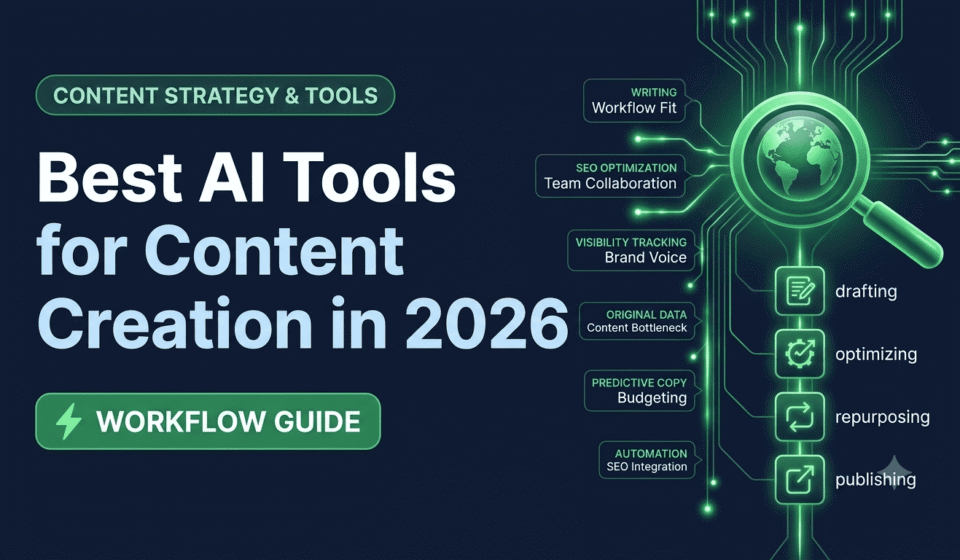
The truth is, no single tool is “the best” for everyone. The best AI content creation tool depends on what you’re creating, how big your team is, and where your actual bottleneck is: drafting, optimizing, or publishing.
This guide breaks down the AI writing tools and content platforms that are actually worth using in 2026, what each one is genuinely good for, and how to pick the right one without wasting your budget.
Quick Answer: What’s the Best AI Content Creation Tool?
Most marketing teams prefer Jasper because of its brand voice controls and campaign-ready workflows. ChatGPT provides more value per dollar for solo creators and founders. Teams interested in LLM content optimization and search visibility should look into Frase or Semrush’s content tools. Rytr is an affordable option for short-form writing.
There isn’t one universal winner. The right choice depends on your workflow, team size, and whether your real problem is writing speed or everything that happens around the draft.
What Are AI Content Creation Tools?
AI content creation tools are software platforms that use generative AI to help write, edit, optimize, and publish content. This includes blog posts, ad copy, emails, social captions, and even images or video.
Some tools are simple assistants you guide with prompts. Others are full platforms that hold your brand voice, product facts, and publishing workflow, so you don’t have to rebuild your instructions every time.
Understanding this difference matters more than comparing feature lists, since it decides how much setup work a tool needs before it is actually useful to your team.
How to Choose the Right AI Content Tool
Before comparing tools, it helps to get clear on three things.
First, what are you actually creating: blog posts, ad copy, social content, or a mix of all three? Second, is your team’s real bottleneck the writing itself, or is it research, fact-checking, and editing after the draft is done? Third, how many people need access, since seat limits and pricing tiers can change the real cost fast.
Once you’re clear on these three answers, most of the options below narrow down naturally.
Best AI Content Creation Tools at a Glance
|
Tool |
Best For |
Starting Price |
Free Plan |
|
Jasper |
Marketing teams needing brand-consistent content |
Around $50 to $60/month |
Trial only |
|
ChatGPT |
Solo creators and flexible everyday writing |
Free, paid plans from $20/month |
Yes |
|
Copy.ai |
Automating repeatable marketing and sales content |
Around $30/month |
No |
|
Frase |
SEO briefs and content optimization |
Around $40/month |
Trial |
|
Semrush Content Toolkit |
SEO-data-driven blog writing |
Around $60/month |
Trial |
|
Writesonic |
SEO content plus AI search visibility tracking |
Around $80/month |
Trial |
|
Anyword |
Predictive, performance-scored ad and email copy |
Around $40/month |
Trial |
|
Rytr |
Budget-friendly short-form writing |
Free, unlimited plan around $8/month |
Yes |
|
HubSpot Content Hub |
Content connected to CRM and website |
Free tools and paid plans vary |
Yes |
This table is a starting point, not a final answer. The right pick depends heavily on your use case, which we’ll go through next.
Jasper is the Best Content Creation Tool for Marketing Teams
Jasper is built for teams, not solo writers typing prompts into a blank box. It focuses on keeping brand voice consistent across blog posts, ads, emails, and social content, which matters a lot once more than one person is writing for the same brand.
It works well for marketing teams of five to fifty people who need content that sounds consistent no matter who’s writing it. It’s less useful for someone who only needs the occasional blog post.
ChatGPT Is the Best and One of the Most Flexible AI Assistant
ChatGPT remains the most flexible AI writing tool available, and it offers excellent value. It handles brainstorming, outlines, first drafts, editing, and repurposing content, all in one place.
It works best for solo marketers, founders, and freelancers who want maximum flexibility without a big monthly bill. The tradeoff is that ChatGPT doesn’t come with built-in SEO scoring or a content workflow. You have to build that process yourself.
Copy.ai Is Best for Automating Repeatable Content
Copy.ai has shifted from simple copywriting into a platform built for repeatable marketing and sales workflows. Instead of writing one piece at a time, it lets teams set up workflows that automatically generate things like outreach content, product descriptions, or campaign copy on a recurring basis.
This is a strong fit for revenue and marketing teams that produce the same types of content again and again and want to automate that process instead of starting from scratch each time.
Frase and Semrush Content Toolkit Is Best for SEO
If your content needs to rank in search results, Frase and Semrush’s content tools are worth a serious look.
Frase focuses on research, SEO briefs, and content scoring, plus a feature that monitors published pages for ranking drops over time. Semrush Content Toolkit ties its writing tools directly to real keyword and competitor data, which helps ground content in actual search demand instead of guesswork.
Both are strong picks for content teams and SEO specialists who want their writing tool to also understand search intent and competition, not just generate paragraphs.
Writesonic Is Best for AI Search Visibility
Search itself has changed. People are asking questions inside tools like ChatGPT and Google’s AI Overviews, not just typing into a search bar.
Writesonic stands out because it doesn’t just write content, it also tracks whether your brand is actually showing up inside these AI-generated answers. For teams that care about visibility beyond traditional rankings, this capability is a genuinely useful feature most competitors don’t offer.
Anyword Is Best for Predictive, Performance-Based Copy
Anyword takes a different approach entirely. Instead of just generating copy, it scores each version based on predicted performance, which is especially useful for ad copy, email subject lines, and landing pages where small wording changes affect conversion rates.
This tool fits performance marketers running many variants and wanting a data-backed way to choose between them, rather than guessing which version will perform best.
Best Budget Option: Rytr
Rytr is the honest, no-frills budget pick. It’s built for short-form content like product descriptions, social captions, and quick rewrites, and its free plan is genuinely usable for testing before you commit to anything paid.
It’s best suited for freelancers and solo creators who need affordable, straightforward writing help. It’s not designed for long-form, research-heavy content or advanced SEO workflows.
Best for Teams Connected to CRM and Website: HubSpot Content Hub
If your content, website, and customer data already live inside HubSpot, Content Hub keeps everything connected. Blog creation, landing pages, and content tied directly to your CRM data all live under one roof.
This makes the most sense for teams already using HubSpot as their core marketing platform. For everyone else, it’s a lot of extra systems to buy into just for content creation.
Which Is the Best Free AI Content Creation Tool?
If you’re just getting started, a few tools offer genuinely usable free plans. ChatGPT’s free plan covers a wide range of writing tasks.
Rytr’s free tier works for light short-form content, though it caps out quickly. HubSpot also offers some free content tools tied to its broader platform.
Free plans are great for testing tone, quality, and workflow fit. They’re rarely enough to run a full content calendar, so treat them as a trial run rather than a long-term plan.
Common Mistakes When Choosing an AI Content Tool
A few mistakes show up again and again when businesses pick the wrong tool.
The biggest one is buying based on the cheapest entry price, without checking what’s actually included once you need real team features. Many tools look affordable until you hit a seat limit or a usage cap.
Another common mistake is assuming that every “SEO” or “AI-optimized” tool covers the same areas. Some only optimize for traditional search engines, while others also track visibility inside AI answer engines, which is a different feature entirely.
The last mistake is publishing AI-generated content without review. AI tools speed up drafting, but they still need a human to check facts, match brand voice, and confirm the content actually answers what the reader is searching for. Skipping this step is exactly how businesses end up with generic content that doesn’t rank or convert.
This phase is also where working with a team that understands both content and technical SEO helps. VRN Exora helps businesses build content workflows that combine AI speed with real SEO strategy, so the content doesn’t just get published faster; it actually performs.
How to Match an AI Tool to Your Content Goals
A simple way to narrow your decision: if you’re a solo creator, start with ChatGPT or Rytr. If you’re a marketing team that needs consistent brand voice across multiple writers, Jasper is a strong fit.
If ranking in search and AI answers are your main goals, Frase, Semrush, or Writesonic deserves a closer look. If you’re automating repeatable content at scale, Copy.ai fits that job specifically.
Most successful content teams don’t rely on just one tool. They pair a drafting tool with an optimization tool, since each one solves a different part of the content process.
Final Thoughts
The best AI content creation tools are the ones that actually fit how your team works, match your content goals, and don’t create more editing work than they save.
AI can speed up the writing process significantly, but the businesses seeing real results in 2026 are the ones pairing AI speed with a real content and SEO strategy behind it.
If you’re not sure where to start, getting a professional look at your content and technical setup can save a lot of trial and error. VRN Exora offers a free SEO audit that shows exactly where your content strategy and site setup need work, so your content, AI-assisted or not, actually has a chance to rank.
Frequently Asked Questions
What is the best AI tool for content creation in 2026?
There’s no single best tool for everyone. Jasper is the strongest pick for marketing teams needing brand-consistent content, ChatGPT offers the most flexibility for solo creators, and Frase or Semrush Content Toolkit are better suited for SEO-focused content. The right choice depends on your team size and content goals.
Can AI-generated content actually rank on Google?
Yes, AI-generated content can rank well, as long as it’s genuinely helpful, accurate, and reviewed by a human before publishing. Search engines reward useful, well-structured content regardless of whether AI helped write the first draft. Unedited, generic AI content tends to underperform, not because it’s AI-written, but because it lacks depth and originality.
What’s the difference between SEO tools and AI content tools?
SEO tools focus on helping content rank in traditional search results using keyword and competitor data. AI content tools focus on generating and optimizing the writing itself. Some platforms, like Frase and Semrush Content Toolkit, combine both, which is useful if you want writing and search strategy in one place.
Is ChatGPT good enough for business content creation?
Yes, especially for solo marketers, founders, or small teams. ChatGPT is flexible and affordable, covering everything from outlines to full drafts to editing. It doesn’t include built-in SEO scoring or brand workflow features, so teams needing that structure often pair it with a dedicated content or SEO tool.
Are free AI content creation tools worth using?
Free plans are worth using to test quality, tone, and workflow fit before committing to a paid plan. Most free tiers are limited in volume, so they work well for testing but aren’t built to support a full, ongoing content calendar.