
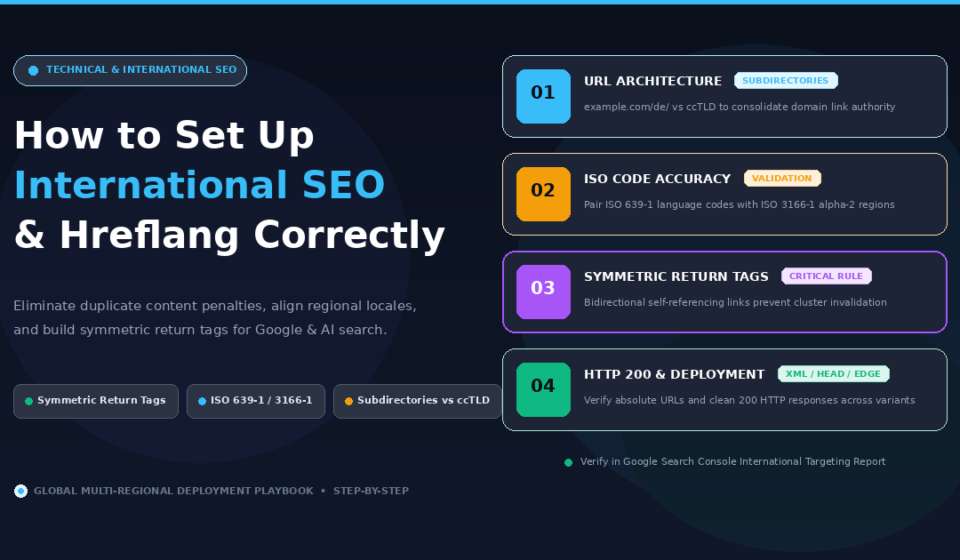

Hreflang is the HTML attribute that tells search engines which language and regional audience a page targets, and which alternate versions of that page exist for other locales, preventing your international content from competing against itself or showing the wrong version to the wrong audience. This guide is for SEO managers, developers, and site owners expanding into multiple languages or countries who want a precise, implementation-ready process, since hreflang errors are extremely common across the web and even a single mistake can cause Google to ignore an entire cluster of otherwise correct annotations. You will learn how to choose the right URL structure, implement hreflang tags correctly, validate your setup, and avoid the specific mistakes that trip up even experienced SEO teams.
What International SEO and Hreflang Actually Solve
Without proper hreflang implementation, search engines can show the wrong language version to users, treat your international pages as duplicate content competing against each other, and fail to consolidate the authority those pages should share as one coordinated cluster. Hreflang solves this by explicitly communicating the relationship between language and regional versions of the same content, helping search engines serve the most appropriate version to each user based on their language and location, rather than guessing based on incomplete signals.
Step 1: Choose the Right URL Structure
International sites work best when their URL structure follows a clear, predictable pattern, and this choice has genuinely permanent SEO consequences, so it deserves careful thought before implementation begins. Country-code top-level domains, such as example.de or example.fr, send the strongest, most explicit geotargeting signal to search engines, but they require building separate link authority for each individual domain from scratch. Subdirectories on a single domain, such as example.com/de/ or example.com/fr/, are the second-best option for pure geotargeting strength, but they consolidate all link equity under one domain, which is why they are the default recommendation for most businesses entering new markets rather than building out separate country-code domains. Whichever structure you choose, consistency matters more than the specific choice itself, since predictable URL patterns make hreflang implementation considerably easier to manage and automate across a large site.
Step 2: Understand How Hreflang Tags Work
A hreflang annotation pairs a language code with an optional region code, such as en-gb for English content targeting the United Kingdom or es-mx for Spanish content targeting Mexico. Use a language-only code when content is generally applicable across all speakers of that language, and add a region code specifically when content genuinely differs by country, different pricing, product availability, or region-specific terminology. If both a general and a regional version genuinely exist, best practice is to include both rather than forcing a single, less precise annotation to cover everything.
Step 3: Get Your Language and Region Codes Right
Incorrect codes are a surprisingly common source of hreflang failure, and they are easy to get wrong without careful cross-referencing. Language codes need to follow the ISO 639-1 standard, and region codes need to follow ISO 3166-1 alpha-2, which produces some counterintuitive results: the United Kingdom’s correct region code is “gb,” not “uk,” meaning “en-uk” is technically invalid even though it is a common, mistaken assumption. Chinese Simplified should use “zh-hans” rather than the more commonly seen but technically incorrect “zh-cn,” though Google does tolerate the latter in practice. Cross-reference every code you plan to use against the official ISO lists directly rather than relying on assumption or a competitor’s implementation as your reference.
Step 4: Implement Self-Referencing and Symmetric Return Tags
Every page in a hreflang cluster needs to reference every alternate version of itself, including a self-referencing tag pointing back to itself in its own language and region. Just as critically, every relationship needs to be symmetric: if the English page references the German page, the German page must reference the English page back. A missing return tag, where page A references page B but B does not reference A back, is one of the single most common hreflang errors on the web, and it causes search engines to disregard the entire relationship between those two pages rather than partially honoring it.
Step 5: Use Absolute URLs and Confirm 200 Status Codes
Hreflang annotations must use absolute URLs, complete with the protocol and domain, never relative paths, since a relative URL can be interpreted inconsistently depending on context. Every URL referenced in a hreflang tag must also return a genuine 200 status code. A hreflang tag pointing to a URL that redirects, returns a 404, or is blocked by robots.txt breaks the entire annotation, since search engines cannot properly evaluate a relationship pointing to a page they cannot successfully reach and confirm.
Step 6: Choose Your Implementation Method
Hreflang tags can be implemented three ways: directly in the HTML head of each page, in the HTTP header for non-HTML files like PDFs, or through an XML sitemap, which is often the most practical option for large sites with many language and regional variants, since it keeps the annotations centralized rather than scattered across thousands of individual page templates. For sites undergoing a migration or working with legacy systems that cannot easily support native hreflang implementation, edge-level injection through a tool like Cloudflare Workers offers a way to add hreflang based on URL patterns without modifying the underlying site code directly. Whichever method you choose, automate it wherever possible, since manually maintaining hreflang tags across a large or growing international site becomes unmanageable quickly and is a common source of drift and error over time.
Step 7: Validate Your Implementation
Validation is what separates a theoretically correct implementation from one that actually works, since even carefully written annotations fail without genuinely reciprocal relationships in practice. Google Search Console’s International Targeting report is the primary, authoritative validation source, showing exactly which annotations Google recognizes and flagging specific errors preventing proper processing. Supplement this with a crawl-based audit using a tool like Screaming Frog or Ahrefs Site Audit, specifically checking for “hreflang non-reciprocal” or “missing return tag” warnings across the entire site. As a final manual check, search your target queries directly on the relevant country version of Google, using a VPN set to that country if needed, to confirm the correct page version actually appears for local searchers rather than relying solely on automated tooling.
Common Hreflang Mistakes That Break the Whole Cluster
Beyond missing return tags and incorrect ISO codes, common failures include using relative instead of absolute URLs, linking non-equivalent pages that do not actually correspond to the same content in a different language, and inconsistent implementation across all versions in a cluster, where some pages carry complete, correct annotations while others are missing or outdated. A single error anywhere in a hreflang cluster is enough to cause Google to disregard the entire cluster and fall back on its own independent signals to determine language and region targeting, which is why precision across every single page in a group matters as much as getting the concept right in principle.
International SEO in the Age of AI Search
Traditional hreflang signals continue to work for organic search engine results pages, but AI Overviews and generative search experiences introduce a genuine new consideration. AI systems can evaluate content semantically across languages, meaning they may collapse near-identical translated content into a single underlying representation rather than treating each language version as an entirely separate signal the way traditional hreflang-based ranking does. This does not make hreflang implementation less important, but it does mean genuinely distinct, locally relevant content, not just a direct translation of the same source page, carries added value for AI visibility specifically, beyond what correct hreflang tagging alone can achieve.
Frequently Asked Questions
What is the most common hreflang implementation mistake?
Missing or asymmetric return tags, where one page references an alternate language version but that version does not reference the original page back. This single error is enough to cause Google to disregard the entire relationship between those pages.
Should I use a ccTLD or subdirectories for international SEO?
Subdirectories, such as example.com/de/, are the default recommendation for most businesses, since they consolidate link authority under a single domain. Country-code top-level domains like example.de send a stronger geotargeting signal but require building separate authority for each domain independently.
How do I know if my hreflang tags are actually working?
Check Google Search Console’s International Targeting report, which shows exactly which annotations Google recognizes and flags specific errors. Supplement this with a crawl-based audit and a manual search from the target country using a VPN to confirm the correct page version actually appears.
Do I need a region code, or is a language code alone sufficient?
Use a language-only code when content applies equally across all speakers of that language. Add a region code specifically when content genuinely differs by country, such as different pricing, product availability, or terminology, and include both a general and regional version when both genuinely exist.
Can hreflang tags point to redirected or blocked URLs?
No. Every URL referenced in a hreflang tag must return a genuine 200 status code. A tag pointing to a redirect, a 404 page, or a URL blocked by robots.txt breaks the annotation and prevents search engines from properly evaluating the relationship.
Does hreflang still matter now that AI search evaluates content semantically?
Yes. Hreflang remains essential for traditional organic search results, but AI systems that evaluate content semantically across languages add a reason to invest in genuinely distinct, locally relevant content, not just direct translation, alongside correct hreflang implementation.
Get a Free Expert Review of Your International SEO
Hreflang errors are common enough that even experienced teams often have them without realizing it. If you want a faster starting point, get a free SEO audit from VRN Exora and see exactly where your international setup needs fixing.