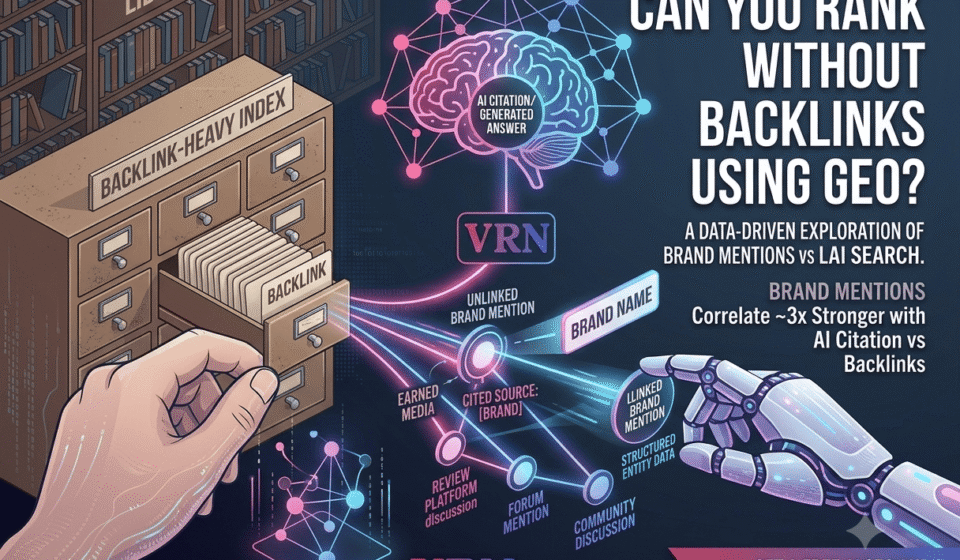

Yes, to a real and measurable degree. For AI citation specifically, unlinked brand mentions correlate roughly three times more strongly with visibility than backlinks do, which means a business can genuinely build strong AI search presence without a large backlink-focused campaign. This guide is for marketers and business owners wondering whether the backlink-heavy playbook that dominates traditional SEO is still necessary for showing up in ChatGPT, Perplexity, and Google AI Overviews. You will learn what the actual data shows about backlinks versus brand mentions for AI citation, why this gap exists, where backlinks still genuinely matter, and how to build real GEO visibility even without a dedicated link-building budget.
The Short Answer
Backlinks fuel traditional Google rankings. AI citation, whether a brand actually gets mentioned inside a generated answer, runs on a different, though related, set of signals, and brand mentions consistently outperform backlinks as a predictor of that specific outcome. This does not mean backlinks are worthless for GEO, since strong traditional rankings still feed into AI Overview citations to a meaningful degree, but it does mean a business without a strong backlink profile is not automatically locked out of AI search visibility the way it would be locked out of competing for a top Google ranking.
What “Ranking” Even Means in a GEO Context
“Ranking” in the traditional sense, a numbered position on a results page, does not really exist inside a generated AI answer. What exists instead is a citation, a reference to a brand or page inside the answer itself, whether that shows up as a footnote in Perplexity, a source chip in a Google AI Overview, or an inline attribution in Copilot. Getting cited is the GEO equivalent of ranking, and it is judged by a meaningfully different set of criteria than the backlink-and-keyword signals that determine a traditional ranking position.
The Data: Brand Mentions Beat Backlinks for AI Citation
The clearest evidence on this question comes from large-scale analyses of AI Overview citations. One widely cited study analyzing tens of thousands of brands found that unlinked, plain-text brand mentions correlated with AI citation likelihood at roughly three times the strength of raw backlink count. A separate meta-analysis synthesizing more than fifty independent studies and case studies confirmed the same directional finding: brand web mentions correlate meaningfully more strongly with AI visibility than backlinks do, treating this as one of the more repeatable, well-evidenced findings in the current GEO research landscape rather than a single outlier result.
The original Princeton research that formalized the GEO discipline found something consistent with this pattern from a different angle: content optimized with credible citations, specific statistics, and authoritative structure earned meaningfully higher visibility in generative engine responses compared to unoptimized content, and backlinks alone did not produce that same lift on their own.
Why This Happens: How AI Systems Actually Build Their Answer
The mechanism behind this gap is fairly intuitive once you understand how these systems actually work. Large language models train on raw text describing a brand across the web, not on the link graph the way a traditional search engine’s ranking algorithm does. A brand discussed consistently and credibly across third-party sources, articles, forums, review sites, and industry coverage, becomes a recognized, well-understood entity the model has genuine confidence citing, while a bare backlink only points toward a URL without necessarily building that same depth of contextual understanding about who or what the brand actually is.
Earned media plays an outsized role in this specific system. Research analyzing over a million AI-cited links found that the large majority came from earned media coverage, not paid placements or advertorial content, reinforcing that genuine, credible third-party discussion of a brand carries real weight in how confidently an AI system will reference it.
Where Backlinks Still Matter
None of this means backlinks have become irrelevant. Backlinks remain the strongest off-page signal for traditional Google rankings, and a meaningful share of AI Overview citations, roughly a third to two-fifths depending on the specific study, still come from pages that also rank well in Google’s traditional top ten results. This means strong traditional SEO, including a healthy backlink profile, continues to feed AI citation indirectly, even as the direct correlation between backlinks and citation weakens. Backlinks also still function as one credible signal among several that a brand genuinely exists and is worth referencing, even if they are no longer the dominant signal they once were for this specific purpose.
What to Build Instead of (or Alongside) Backlinks
If brand mentions matter more than backlinks specifically for AI citation, the practical implication is a shift in where marketing effort goes. Digital PR remains valuable, but the actual target shifts from earning a followed link to earning a genuine mention, whether or not that mention includes a hyperlink at all. A no-follow mention in a respected publication, a favorable comparison on a review platform, or a genuine discussion on a community site like Reddit can all feed AI citation in a way a purely link-focused outreach campaign historically underweighted. Structured data and clear entity signals also matter here, since AI systems reason over an underlying knowledge graph built substantially from text mentions and schema markup, not exclusively from raw href links.
The Catch: Your Own Site Is Only Part of the Equation
A genuinely important caveat is that a brand’s own website reportedly makes up only a small share, often cited around five to ten percent, of the total sources an AI system actually draws from when constructing an answer. The larger share comes from external sources describing the brand: review platforms, industry publications, community discussions, and earned media coverage. This means a GEO strategy focused entirely on improving your own site’s content, while genuinely necessary, is incomplete on its own. Real GEO success requires attention to how a brand is discussed across the wider web, not just what appears on the company’s own domain.
A Realistic GEO Strategy Without a Backlink Budget
A business without resources for a traditional link-building campaign can still build real AI visibility by focusing deliberately on brand mention generation instead. Prioritize genuine PR and expert commentary opportunities regardless of whether they include a followed link, actively participate in and monitor the specific third-party platforms, review sites, community forums, and industry directories that AI systems draw from most heavily in your specific category, and ensure your own site’s content includes clear, specific statistics and credible sourcing, since this remains one of the most consistently evidenced levers for improving citation likelihood directly on your own pages. Track which sources competitors get cited from that you do not yet appear in, and target those specific gaps rather than pursuing a generic, undirected outreach campaign.
Frequently Asked Questions
Do backlinks matter at all for AI search visibility?
Yes, but less directly than for traditional rankings. A meaningful share of AI Overview citations still come from pages that also rank well in Google’s organic results, which means backlinks continue to help indirectly by supporting traditional SEO performance, even as the direct correlation between backlinks and citation has weakened.
What matters more than backlinks for getting cited by AI?
Unlinked brand mentions across credible third-party sources, along with clear, specific statistics and authoritative sourcing directly on your own content. Multiple independent studies have found brand mentions correlate roughly three times more strongly with AI citation than raw backlink count.
Does this mean link building is no longer worth doing?
No. Backlinks remain the strongest signal for traditional Google rankings, and traditional rankings still feed into a meaningful share of AI citations. The practical shift is broadening PR and outreach efforts to value genuine brand mentions, linked or not, rather than focusing exclusively on acquiring followed links.
Why does a brand’s own website matter less than expected for AI citation?
Because AI systems draw the majority of their source material from external content describing a brand, review platforms, earned media, community discussions, rather than exclusively from the brand’s own site, which reportedly accounts for only a small share of total citation sources.
Can a small business realistically compete on brand mentions without a PR budget?
Yes, to a meaningful degree. Genuine participation in relevant industry directories, review platforms, and community discussions, combined with responding to journalist and expert-commentary opportunities regardless of whether they include a link, can build real brand mention presence without a large-scale paid PR campaign.
Is it accurate to say GEO has replaced the need for SEO entirely?
No. GEO and SEO share real foundations, including quality content, topical authority, and E-E-A-T, and they optimize for related but distinct outcomes. Strong traditional SEO performance continues to support AI citation indirectly, so the two disciplines work best pursued together rather than as substitutes for one another.
Get a Free Expert Review of Your AI Search Visibility
Knowing whether your brand is being mentioned in the right places takes the right visibility into your current footprint. If you want a faster starting point, get a free SEO audit from VRN Exora and see where your brand currently stands across both traditional rankings and AI citations.