
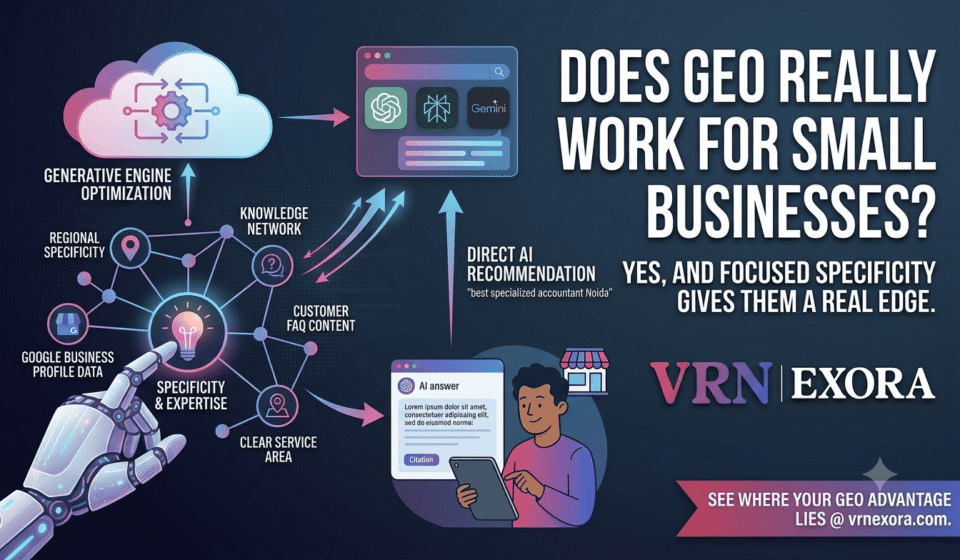

Yes, GEO genuinely works for small businesses, and in some respects small, locally focused businesses have a real structural advantage that larger, more generic brands do not. This guide is for small business owners and marketers wondering whether generative engine optimization is worth their limited time and budget, or whether it is a discipline that really only benefits large enterprises with big content teams. You will learn why AI search visibility matters even at small scale, where small businesses genuinely have an edge, where GEO does require real resources, and how to get started without wasting money on the wrong kind of help.
The Short Answer
GEO works for small businesses in the same fundamental way it works for larger ones: by earning citation inside AI-generated answers through genuine expertise, clear structure, and technical accessibility, none of which are exclusive to companies with large marketing budgets. What actually determines GEO success is not company size, it is topic relevance, original information, real expertise, clear structure, and whether AI systems can technically access and understand the content, all of which a small, focused business can genuinely compete on.
Why AI Search Visibility Matters Even for Small Businesses
The shift toward AI-mediated discovery is not a large-enterprise phenomenon happening somewhere else. AI referral traffic has grown at a striking pace, with some tracked properties reporting several-hundred-percent year-over-year increases in AI-sourced traffic through 2025 and into 2026, and Google itself reported its AI Mode feature surpassing one billion monthly active users in 2026, with query volume more than doubling every quarter since launch. For a small business, this matters because a prospective customer increasingly asks an AI assistant directly for a recommendation, “best plumber near me” or “most reliable accountant for a small business,” rather than typing a bare keyword into Google and clicking through a list of links. A business absent from that AI-generated answer never even makes it onto the shortlist a customer is building in their head.
The Real Advantage Small, Local Businesses Have
This is the part most GEO discussions miss: local businesses with correctly structured location information are actually mentioned noticeably more often in AI answers to regional questions, since AI assistants readily fall back on specific, well-defined regional expertise when a question has a local dimension. A small, genuinely specialized local business, with clear service area information, complete profile data, and content that speaks specifically to its actual customer base, is often easier for an AI system to confidently recommend than a large national brand trying to be relevant everywhere at once and specific nowhere. Specificity, not scale, is the advantage here, and specificity is exactly what a focused small business naturally has.
Where GEO Genuinely Requires Resources Small Businesses May Lack
It would be dishonest to claim GEO is entirely a level playing field. Larger businesses with dedicated content and technical teams can move faster on the content depth, original research, and consistent publishing cadence that strengthens AI citation over time, and research comparing traditional SEO scores against AI visibility scores across many sites has found a meaningful average gap between the two, suggesting most sites, small and large alike, have real, unaddressed AI visibility work still ahead of them. A small business without any dedicated marketing support will genuinely need to prioritize carefully rather than attempting a comprehensive GEO program all at once.
What GEO Actually Rewards
The controlled academic research behind GEO, including the original Princeton study, tested specific tactics against each other and found that not every popular GEO tactic actually holds up under real testing. What consistently does work is adding credible citations, specific statistics, and genuine expertise to content, not company size, budget, or content volume. Google’s own guidance for its AI search features reinforces this directly, recommending businesses continue focusing on core SEO fundamentals and creating unique, genuinely helpful, non-commodity content rather than chasing unproven AEO or GEO tricks. Repeating the phrase “GEO” throughout a page, adding excessive headings, or generating artificial mentions will not move the needle, regardless of how large or small the business behind the page is.
The GEO Agency Trap Small Businesses Should Watch For
Because GEO has become a genuinely urgent topic for small business owners, the market of agencies offering GEO services has grown quickly, and it remains uneven in quality. Some providers offer genuine original research, technical optimization, and coordinated digital PR, while others have simply relabeled an existing SEO package with the word GEO added to the pitch deck. Before hiring outside help, a small business should request comparable case studies, a clear written scope of work, transparent pricing, and reporting that connects AI visibility improvements back to actual leads or revenue, since no responsible agency can honestly guarantee a specific ChatGPT, Gemini, or Perplexity recommendation, and any pitch promising that guarantee is worth real skepticism.
A Realistic, Low-Cost GEO Starting Point
A small business does not need an enterprise GEO program to start seeing real benefit. The most cost-effective starting point is strengthening what already exists rather than building an entirely new content operation: complete and accurate Google Business Profile data if the business is local, clear, specific service pages using plain language rather than vague marketing copy, genuine FAQ content answering the real questions customers ask before buying, and confirming AI crawlers are not accidentally blocked in robots.txt, a common, purely technical oversight that costs nothing to fix once identified. This foundation alone addresses much of what actually predicts AI citation, well before any investment in dedicated content production or paid tools becomes necessary.
How to Measure Whether It’s Actually Working
Judge GEO success by more than the raw number of times an AI system happens to mention the business, since that number alone does not capture the full picture. Ask real, realistic buyer questions directly to ChatGPT and Perplexity periodically and track whether and how the business gets described, monitor Google Search Console for any AI-related performance reporting as it becomes more broadly available, and track leads or inquiries that mention finding the