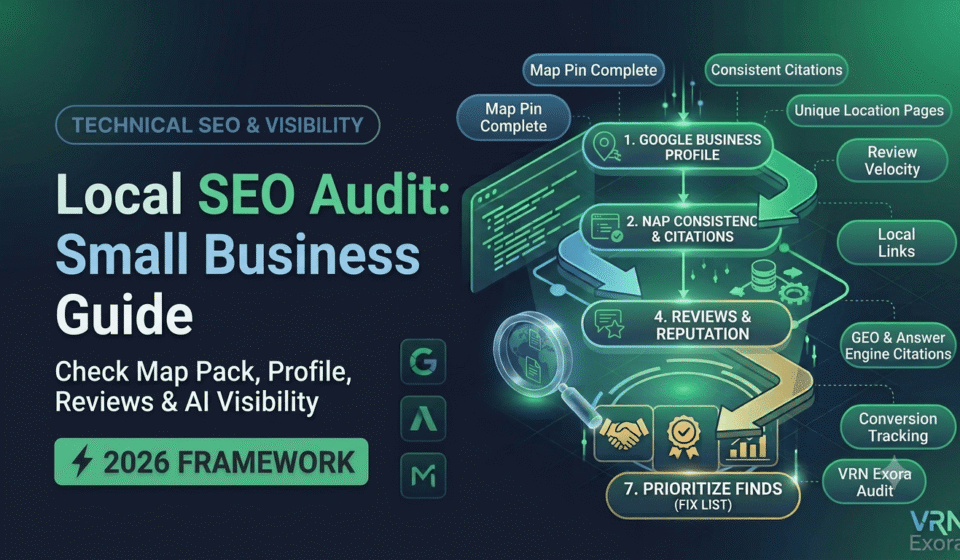

A local SEO audit for a small business is a structured review of your Google Business Profile, citations, website, and reviews that shows exactly why you are or are not appearing in the Google Map Pack and local search results. This guide is for small business owners, marketers, and anyone managing local visibility without a large in-house SEO team. You will learn the right order to check each area, which signals actually move rankings in 2026, and how to turn what you find into fixes you can realistically act on yourself.
What Is a Local SEO Audit?
A local SEO audit is a systematic review of the signals Google and AI search tools use to decide which businesses appear in the local pack, Google Maps, and local organic results. It covers six connected areas: Google Business Profile, name, address, and phone consistency across the web, on-page local SEO, reviews, local backlinks, and increasingly, visibility in AI-generated local answers.
Local search carries unusually high purchase intent. A large share of all Google searches have local intent, and most consumers research a business online before calling or visiting, which means a gap anywhere in this system directly costs calls, bookings, or walk-ins. The order matters: start with your Google Business Profile since it is the single highest-leverage asset, then work outward through citations, your website, and reviews.
Step 1: Audit Your Google Business Profile
Google Business Profile completeness has become the strongest single local pack ranking signal, ahead of even review count, based on recent large-scale correlation studies. Start by searching your business name on Google and checking whether the listing says “Own this business.” If it does, nobody has claimed it yet. If a competitor or former employee claimed it, you will need to go through Google’s ownership resolution process before doing anything else.
Once ownership is confirmed, review every field for accuracy and completeness:
- Primary category is correct and specific, since getting this wrong is the single highest-leverage mistake and no other fix fully compensates for it
- Secondary categories reflect every relevant service you actually offer
- Business name matches your real-world signage exactly, with no keyword stuffing added
- Hours, including holiday hours, are current
- Service area is accurate for businesses that travel to customers rather than operating from a single storefront
- Photos are current, clear, and regularly updated rather than left untouched for years
- Products, services, and attributes fields are filled in completely rather than left blank
For multi-location businesses, audit every location individually. It is common for one or two locations to fall through the cracks during staff turnover while the flagship location stays well maintained.
Step 2: Check NAP Consistency and Citations
A citation is any mention of your business name, address, and phone number on another website, such as Yelp, Apple Maps, Bing Places, or an industry-specific directory. Even small inconsistencies, like “St.” versus “Street” or two different phone number formats, fragment the trust signal Google uses to confirm your business is real and correctly located.
Audit your existing citation footprint by pulling your business name and phone number through a citation tool or a manual directory search, then mark each listing as correct, inconsistent, or duplicate. Fix inconsistent listings and merge or remove duplicates through each platform’s process. Citation count has lost significant ranking weight over the past several years, so prioritize accuracy on a smaller number of authoritative directories over chasing volume across dozens of low-quality ones.
Step 3: Audit Your Website for Local On-Page SEO
Your website supports the Google Business Profile rather than replacing it, so this step focuses on whether your site reinforces the same local signals. Check that your business name, address, and phone number on the website match your Google Business Profile exactly, ideally placed in the footer on every page.
For businesses serving multiple cities or neighborhoods, review your location pages individually. Each one needs genuinely unique content describing that specific area, not a single template with the city name swapped, since duplicated location pages tend to compete with each other rather than each ranking on its own. Confirm LocalBusiness schema markup is implemented correctly and matches your actual NAP data, and check that your site loads quickly on mobile, since most local searches happen on a phone while someone is already nearby or on the move.
Step 4: Review Your Reviews and Reputation Signals
Reviews remain one of the most heavily weighted local ranking signals, and recent research shows review velocity, meaning how many reviews you have earned recently, predicts ranking better than your total review count alone. A business with a steady flow of new reviews each month tends to outperform one with a large historical total that has gone quiet.
During the audit, check:
- Your average rating and total review count against your closest local competitors
- How many reviews you have received in the last 90 days compared to the prior 90 days
- Your response rate to reviews, both positive and negative, since responding signals an active, trustworthy business
- Whether reviews are concentrated only on Google or spread across other platforms customers actually check, such as Yelp or industry-specific review sites
Set up a simple, consistent process for requesting reviews after a completed job or purchase rather than relying on customers to leave one unprompted, since steady, patient growth tends to perform better than occasional spikes.
Step 5: Check Local Rankings and Search Console Data
Search your primary keywords from an incognito browser window while physically in or near your service area, and note your position in both the Map Pack and the organic results below it. Rankings can vary by the exact location you search from, so check from a few different points across your service area rather than relying on a single search.
In Google Search Console, filter the Performance report to your local, non-branded keywords and review clicks, impressions, and average position over the last three months. A steady decline in impressions for local terms often points to a Google Business Profile or citation issue rather than a website problem, since local pack visibility depends heavily on signals outside your own site.
Step 6: Audit Local Backlinks
Backlinks from other local businesses, chambers of commerce, local news sites, and community organizations carry real weight for local rankings, often more than a generic national link would. Review your current backlink profile for local relevance rather than just raw domain authority, and compare it against one or two competitors who consistently outrank you in the map pack.
Look for easy opportunities such as unlinked mentions of your business in local news coverage or community event pages, since converting an existing mention into a link is typically faster than earning a brand new one.
Step 7: Check AI Search Visibility for “Near Me” Queries
Local search in 2026 goes beyond the classic Map Pack. ChatGPT, Perplexity, and Google’s AI Overviews increasingly answer queries like “best plumber near me” or “coffee shop open now” directly, often before a searcher ever sees a map pin. If your business is not appearing in these AI-generated answers, you are invisible to a growing share of local searchers regardless of how well you rank in the traditional pack.
Test this directly by asking ChatGPT and Perplexity a handful of realistic local questions a customer would ask about your category and area. AI systems draw heavily on the same signals that matter for traditional local SEO, particularly a complete Google Business Profile, consistent citations, and detailed, specific reviews, so strengthening those fundamentals also improves your odds of being mentioned in AI answers.
How to Prioritize and Fix What You Find
Fix Google Business Profile completeness issues first, since this is the highest-leverage signal and often the fastest to correct. Move next to NAP inconsistencies on your most authoritative citations, then to review velocity, since both compound over the following weeks and months rather than delivering an instant fix. Website and location page improvements come next, followed by local link building, which tends to be the slowest area to show results.
Rerun the full audit quarterly. Local search moves fast: competitors open, close, rebrand, and earn new reviews on a monthly basis, so a local SEO audit is a recurring discipline rather than a one-time project.
Frequently Asked Questions
What is the most important part of a local SEO audit?
Google Business Profile completeness is currently the strongest single ranking signal for the local pack, ahead of review count and citations, so it deserves the first and most careful attention in any audit.
How often should a small business run a local SEO audit?
Quarterly is the right cadence for most small businesses, since local competitors, reviews, and citation data all change fast enough to create new gaps within a few months.
Do citations still matter for local SEO in 2026?
Yes, but their ranking weight has declined compared to a decade ago. Accuracy on a smaller set of authoritative directories now matters more than the total number of citations you hold.
How many reviews does a small business need to rank well?
There is no fixed number, since review velocity, meaning a steady stream of recent reviews, predicts ranking better than a large historical total. A consistent flow of new reviews each month outperforms an occasional spike.
Can a small business do a local SEO audit without hiring an agency?
Yes. The Google Business Profile, citation, on-page, and review steps in this guide can all be done manually with free tools like Google Search Console and an incognito browser window, though multi-location businesses or highly competitive markets often benefit from expert support.
Does local SEO affect visibility in AI tools like ChatGPT?
Yes. AI assistants increasingly answer “best near me” style questions directly, and they lean on the same underlying signals, particularly Google Business Profile completeness, citation consistency, and review detail, that drive traditional local pack rankings.
Get a Free Expert Review of Your Local Presence
Checking every local signal by hand takes time, and it is easy to miss a citation inconsistency or profile gap quietly costing you calls. If you want a faster starting point, get a free SEO audit from VRN Exora and see exactly which local SEO issues are worth fixing first.